A bearing shows a direction as an angle from north. They are always measured counterclockwise using three figures, such as 045 degrees or 180°. Being able to understand bearings helps you to read maps and follow routes.
Bearings are a visual topic on the GCSE Mathematics curriculum, involving diagrams and an understanding of geometry, angles, and direction. Exam questions will normally expect you to interpret diagrams, measure angles, or calculate the distance between two points.
In this article, we will learn about bearings, including the three key rules, and how to apply them to a diagram. Worked examples and practice questions are included to reinforce and test your understanding. This revision guide is suitable for all major exam boards, including AQA and Edexcel.
If you need further help revising this topic, TeachTutti has specialised GCSE Maths tutors who can teach you in person or online using the TeachTutti learning platform.
What are Bearings?
A bearing describes a direction of one point to another using an angle. They are always measured clockwise from north. To find the angle, you start at the north line and rotate clockwise until you reach the second point.
They are written in three figures. It doesn't matter if the angle is less than 100 degrees. Sticking to this format avoids confusion when describing directions. For example:
- East = 090 degrees
- South = 180 degrees
- North-east = 045 degrees
For example, let's say we are standing at point A and want to travel to point B. The direction from A to B is 60 degrees clockwise from north. This means the bearing of B from A is written as 060°.
This is the basic principle of bearings. It's important to have a firm understanding, as most exam questions will start by asking you to find or measure a bearing on a diagram, before progressing to complex calculations.

Three rules of Bearings
There are three rules to follow with bearings. Memorise these rules to make it easier to interpret diagrams and avoid mistakes.
1 - Measured from the north
Every bearing starts from a north line. It's usually shown as a vertical line pointing upwards. When calculating a bearing, this is where the angle starts. This line may already be provided in exam questions. Otherwise, you may need to draw a north line as a starting point.
2 - Measured clockwise
After finding or writing the north line, measure the angle by going clockwise until you reach the second point. Use a protractor rather than a ruler.
Be careful not to measure anticlockwise. This is a common mistake, and it will lead to an incorrect answer, even if the angle you measure is accurate for this direction. For example:
- A direction east has a bearing of 090 degrees
- A direction south has a bearing of 180 degrees

3 - Three figures
The bearings need to be written as three-digit numbers. Add a zero before the value when the angle is less than 100 degrees. This format keeps the bearings consistent and clear in your exam answers. For example, 45 degrees is written 045°, and 8 degrees is written 008°.
How to calculate a Bearing on a diagram
GCSE Maths exam papers may ask you to find the bearing from one point to another. They will provide a diagram for your work. You need to measure the angle using the north line and the direction between the points.
Follow the steps below.
1 - Find the starting point
This is a typical question:
"Find the bearing of B from A."
You need to start at point A and look towards point B. You always being the measurement from the starting point.
2 - Draw the north line
If a starting point is given rather than a north line, you need to draw a straight vertical line. This is the reference point for measuring the bearing.
3 - Draw a line to the second point
Draw a straight line from the starting point to the second point. This is the direction of travel.
4 - Measure the angle clockwise
Measure the angle clockwise from the north line to the line that joins the two points. This is the bearing. You will normally be instructed, but aim to use a protractor to calculate the bearing rather than a ruler.
You then need to write it in three digits. For example, if the angle is 70 degrees, you need to write 070 degrees.
Reverse bearings
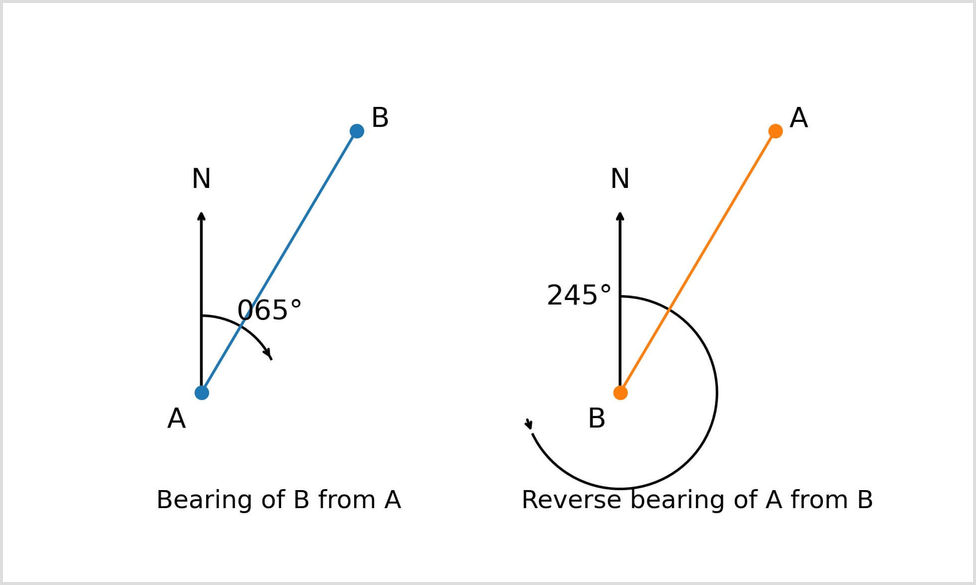
You may be asked to provide the bearings from one point to another, and then the bearings in the opposite direction. Finding the bearing in the anticlockwise direction is called reverse bearing or reciprocal bearing.
To put it another way, imagine travelling from point A to B. This is a normal bearing. The reverse bearing is travelling from point B back to A.
The reverse direction is always 180 degrees different from the original bearing. This is because a circle is exactly 360 degrees.
Finding a reverse bearing
There are two rules to find a reverse bearing:
- The bearing is less than 180 degrees = add 180 degrees
- The bearing is more than 180 degrees = subtract 180 degrees
Example 1:
- The bearing of B from A is 065 degrees.
- To find the bearing of A from B, we need to add 180 degrees to 065 degrees (245 degrees).
- The answer is 245 degrees.
Example 2:
- The bearing of B from A is 310 degrees.
- To find the bearing of A from B, we need to subtract 180 degrees.
- 310 degrees - 180 degrees = 130 degrees. This means the reverse bearing is 130 degrees.
Worked examples of Bearings questions
1 - Find a Bearing from a diagram
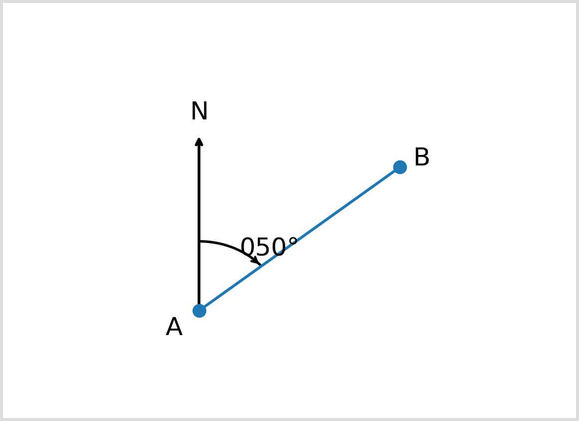
Point A and B are shown on a map. This diagram shows a north line at point A.
Find the bearings of B from A:
- Start at point A and find the north line.
- Measure clockwise starting from the north line, and joining A to B.
- Write the answer as a three-figure bearing. As it is 50 degrees, you need to write the answer as 050 degrees.
2 - Find a missing angle using geometry
Bearings may appear alongside triangles, which combine bearings with geometric angle rules. You may be expected to use trigonometry to find the missing angle, and then find the bearing.
For example:
- The bearing of B from A is 120 degrees.
- The angle at point B inside a triangle is 35 degrees.
If this is the case, start with the rule that all angles in a triangle add up to 180 degrees. After finding the missing angle, you can proceed to calculate the bearing.
3 - Bearings with distance
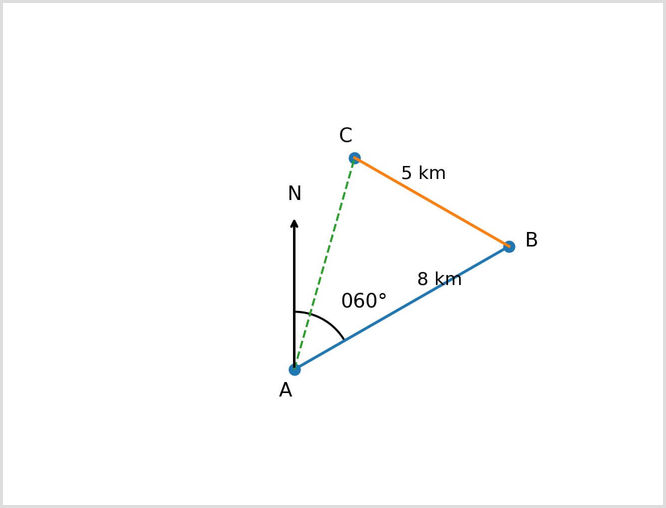
Bearing questions may include distance between points. This can create a triangle, requiring an understanding of trigonometry.
For example, a ship travels 8 km on a bearing of 060 degrees. It then travels 5 km on another bearing.
You may be asked to find the distance between the starting point and the final position, or the bearing of the final position.
Solving these problems may require since, cosine, or tangent.
Quiz questions
1
What is the bearing of east?
2
The bearing of B from A is 070 degrees. What is the bearing of A from B?
3
A plane travels from point A to point B on a bearing of 300 degrees. What direction is this?
Common mistakes
- Measuring the angle - Make sure you measure the angle clockwise. A common error is to measure anticlockwise from the north point. Even if the calculation is correct anticlockwise, it will still return the wrong answer.
- Three figures - Always write your bearings in 3 digits. It feels messy prepending a 0 before 45 degrees, but 045 degrees is the correct answer. Forgetting the leading zeros can lead to lost marks.
- Starting from the wrong point - A common exam question format is: "Find the bearing of B from A." You need to start at point A and measure towards B. If you measure from the wrong point, the answer will be a reverse bearing and incorrect.
- North line - Sometimes, students measure the angle between the two points directly instead of measuring from the north line. Bearings must always begin from the north direction. If a north line is not drawn in the diagram, it should be imagined or drawn from the starting point.
Final thoughts - Learning Bearings for GCSE Maths
The key to solving bearings is remembering that you measure clockwise from north and write your answer in three figures. We have explored a basic understanding of bearings, which will allow you to tackle more complex questions involving triangles, reverse bearings, and distances.
When you are confident, you can then test yourself on bearings questions, using MathsGenie. Bear in mind that you will need to print out this resource to calculate the questions with a protractor. For further reading, you can read a refresher on trigonometry by Third Space Learning. You can then test yourself with bearing questions that include angles.
If you need help using bearings, TeachTutti has experienced Maths GCSE tutors. Every tutor has an enhanced DBS check, and will tailor lessons to your specific needs.