Waves surround us all the time. Whether we are listening to music, walking under the light of a lamp at nighttime, or watching the ripples on a pond. Waves are an important topic in GCSE Physics. They show how energy may be transferred between stores without transferring matter. Waves are vital to everyday life, from the vibrations in sound to the light waves that allow us to see.
This article explores the key properties of waves, including amplitude, wavelength, frequency and wave speed. We cover the equations you need to memorise, practical experiments and common mistakes to avoid. Quiz questions are included as a resource - they are multiple choice with descriptions and explanations for the correct answer. It is suitable for combined and single science for all major exam boards, including AQA.
If you need further support, Teachtutti has verified GCSE Physics tutors who can boost your revision and help you ace this topic, such as making revision notes.
Types of waves
Waves are one way that energy can be transferred from one place to another. They don't permanently displace the particles of the medium. Waves can propagate through solids, liquids and gases. Electromagnetic waves can even move in a vacuum.
There are two types of waves in GCSE Physics: transverse waves and longitudinal waves. Understanding the difference between these waves explains complex wave phenomena. This includes interference, diffraction and resonance, which are important in various scientific and engineering fields.
Transverse waves
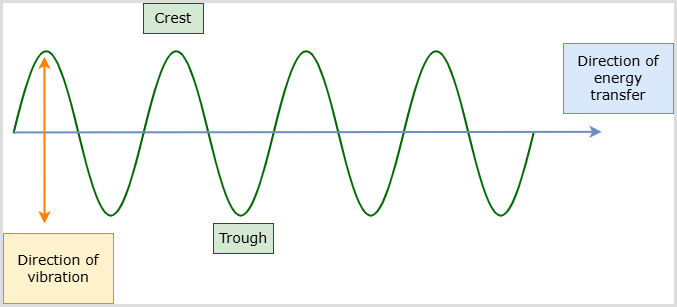
The vibrations in transverse waves occur perpendicular to the direction of energy transfer. For example, imagine shaking one end of a rope up and down while the other end is fixed in place. The wave moves horizontally along the rope while the rope moves vertically.
Transverse waves include a wide range of phenomena around the world. This includes the light we see and the radio waves used in communication.
Key characteristics of transverse waves:
- Direction of oscillation direction - Perpendicular to the direction of wave travel.
- Mediums - Can travel through solids and on the surfaces of liquids. They can't travel through liquids or gases.
- Examples - Electromagnetic waves can propagate through a vacuum because they don't need a medium. This includes light, radio waves and X-rays.
Longitudinal waves
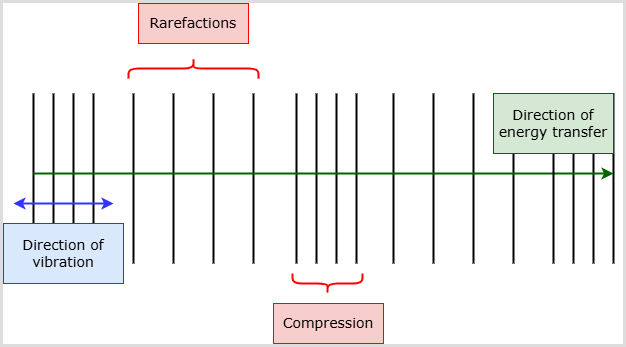
The vibration of particles in longitudinal waves occurs parallel to the direction of energy transfer. When a tuning fork vibrates, the sound wave compresses and rarefies the air particles in the same direction the sound travels. This creates compression and rarefaction. They help us to understand how sound travels and how seismic waves move through the Earth.
Key characteristics of longitudinal waves:
- Oscillation direction - Parallel to the direction of wave travel.
- Mediums - Can travel through solids, liquids and gases. It can't propagate through a vacuum because these waves need a medium to transmit energy.
- Examples - Sound waves. Another example is seismic P-waves, which are primary waves generated during earthquakes.
1
What is a wave in physics?
Key properties of Waves
The properties of waves tell us how they behave and how energy is passed back and forth through a medium. They are interrelated and help us understand sound, light and water waves:
- Amplitude - The maximum displacement of a point on the wave from its rest position (the equilibrium). The amplitude shows the energy carried by the wave: the greater the amplitude, the more energy the wave transmits.
- Wavelength - The distance between 2 consecutive corresponding points on a wave e.g. crest to crest or trough to trough. The wavelength shows the size of a complete wave cycle. It is an important metric in learning wave behaviour.
- Frequency (f) - The number of complete wave cycles passing a given point in one second. We measure frequency in Hertz (Hz). It is inversely related to the wave's time period (T), where T = 1/f.
- Wave speed (v) - The rate at which the wave propagates through a medium. The wave speed is calculated using the formula v = f × wavelength. This means the wave speed is directly proportional to the frequency and the wavelength.


2
What equation relates wave speed, frequency and wavelength?
Practical experiments
Practical experiments are helpful to understand the properties of waves and how they are measured. These are three experiments you will cover in GCSE Physics: the ripple tank, the vibrating string and measuring the speed of sound in air.
Ripple tank
A ripple tank is used to create and visualise water waves. A shallow tray of water is set up with a mechanism that is either a motorised paddle or manual agitation. This creates regular ripples. You can calculate the wavelength by measuring the distance covered by a set number of wave cycles.
You can find the frequency by counting the waves that pass a fixed point over a timed interval. The wave speed is computed using the relationship v = f x wavelength.
This experiment is useful because it shows how waves propagate and how their properties are interrelated.
Vibrating string
This experiment is also known as measuring waves in a solid. It shows how waves travel through solid media.
A string is attached to a vibration generator and a mass is used to apply tension. Standing waves form along the string as the generator creates vibrations.
You can measure the distance corresponding to several half-wavelengths. The full wavelength is found by doubling the average length of one half-cycle. With the frequency provided by the generator, the wave speed is determined using the same fundamental equation.
Measuring the speed of sound in air
This experiment shows the principles of wave propagation in air. This is despite slight inaccuracies that can arise from human reaction times.
The aim is to calculate the speed of sound by timing how long it takes vibrations heard as sound to travel a known distance. For example, we can record the delay between a visual cue and the sound reaching the observer in the distance using a stopwatch and a starting pistol or a similar. The speed of sound is found using the formula v = distance / time.
3
What experiment shows the wave properties in a liquid medium?
Wave equations
We have listed the wave equations you need to memorise for your exams. Each equation governs an aspect of wave behaviour.
Frequency and time period
The time period (T) of a wave is how long a complete cycle lasts. Frequency (f) is the number of complete cycles that occur in one second. Their relationship is given by T = 1/f.
Example 1 - A sound wave has a frequency of 250 Hz. We find the time period by the following: T = 1/250 = 0.004 seconds.
Example 2 - An electromagnetic wave has a frequency of 50 Hz. We find the time period by the following: T = 1 / 50 = 0.02 seconds. This shows that compared to the first example, the time period increases when the frequency decreases.
Wave speed equation
The wave speed (v) is found by multiplying the frequency and wavelength: v = f × wavelength. This equation shows that an increase in frequency/wavelength leads to a higher wave speed - as long as the object (medium) is constant.
Example 1 - A wave with a frequency of 100 Hz and a wavelength of 2 meters. The speed of the wave is: v = 100 × 2 = 200 m/s.
Example 2 - A seismic wave has a frequency of 500 Hz and a wavelength of 0.5 metres. The speed of the wave is: v = 500 x 0.5 = 250 m/s. This shows that a higher frequency combined with a smaller wavelength can still result in a high wave speed, as compared to the first example.
Interrelationship of variables
We can see from these equations that when the wave speed is fixed, an increase in frequency must parallel a decrease in wavelength. The opposite is true: if the frequency decreases, then the wavelength increases. Frequency and wavelength are interdependent, which is a fundamental concept in understanding how waves behave under different circumstances.
Worked examples are common in exam questions, such as calculating the time period from a given frequency or determining wave speed from measured wavelength and frequency. Understanding and memorising these equations will improve your performance in GCSE Physics exams.
4
What is the wave speed when the length is 4 meters and the frequency is 50 Hz?
The relationship between wave properties
The relationship between different wave properties is important. It is expressed by the wave speed expression v = f × wavelength. Any change made to one of these variables will have a direct effect on the others. The relationships also help us to understand wave behaviour in different environments, such as sound travelling faster in solids compared to air.
Changes in frequency
If the frequency (f) increases and the wave speed (v) remains constant, the wavelength must decrease to compensate. Similarly, if the frequency decreases, the wavelength increases proportionally.
Example:
- A wave has a speed of 300 m/s and an initial frequency of 100 Hz. We find the wavelength through v / f: 300 / 100 = 3 m
- If the frequency increases to 150 Hz, the new wavelength is: 300 / 150 = 2 m
- This shows that as the frequency increases, wavelength decreases.
Changes in wave speed
If the wave speed (v) increases, the frequency (f), wavelength, or both must also increase. The same is true if the wave speed decreases: frequency or wavelength or both must decrease.
Example:
- Sound waves travel faster in warm air than they do when it's cold. Let's say the speed of sound in warm air is 340 m/s and in cold air, it is 330 m/s. The wavelength of a 500 Hz sound wave will change as follows:
- Warm air - The wavelength is 340 / 500 = 0.68 m
- Cold air - Wavelength = 330 / 500 = 0.66 m
- The frequency of a sound wave is constant when it moves between mediums. This means the wavelength has to change to meet differences in speed.
5
What happens to a wavelength when the frequency of the wave doubles but the wave speed stays the same?
Real-world applications
Waves are important in our daily lives and have roles in fields as diverse as science, technology and maths (such as trigonometry). These include the following:
- Sound waves - Sound waves are longitudinal waves that let us communicate. They travel through air, liquids and solids. When we speak, the vibrations in the vocal cords create compressions and rarefactions in the surrounding air. This is detected by our ears as sound.
- Light and electromagnetic waves - Light waves are transverse electromagnetic waves. They can travel through a vacuum and don't need a medium. These waves are crucial to technologies such as fibre-optic communications, which use the transmission of light to convey information.
- Water waves - The ripples on a body of water are an example of water waves. It is what you typically think of when you hear the word waves in a conversation. These waves can be studied using a ripple tank experiment, which clearly shows properties including wavelength and frequency.
- Seismic waves - This is created by earthquakes and travel through the layers of our planet. They are used by seismologists to study the structure of the Earth and to assess the impact of seismic activity.
6
What is an example of a longitudinal wave?
Tips and common mistakes - AQA GCSE Physics
Now that you understand waves for GCSE Physics, we want to ensure you score highly on these questions by applying this knowledge. Below are our suggested exam tips and common mistakes to avoid when answering questions related to waves.
- Label diagrams - Make sure your diagrams are accurate and labelled with appropriate terms e.g. amplitude, wavelength, crest, trough compressions and rarefactions. You will earn marks if the diagram is well-labelled, even if your written content for the question is brief.
- Label diagrams - Make sure your diagrams are accurate and labelled with appropriate terms e.g. amplitude, wavelength, crest, trough compressions and rarefactions. You will earn marks if the diagram is well-labelled, even if your written content for the question is brief.
- Understand the relationships - The wave speed equation that links frequency and wavelength is v = f × wavelength. It's common to mistake how one variable affects the other. Remember that the wave speed is constant, while an increase in frequency leads to a decrease in wavelength and vice versa.
- Units - Always use the correct units in your calculations and answers. Frequency should always be in Hertz (Hz), wavelength in metres (m) and wave speed in metres per second (m/s). It goes without saying that using the wrong unit will lead to lost marks.
- Double-check calculations - Check your workings before moving on. This is especially important when dealing with decimals or conversions. A small miscalculation can lead to a completely different answer.
7
Why must you show each step when solving a wave problem in an exam?
Final thoughts
We have explored the types of waves and their key properties, including amplitude, wavelength, frequency and wave speed. Some equations govern these properties and their independencies, which need to be memorised for examinations. There are three main experiments to see how the concepts are applied in the real world: the ripple tank setup, vibrating string methods and sound speed measurements.
Now you have a grounding in waves, you should attempt past papers to test your understanding. A useful related link is past papers on waves by ExamPaperPractice. You can also read about the Fourier Series, which shows how complex waveforms can be broken into simpler components using the Fourier analysis.
If you want personalised support for this and related topics, TeachTutti has the best GCSE Physics tutors who can help you revise. Lessons can be in-person or online, and they are designed to meet your specific needs, such as preparing revision notes and answering exam questions under time pressure.
Frequently asked questions
Waves are disturbances that transfer energy from one location to another. The particles inside the medium aren't permanently moved during this transfer. Waves can propagate through solids, liquids and gases. Electromagnetic waves that conduct electricity can even move through a vacuum.
Transverse waves have oscillations that occur perpendicular to the direction of energy transfer e.g. water waves. Longitudinal waves involve oscillations parallel to the direction of propagation e.g. sound waves.
The equation v = f × wavelength shows the relationship (v is the wave speed and f is the frequency). If the wave speed remains constant, an increase in the wavelength results in the same decrease in frequency. Similarly, if the wavelength decreases, the frequency increases.
Sound is caused by the vibration of particles in the air. There are methods to measure the speed of sound. The time delay is usually measured between a visual cue (e.g. a hand signal) and the sound (e.g. a pistol shot) over a measured distance. You can calculate the speed of sound using v = distance / time taken.
You'll display your understanding of waves by accurately labelling diagrams and each stage of your calculations. For example, writing labels such as amplitude, wavelength, crest, trough, compressions and rarefactions displays your understanding. It will improve your marks even if your final answer is incorrect.
This post was updated on 08 Jul, 2025.