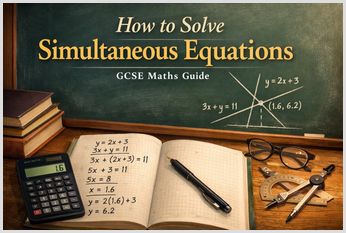
Simultaneous equations are a key part of the GCSE Maths curriculum. The question will give two equations that have the same variables. You need to find values that make both equations true. For example: x + y = 10 and x ? y = 2. Each equation explains a relationship between x and y. Simultaneous equations are a type of system of equations in which two equations with the same variables must be satisfied simultaneously.
There are three methods to solve simultaneous equations at GCSE: substitution, elimination, and using a graph. We will explore each method step by step, with worked examples, common mistakes to avoid, and exam tips. This article is suitable for GCSE Maths revision across all major exam boards, including Edexcel.
If you need further help learning methods for solving simultaneous equations, TeachTutti has experienced GCSE Maths tutors who can support your revision, such as by solving equations or learning how to set up systems of equations. Lessons can be in person or online via the TeachTutti learning platform.
Importance of Simultaneous Equations
To solve simultaneous equations, you need a solid understanding of algebra, how to rearrange equations, and to use methodical, step-by-step workings.
A pair of equations is called simultaneous equations because two conditions must both be true, and they have to be solved at the same time. You learn something about the same variables from both equations. The answer has to work for either equation at the same time.
You can use graphs to see this process visually. A straight line represents every equation. The answer is found when the two lines intersect. This is the value for each variable that is true for the two simultaneous equations.
GCSE questions on this topic normally give two linear equations with two variables, called x and y. The problem can usually be solved with algebra, such as substitution or elimination, which are explored below. You could also see questions involving a straight line and a curve for higher-tier papers.
We will explore three key algebraic methods: substitution, elimination, and graphing.
1 - Solve Simultaneous Equations using the Substitution Method
The substitution method means rearranging one of the equations and placing it into the other. It removes one variable, letting you solve the equation methodically. It's the easiest method when one equation has a variable on its own or can be easily rearranged.
Take the following steps:
- Rearrange one equation so one of the variables is written in relation to the other.
- Put this expression into the second equation.
- Find one variable by solving the new equation.
- Put the variable back into one of the original equations to find the remaining unknown variable.
Worked example
Solve the simultaneous equations: y = 2x + 3 and 3x + y = 11:
- Put the expression for y in the second equation - The second equation 3x + y = 11 becomes 3x + (2x+3) = 11.
- Simplify the new equation - 5x + 3 = 11.
- Solve the x variable - 5x = 8, so x = 1.6 (8 / 5).
- Substitute the x value back to find y - Use the first equation: y = 2x + 3 becomes y=2(1.6) + 3. This means y=6.2.
- The final answer is x = 1.6 and y = 6.2.
2 - Solving Simultaneous Equations using Elimination
When using the elimination method, you're trying to remove one of the variables. You do this by adding or subtracting the two equations together so one of the variables is cancelled out. It works when the coefficients of a variable (such as 5x, which means 5 times x) are the same on both sides, or can be made the same by multiplying one equation.
Take the following steps:
- Write both equations vertically so the variables line up on top of each other.
- If needed, multiply the equations so the coefficients match for one of the variables.
- Add or subtract the equations to remove a variable.
- Solve the new equation for the remaining unknown variable.
- Substitute this value into one of the original equations to find the second variable.
Worked example
Solve the simultaneous equations: 2x + y = 11 and x - y = 1
- Write the equations on top of each other - The y terms are +y and -y. This means they will cancel when we add the equations.
- Add the equations - 2x + y and x - y = 11 + 1. This becomes: 3x = 12.
- Solve the x variable - x = 4 (12 / 3).
- Substitute this value back to find y - Use the second equation: x - y = 1 becomes 4 - y = 1. This means y = 3.
- The final answer is x = 4 and y = 3.
3 - Solve Simultaneous Equations Graphically
Simultaneous equations can also be solved graphically. You need to plot both equations on a graph and find the point where they intersect.
Simultaneous equations are a type of system of equations because both equations share the same variables and must be true simultaneously. This is shown in a graph: the solution to both equations is where the two lines intersect. Each equation represents a straight line, and it is a useful tool for helping students visualise these concepts.
Take the following steps:
- Rearrange both equations to make y the subject.
- Choose the values for x and calculate the values for y.
- Put the points for each equation on a graph.
- Draw a straight line through the points.
- Find where the lines intersect in the graph. The coordinates of this intersection point give the solution to the simultaneous equations.
Worked example
Solve the simultaneous equations: y = x + 2 y = -x + 6
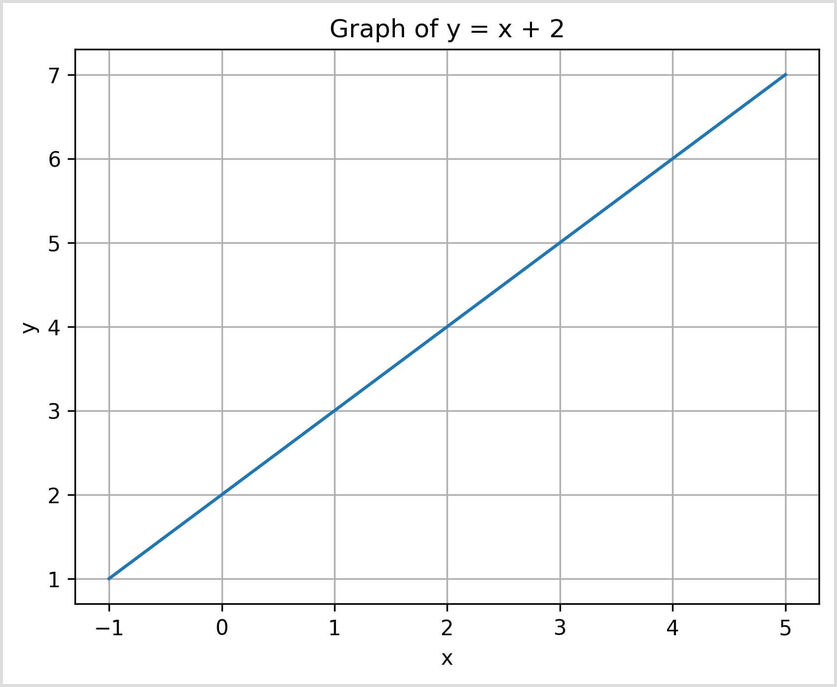
1. Create a table of values for the first equation: y = x + 2. The example values can be: x = 0, y = 2; x = 2, y = 4; and x = 4, y = 6
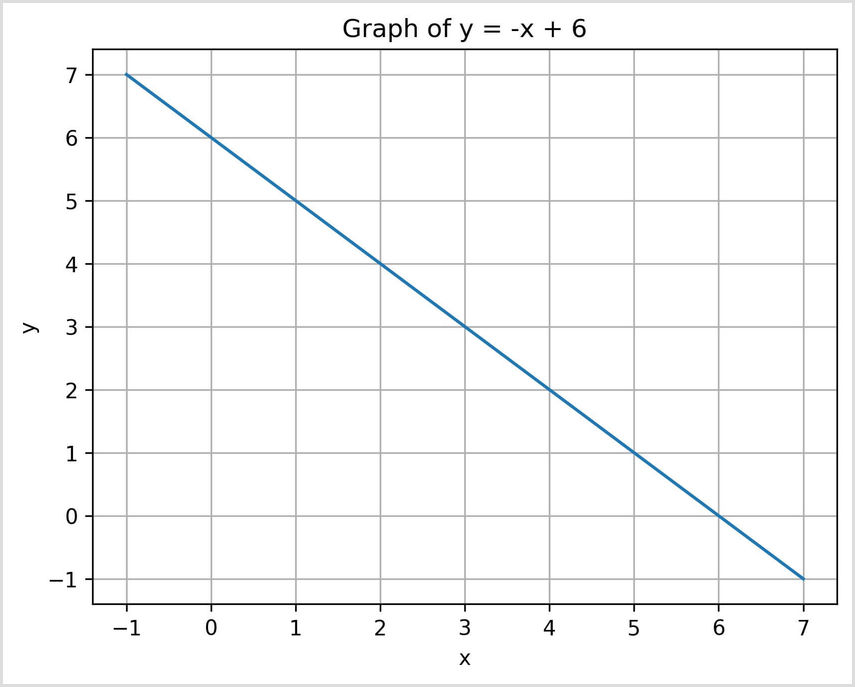
2. Create a table of values for the second equation: y = -x + 6. The example values can be x = 0, y = 6; x = 2, y = 4; and x = 4, y = 2
3. Plot both lines on the same graph. They intersect at x = 2 and y = 4.
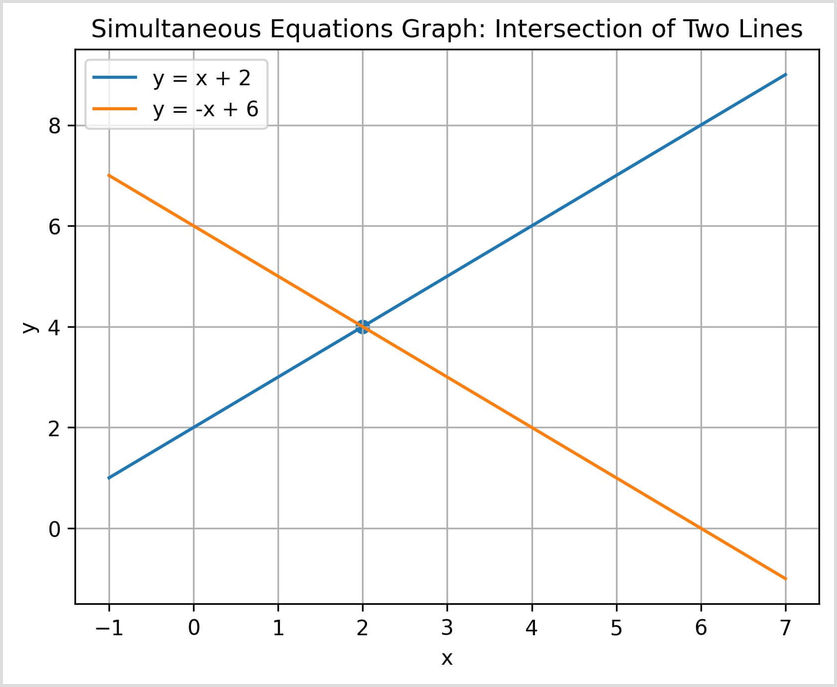
This means the final answer is x = 2 and y = 4 as they satisfy both equations. Graphical methods help us to show why the solution works. However, solving simultaneous equations algebraically using substitution or elimination is more common in GCSE Maths, as it gives exact answers rather than the approximate values from graphs.
Common mistakes
There are several steps to answering a question with a pair of simultaneous equations, so it's easy to make small mistakes. We have listed the common errors below to help you avoid losing marks in an exam:
- Forgetting to substitute back - When you have found one unknown variable, it's important to substitute it back into the original equations so you can find the second value. Students sometimes stop after the first variable and forget there are two unknown variables to find.
- Rearranging equations - It's common to rearrange an equation when using substitution. Be careful when moving terms across the equals sign. Make sure you have rearranged the equation correctly before continuing with your calculations.
- Arithmetic - Simple calculation errors cause many mistakes, especially when you're adding or subtracting equations to eliminate one of the variables. Write each step of the process to double-check your workings.
- Cancel the wrong terms - To simplify equations with multiple variables, elimination removes one variable by adding or subtracting equations. Make sure that you don't accidentally add the equations when they should be subtracted, or vice versa.
- Check the answer - The best way to avoid any of the mistakes above is to put the values for x and y back into their original equations. If the values work in both equations, your answer is correct.
Exam advice
Approach questions on simultaneous equations with a clear strategy. If you know the methods and apply the correct one, it is easier to avoid mistakes.
- Choose your method - One will be better suited than the others. Look at the equations and decide which is the easiest. If it already has a variable on its own, substitution is the best method, e.g. y = 2x + 5. Use elimination if the coefficients of a variable already match or can be made the same. If a graphical solution is required, use graphs to answer the question.
- Show your workings - You are awarded marks for both your method and the final answer. Give clear workings through each step of your calculations. Do this clearly so the examiner can follow your method.
- Keep equations aligned - Make sure the equations line up underneath each other when using elimination. This ensures that the x and y terms line up and shows which terms to cancel when you add or subtract the equations.
- Check your answer - When you have solved the equations, double-check your calculations by substituting the values into the original equations. If the equations both work, your findings are correct.
- Watch the signs - Pay attention to the negative signs. It's common for students to forget the signs or change them incorrectly during calculations. This is particularly true when adding or subtracting equations.
Worked practice questions
The worked examples below are similar to the questions that will appear on the GCSE Maths exam. We have worked through these questions in steps so you can see the methods described in practice.
Question 1
Solve the simultaneous equations: 2x + y = 11 and x - y = 1
- Add the equations so you can remove y: 2x + y and x - y = 11 + 1. This leaves 3x = 12.
- Solve the x value: 3x = 12, so x = 4 (12 / 3).
- Substitute into the second equation. Rather than x - y = 1, you can now use 4 - y = 1. This means y = 3.
- The final answer is x = 4 and y = 3.
Question 2
Solve the simultaneous equations: y = 3x + 1 and 2x + y = 9
- Substitute the first equation into the second to remove y. 3x + 1 and 2x + (3x + 1) = 9.
- This can be simplified to 5x + 1 = 9 by combining the equations.
- Find the x value: 5x = 8, so x = 1.6 (8 / 5).
- Substitute the x value into the first equation. y = 3(1.6) + 1. This means y = 5.8 (3 x 1.6 + 1).
- The answer is x = 1.6 and y = 5.8
Question 3
Solve the simultaneous equations: 3x + 2y = 16 and x + 2y = 10
- Subtract the second equation from the first to remove the y terms: 3x + 2y (x + 2y) becomes 2x = 6.
- Find the x value: 2x = 6, so x = 3.
- Substitute the x term back into the second equation: 3 + 2y = 10. This means 2y = 7 and y = 3.5.
- The answer is x = 3 and y = 3.5.
Quiz questions
1
Solve the simultaneous equations: x + y = 10 and x - y = 2
2
Solve the simultaneous equations: y = 2x + 1 and x + y = 10
3
Solve the simultaneous equations: 2x + y = 13 and x + y = 9
4
Solve the simultaneous equations: 3x + y = 10 and x + y = 6
Final thoughts
Simultaneous equations are two or more equations that share the same variables. We have explored the different methods to work out the values across these equations:
- Substitution - One equation is rearranged and inserted into the other
- Elimination - A variable is removed by adding or subtracting the variables
- Graphical methods - The equations are plotted on two graphs, and the intersection point gives the answer
For further reading, you can learn more about rearranging equations with this article by Third Space Learning. You can also tackle past paper questions on Simultaneous Equations from Corbett Maths.
If you need extra support solving the unknown values in Simultaneous Equations, TeachTutti has top GCSE Maths tutors. Every tutor has an enhanced DBS check and provides bespoke tuition for your specific needs.