The sine and cosine rules are used to find the missing sides or angles in triangles that are not right-angled. They are used instead of Pythagoras and basic trigonometry, which don't apply to these types of triangles.
The shorthand for these rules is cos and sin. They are a feature of the higher-tier of GCSE Maths and should be expected in exams.
This article will explain the cosine and sine rules. It will explain the formula and how it works, including providing examples. Quiz questions are included to test your understanding. It is suitable for GCSE Maths revision across all major exam boards.
If you need further support, TeachTutti has qualified Maths GCSE tutors. Lessons can be in person or online using the TeachTutti learning platform.
Sine rule - Formula
The sine rule is a formula for finding missing angles or sides in a triangle that isn't right-angled. It links each side to the sine, which is a trigonometric value based on the size of the angle opposite it.
This is the formula:
a / sin A = b / sin B = c / sin C
Each letter represents a matching pair. The pairing itself is important, as every side must match the angle that is directly opposite:
- a, b, c - The lowercase letters are the side lengths of the triangle
- A, B, C - The uppercase letters are the angles opposite those sides

Exam questions will typically expect you to compare two fractions at a time, using the sine rule. For instance, you may be asked to compare side "a" with side "b".
When using the sine rule, you normally need to substitute known values into the formula. You will also need to rearrange the equation. It's advisable to use a calculator in degree mode for accuracy.

When to use the Sine rule
You should use the sine rule when the triangle is not right-angled, and you know one of the angles and the side opposite it. The sine rule is built around matching sides to their opposite angles, so you must have an opposite pairing.
In exams, you will apply the sine rule when there are two angles and one side known. You need to find the other side. Alternatively, you may be given two known sides and an angle, provided that the known angle is opposite one of the known sides.
If you don't have an angle-opposite pairing, the sine rule is not appropriate for calculations. You will need to use another method, such as the cosine rule.
The sine rule isn't limited to a specific triangle shape. As long as the triangle isn't right-angled and you have the correct information, the rule can be applied.
1
In the sine rule, what parts of the triangle must always match?
Cosine Rule - Formula
The cosine rule is used to find a missing side or angle when the triangle doesn't have a right angle. Because of this, it's considered an extension of the Pythagoras theorem.
This is the formula:
a2 = b2 + c2 - 2bc cos A
This is the breakdown of the formula. The letters can be changed depending on the side or angle you are trying to find:
- a - The lowercase a is the side you are trying to find
- A - The uppercase A is the angle opposite to a
- b and c - These are the other two sides of the triangle

To use the cosine rule, the triangle must have two known sides and a known angle between them. Alternatively, you can find an angle with the cos rule when all three sides of the triangle are given.

When to use the Cosine rule
The triangle needs to have two known sides, plus the angle between them. You need to find the third side. Alternatively, all three sides must be known if you're asked to find an angle. You don't need to have an opposite pairing, unlike the sine rule.
This rule works with squares of length. If the triangle isn't right-angled and the question resembles Pythagoras’ theorem, it's a good idea to use the cos rule.
Remember that this formula applies to the side or angle opposite what you are trying to find. If the angle and side don't match, this calculation will fail.
2
What method should you use when the triangle has two known sides and the angle between them?
Worked Examples - Find the angle and sides of a triangle
The questions we have given below are typical for GCSE Maths. Trigonometry calculations are typically visual questions, and you should expect to work with a diagram.
Example 1 - Finding a Side (Sine)

The triangle shows the following:
- Angle A is 40 degrees
- Angle B is 65 degrees
- Side a is 8 cm. It is directly opposite angle A
The sine rule can be used here because the triangle has given an angle and its opposite side.
Workings:
- First of all, start by writing down the sine rule: a / sin A = b / sin B
- Substitute in the values shown in the diagram: 8 / sin 40 degrees = b / sin 65 degrees
- Rearrange the formula to make b the subject: b = 8 sin 65 degrees / sin 40 degrees
- Finally, use a calculator in degrees mode for the answer: b is approximately equal to 11.3cm
Example 2 - Finding a side (Cosine)

The triangle shows the following:
- Side b is 7 cm
- Side c is 10 cm
- Angle A is 52 degrees. This is the angle between sides b and c
The cosine rule can be used because two sides and an angle are known.
Workings:
- Begin by writing down the cosine rule: a2 = b2 + c2 - 2bc cos A
- Add the values from the diagram to the formula: a2 = 72 + 102 - 2 x 7 x 10 x cos 52 degrees
- Simplify the calculation: a2 is approximately equal to 62.8
- Finally, find the square root: a is approximately equal to 7.9cm
Example 3 - Finding an angle (Cosine)

The triangle shows the following:
- Side a is 9 cm
- Side b is 6 cm
- Side c is 11 cm
The cosine rule can be applied because all the sides are known, and we need to find angle A.
Workings:
- Start with the rearranged formula: cos A = b2 + c2 - a2 / 2bc
- Substitute in the values shown: cos A = 62 + 112 - 92 / 2 x 6 x 11
- Find the initial answer: cos A is approximately equal to 0.576
- Use the inverse cosine: A is approximately equal to 55 degrees
Maths quiz - Practice sine and cosine rules
3
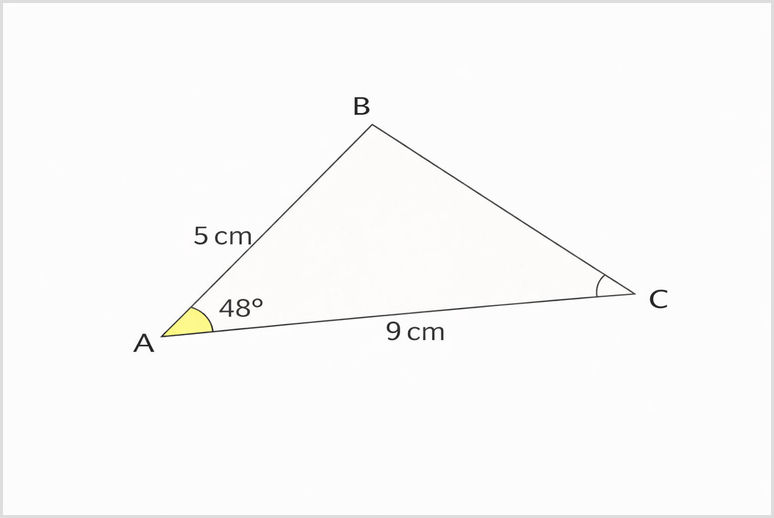
What method can find the length of side b?

4
What method can find the missing side?
Conclusion
The sine and cosine rules can be used to find angles and sides for triangles that aren't right-angled. The formulas show a clear relationship between sides and angles. Apply them carefully, substituting the triangle values into the formula, rearranging your workings, and simplifying as a final step.
The first step in tackling a geometry problem is to identify the information you're given. Then you can decide what the correct rule is, whether it's the sine rule, cosine rule, basic trigonometry, or Pythagoras' theorem. Show your workings clearly in logical steps, to avoid mistakes and earn more marks in your exams.
If this topic is complex and there are gaps in your understanding, you may benefit from an overview of right-angled triangles by BBC Bitesize. Alternatively, you can test your understanding with exam questions on the cosine rule and sine rule by Corbett Maths.
If you need support, TeachTutti has experienced Maths GCSE tutors. Every tutor has an enhanced DBS check and will tailor lessons to your specific needs, such as understanding the theory behind each mathematical technique and learning how to use them efficiently.
Frequently asked questions
Glossary
- Angle - The space between the two sides of a triangle. An angle is measured in degrees.
- Cosine rule - A formula to find the missing side or angle. The two sides and the included angle must be known, or when all three sides must be known. This only works when the triangle isn't right-angled.
- Degrees - A degree is a unit to measure angles. When using trigonometry, calculators must be set to degrees.
- Included angle - This is the angle between two known sides of a triangle.
- Non-right-angled triangle - A triangle that doesn't have a 90-degree angle.
- Opposite angle - This angle of a triangle is directly opposite a given side.
- Opposite side - This side of a triangle is directly opposite a given angle.
- Pythagoras’ theorem - A famous formula that states that in a right-angled triangle, the square of the hypotenuse equals the sum of the squares on the other two sides.
- Sine rule - A formula that links the sides of a triangle to the sine of their opposite angles. This only applies to triangles that aren't right-angled.
- Trigonometry - A topic in Maths that explores the relationship between angles and sides in triangles.