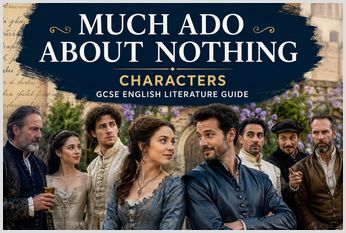
Much Ado About Nothing is one of William Shakespeare's best-known comedies. It was written in 1558 - 1589 and focuses on two romances when soldiers arrive in the town of Messina, Italy. One is between Claudio and Hero, while the other romance is between Claudio's friend Benedick and Beatrice, Hero's cousin. The play is filled with witty lines and memorable scenes, and the themes include romance, deception, humour, and misunderstandings. These are represented through the characters, including their relationships, decisions, and personal growth.
This article will explore the main and supporting characters in Much Ado About Nothing. We will examine their personalities, motivations, and growth during the plot. Plot examples and key quotes are provided to show how they stress key themes, such as Beatrice's independence and Don John's villainy. The guide is suitable for GCSE English Literature revision.
If you need further support, TeachTutti has qualified GCSE English Literature tutors. Every tutor has an enhanced DBS check and can teach in person or online through the TeachTutti learning platform. They will tailor lessons to your needs, whether you need help memorising key quotes or improving your exam technique.
Key takeaways
- Beatrice - She is an intelligent and independent noblewoman. She's an important character and displays wit, loyalty, and personal growth.
- Benedick - He's a witty soldier. Introduced as a bachelor, he eventually becomes a loyal, loving partner through the events of the play.
- Hero - The daughter of Leonato, the governor of Messina. The false accusation about Hero drives the play's conflict.
- Claudio - He is a brave soldier, but impulsive. Claudio is quick to judgment, deciding on appearances rather than facts.
- Don Pedro – The Prince of Aragon. Don Pedro tries to unite others, which brings happiness and also unintended consequences.
- Don John - The villain of the play, who nearly destroys Hero's relationship with Claudio.
- Leonato - Hero's father and Messina's governor. He reflects the importance of family honour and reputation.
- Dogberry - A constable who accidentally discovers Don John's plot. He is comical and restores justice.
- Supporting characters - They include Margaret, Borachio, Ursula, Friar Francis, Antonio, Verges, and Conrad. They advance the plot, reveal the truth, and reinforce the key themes.
Beatrice
Beatrice is the niece of Leonato, the governor of Messina. She is intelligent, confident, and quick-witted. Beatrice openly challenges the societal expectation that she should marry, which is shown in her lively exchanges with Benedick.
When she is introduced, Beatrice proclaims that she won't marry. She mocks Benedick whenever they meet, which implies a history of bickering over many years. This hides affection between them, which becomes clearer as the play continues. This "merry war" of exchanges is comedic, yet also reflects love growing from respect and a long friendship.
Beatrice is fiercely independent, rejecting the idea that a woman needs to marry and obey her husband. Her exaggeration below shows her dismissive attitude towards romantic promises and her desire for independence. It would have seemed alien to an Elizabethan audience:
"I had rather hear my dog bark at a crow than a man swear he loves me." (Act 1, Scene 1)
Beatrice is tricked into believing Benedick loves her when she overhears a staged conversation. She reflects on what she has heard and acknowledges her feelings towards him. Unlike Claudio and Hero, her relationship with Benedick develops through honesty and mutual understanding.
She is extremely loyal to her cousin, Hero. When she is falsely accused of being unfaithful, Beatrice furiously remonstrates with the men witnesses the public shaming, who don't rally to defend her. She demands that Benedick prove his love by challenging Claudio, which shows her sense of justice and willingness to challenge injustice. It also highlights the unequal treatment of women in Shakespeare's society, where a mere accusation can condemn a woman's reputation:
"Kill Claudio." (Act 4, Scene 1)
Beatrice shows her frustration that she can't challenge Claudio herself. This reinforces the limited power available to women then and the restrictions that were placed upon them:
"O that I were a man!" (Act 4, Scene 1)
When the play ends, Beatrice has fallen in love, but on equal terms. She is still independent, and their relationship implies a successful marriage built on respect, honesty, and equality.
Benedick
A soldier for Don Pedro, the Prince of Aragon, Benedick is presented as witty and confident. He often mocks the idea of love, insisting he will never marry and wants to remain a bachelor. This attitude changes as his character develops during the story, and he falls in love with Beatrice.
Benedick hides his emotions behind humour. He enjoys exchanging insults with Beatrice, which implies they have a deep, long-lasting relationship. Shakespeare uses their romance to suggest that love can develop from friendship and a shared respect and sense of equality.
Benedick initially rejects the idea of marriage as he doesn't want to lose his freedom. He critiques men who have fallen in love, which creates dramatic irony as the audience knows his opinion is about to change:
"I will live a bachelor." (Act 1, Scene 1)
Don Pedro, Claudio and Leonato trick him into believing that Beatrice loves him. He thinks carefully about this and decides that he should be honest if Beatrice confesses her love to him, rather than act with pride.
Benedick's turning point comes when Don Pedro, Claudio and Leonato trick him into believing that Beatrice secretly loves him. Unlike Claudio, who is quick to judge Hero without evidence, Benedick carefully considers what he has heard. He decides that if Beatrice truly loves him, he should be honest rather than allowing his pride to get in the way.
When Hero is publicly shamed, Benedick refuses to go along with Claudio, who acts immediately on what he has heard and societal pressure. Instead, Benedick listens to Beatrice and chooses justice over loyalty to his friend. This scene shows how much he has matured and become more thoughtful. It also shows the sincerity of his love for Beatrice and his sense of honour.
We can see how much his outlook has changed when he responds to a joke Claudio makes about marriage. Instead of agreeing with the jest, he encourages Claudio to find someone whom he loves to marry. This reflects his emotional growth:
"Prince, thou art sad; get thee a wife, get thee a wife." (Act 5, Scene 4)
Hero
Hero is the daughter of Lenato, the governor of Messina. She reflects the qualities Elizabethan society expected in women: she is quiet, gentle, and obedient. Hero also has a main role in the play's plot with the false accusations made against her. This deception lets Shakespeare explore the themes of honour, reputation, and the treatment of women.
When Don Pedro arranges a match with Claudio, she quickly accepts his courtship. Their marriage is shown as a family matter rather than personal, and Hero doesn't challenge these societal expectations, unlike her cousin Beatrice.
After accepting Claudio's affections, a wedding is arranged. However, Don John tricks Claudio into believing that Hero has been unfaithful. Borachio arranges for Margaret, Hero's gentlewoman, to meet him at Hero's bedroom window. Claudio witnesses this, and Borachio tricks him by referring to Margaret as Hero, making him believe Hero is being unfaithful with another man.
Claudio publicly humiliates Hero in front of her friends. She protests her innocence and is shocked by Claudio's accusations. This quote also shows her innocence, as she is genuinely confused. The audience is encouraged to sympathise with her:
"Is my lord well, that he doth speak so wide?" (Act 4, Scene 1)
Friar Francis fakes Hero's death to find out the truth of her supposed infidelity. The hope is that Claudio will recognise the effect of his condemnation, which underscores the importance of reputation in Shakespeare's society.
Borachio confesses to the deception, and Claudio realises his mistakes. Hero forgives him, and they reunite. Readers have questioned her willingness to forgive Claudio, but Shakespeare restores harmony and provides a happy ending with their reconciliation:
"One Hero died defiled, but I do live." (Act 5, Scene 4)
The quote above shows that her reputation has returned. The "Hero" who was falsely accused has died, while the woman standing before Claudio has been cleared of wrongdoing. This reinforces the theme that truth overcomes deception.
This quotation symbolises both her survival and the restoration of her reputation. The "Hero" who was falsely accused has effectively died, while the woman standing before Claudio has been completely cleared of any wrongdoing. Shakespeare uses this moment to reinforce the theme that truth eventually overcomes deception.
Claudio
Claudio is a young soldier who has recently returned from a successful battle. He falls in love with Hero and appears to be honourable and romantic. However, he has a clear weakness in that he can be easily influenced and is quick to judge others. He also places high importance on societal reputation.
He earns Don Pedro's respect when he returns home from a successful battle. Despite this, he is shy to show his feelings towards Hero. Instead, he asks Don Pedro to court her on his behalf. This implies that Claudio trusts the actions and appearances of others over his own.
Claudio believes Don John's lie that Don Pedro is courting Hero for himself. This misunderstanding is quickly resolved, which hints at a serious deception later in the play. He is shown to be far too willing to accept rumours at face value.
After believing he has witnessed Hero being unfaithful, Claudio accuses her in public, humiliating her in front of friends and family. It is shocking to the audience how quickly his expressions of love turn to anger when his reputation is at stake. The metaphor below compares his beloved to a fruit that looks fresh but is spoiled inside. Ironically, he is suggesting appearances can be deceptive, but accepting them immediately at the same time:
"Give not this rotten orange to your friend." (Act 4, Scene 1)
Honour has high importance in Elizabethan society. Claudio chooses to reject Hero rather than marry a woman who is considered unfaithful. This implies his social status is more important to him than compassion, making Claudio a deeply flawed character.
Claudio is overcome with guilt when he discovers the truth. He takes responsibility for Hero's supposed death and honours her memory after Leonato's urging. His remorse is genuine and suggests he has learnt from his mistakes. He then accepts the proposal to marry Leonato's "niece", who is revealed to be Hero. The reunion restores peace, but modern audiences will understandably question if Claudio deserves Hero's forgiveness.
At the end of the play, Claudio recognises Hero's innocence and the extent of his mistakes. He shows deep regret as he has grown from a character full of suspicion and pride to one of remorse and reconciliation:
"Sweet Hero! now thy image doth appear / In the rare semblance that I loved it first." (Act 5, Scene 4)
Don Pedro
Don Pedro is the Prince of Aragon. He is highly respected as the leader of the soldiers returning from a successful battle. He displays authority and is generous, trying to help those around him. He acts as a matchmaker during the play, trying to foster relationships between the other characters. Despite these personality traits, he isn't immune to the accusations made against Hero.
He notices that Claudio is too shy to admit his feelings to Hero. To help his friend, he disguises himself with a mask at the masquerade ball. He woos Hero on Claudio's behalf, showing his loyalty and kindness. However, it creates unintended confusion when Don John convinces Claudio that the prince secretly wants to marry Hero.
Don Petro notices the playful rivalry between Beatrice and Benedick. He spots that they would be a good couple and tricks each into believing the other is secretly in love. This deception contrasts with Don Pedro's deception as it is designed to create happiness rather than harm.
In a joking speech, he compares his plan to the Greek hero Hercules, showing his confidence and playfulness. He sees their union as a challenge, but worthwhile pursuing:
"I will undertake one of Hercules' labours; which is, to bring Signior Benedick and the Lady Beatrice into a mountain of affection." (Act 2, Scene 1)
However, Don Pedro believes the false accusation against Hero. He doesn't use his authority to investigate further and supports the public shaming of Hero. This shows that even respected individuals can be manipulated in accepting appearances at face value. Shakespeare uses this general acceptance of Hero's infidelity as a warning that seeing something is not always the same as understanding it.
When Borachio confesses to his plot, Don Pedro accepts the truth. He apologises for his part in Hero's plight, but doesn't join in their celebrations when they reconcile. This is a subtle reminder that the Prince hasn't found happiness for himself.
Don John
Don John is the main antagonist. He is the illegitimate half-brother of Don Pedro, the Prince of Aragon. As such, he rejects friendship, romance, or celebration. Instead, he enjoys creating conflict and taking advantage of other people's weaknesses. He is represented as an outsider who resents the admiration and respect afforded to his brother.
The play begins with soldiers returning from a successful battle. Don John isn't interested in the celebrations and isolates himself, admitting he prefers to be honest about who he is, even if he is disliked as a result. This makes him unusual among Shakespeare's villains: he doesn't hide his intentions and refuses to change. He favours bitterness over reconciliation:
"I cannot hide what I am." (Act 1, Scene 3)
He lies to Claudio when he says that Don Petro wants to marry Hero. The deception is quickly uncovered, but it shows how easily Claudio is manipulated, encouraging Don John to go further. He tricks Claudio into believing Hero has been unfaithful on the eve of her wedding, as Borachio pretends to meet Hero under her bedroom window using the innocent Margaret, which Claudio secretly observes.
Claudio accepts what he sees and publicly shames Hero. This shows how adept Don John is at spotting the weaknesses in others, being a villain who relies on manipulation rather than violence. He has no remorse for his actions and flees Messina rather than take responsibility. When he is captured, Shakespeare delays his sentencing until the following day, so the play can end with love and forgiveness.
In the quote below, Don John refers to his brother. It shows his motivation is to ruin his brother's happiness rather than financial gain. His jealousy and resentment drive his actions:
"If I can cross him any way, I bless myself every way." (Act 1, Scene 3)
Leonato
Leonato is Hero's father. As the governor of Messina, he is the highest-ranking character. As such, he is respected by all and welcomes the soldiers who are returning from a successful battle in the war. He's a generous host and caring father to Hero. He is also influenced by a sense of honour and reputation.
When the returning soldiers enter his home at the start of the play, he welcomes them and supports Claudio's proposal to Hero. He watches the playful mocking between Beatrice and Benedick with amusement, joining Don Pedro's plan to foster a romantic relationship between the two. This scene presents him as wise and likeable, valuing friendship and family.
However, he is immediately overcome by shame when Claudio accuses Hero of being unfaithful. He doesn't defend his daughter and believes the accusations. This underscores how important family honour was to Elizabethan society, where a daughter's reputation could affect the standing of the entire house. In the quote below, he sees death as preferable to dishonour. It's a response modern audiences may struggle to understand, but which reinforces the societal pressure of the time:
"Death is the fairest cover for her shame." (Act 4, Scene 1)
Leonato accepts Friar Francis' risky plot to uncover the truth by pretending Hero has died. He shows wisdom in recognising it is the best chance to clear her name, being willing to listen to advice and work for justice. When the truth is revealed, he regrets his abandonment of Hero and demands that Claudio acknowledge his mistake and honour Hero before they are wed.
When Claudio shows remorse for his accusation, Lenato forgives him, and they reconcile. He admits that his grief made him vulnerable, unable to think clearly. Shakespeare uses Leonato to suggest that strong emotions can affect our judgment:
"Being that I flow in grief, / The smallest twine may lead me." (Act 4, Scene 1)
Dogberry
Dogberry provides most of the comic relief in the play. He is the constable of Messina and believes he is both an intelligent and capable officer. However, he often confuses his words and their meaning, to funny effects. Despite this, he is very important due to his investigation, which uncovers the plot against Hero.
Shakespeare uses Dogberry to critique those who judge solely on appearance and imply that wisdom is not always linked to social standing or education. While Dogberry and the watchmen accidentally discover the truth through observation and patience, the noble characters don't look for the truth because they believe what they've seen.
Dogberry displays tremendous confidence. He speaks with authority at all times, even when he chooses the wrong words. These mistakes are called "malapropisms", which is a regular comic technique in the play. For example, Dogberry means to say the watch has apprehended two suspicious people, but instead calls them "auspicious" or promising, which confuses the other characters. It makes him a very memorable character:
"Our watch, sir, have indeed comprehended two auspicious persons." (Act 3, Scene 5)
He is honest and does his duty. When his watchmen overhear Borachio boasting about his deception against Hero, Dogberry arrests him, Conrad. This eventually reveals the truth to Hero's father, Leonato.
Another amusing moment is when Dogberry defends his dignity. Unfortunately, he confuses his words and repeats the insult made against himself. These mistakes make Dogberry a sympathetic comedic character, yet one who has solved the mystery and restored Hero's reputation:
"Remember that I am an ass." (Act 4, Scene 2)
Minor characters
Margaret
She is Hero's gentlewoman and assists her mistress with daily life, as she comes from a lower class. Borachio arranges to meet Marget at Hero's bedroom window. He tricks Margaret into taking part in Don John's plot by calling her "Hero". This makes Claudio and Don Petro think they are witnessing Hero's betrayal. Marget has no idea she is helping to create this accusation.
She's lively, witty, and playful with Benedick. She is also outspoken and confident. Shakespeare's uses her character to highlight how innocent actions can have serious consequences if taken out of context.
In the quote below, Margaret encourages Hero to sing a love song while getting ready for her wedding. It creates a dramatic irony for the audience, who know the wedding is going to be a disaster:
"Clap's into 'Light o' love.'" (Act 3, Scene 4)
Borachio
Borachio is loyal to Don John and puts his plans into action. He tricks Margaret into appearing at Hero's window, hoping to trick Don Petro and Claudio so the marriage will be stopped. In the quote below, he proudly describes his scheme, with the word "poison" used as a metaphor to show how easily lies can spread:
"The poison of that lies in you to temper." (Act 2, Scene 2)
He starts to feel guilty and responsible for his actions. Borachio admits his actions when he is arrested by Dogberry's watch. This confession restores Hero's innocence and resolves the play's main conflict.
Ursula
Ursula is another gentlewoman for Hero. She talks with Hero about Benedick's love for Beatrice, which Beatrice secretly overhears. Despite having few lines, this conversation is crucial in moving this storyline forward. While Don John deceives to hurt a relationship, Ursula's deception is intended to foster love.
In the quote below, she pretends to criticise Beatrice's pride and unwillingness to show her feelings. This encourages Beatrice to start accepting her love for Benedick:
"Sure, sure, such carping is not commendable." (Act 3, Scene 1)
Friar Francis
Friar Francis is wise and is the first major character who doubts the accusations against Hero. He sees her distress and shock when she is accused. He calmly makes a judgment, unlike the emotional reaction of other characters.
Francis suggests pretending that Hero has died. He thinks the guilty people will confess their part in this deception, forcing Claudio to reflect on his actions. It's successful and restores her reputation. In the quote, he says he decided Hero's innocence based on her reaction:
"By noting of the lady." (Act 4, Scene 1)
Antonio
Antonio is Leonato's older brother and Hero's uncle. He is loyal to his family, defending the family's honour against Claudio and Don Pedro when Hero is shamed in public. He represents the importance of family in Elizabethan society, supporting Leonato when his daughter Hero is accused. The quote below shows his honesty and determination to defend his honour, even when challenged by younger men:
"I am a plain-dealing villain." (Act 5, Scene 1)
Verges
Verge is the deputy constable and is also a comedy character like Dogberry. He is loyal and patient, amusingly confused by Dogberry's strange use of language.
He oversees the watchmen who arrest Borachio and Conrad, playing a practical role in resolving the play's conflict. He defends Dogberry, which shows his loyalty and respect for his superior:
"An old man, sir, and his wits are not so blunt." (Act 3, Scene 5)
Conrad
Conrad carries out the deception against Hero with Borachio. He supports Don John and doesn't worry about the consequences of their actions. When he's arrested, Conrad insults Dogberry, becoming frustrated at his incompetence:
"Away! You are an ass, you are an ass." (Act 4, Scene 2)
It's a funny exchange, as Dogberry focuses on the insult rather than the crime. Dogberry then responds with the line below, which is one of Shakespeare's most famous comic moments:
"Remember that I am an ass," (Act 4, Scene 2)
Conclusion - Characters in the play Much Ado About Nothing
William Shakespeare uses the characters in his romantic comedy Much Ado About Nothing to explore important themes, including love, honour, reputation, deception, and forgiveness. Both major and minor characters play roles in shaping the plot and these ideas. For example, Don John's manipulation, which creates the play's conflict, the personal growth of Benedick from a determined bachelor, and Hero's resilience to attacks on her character.
When you are revising the characters of this play for GCSE English Literature, ask yourself what the main themes are that each character represents. Choose plot examples for each character that display this, and memorise two or three quotes. Focus on the motivations of the character and particularly their relationships with the romantic focus of the play.
For further reading, you can learn the historical context for Much Ado About Nothing from Save My Exams. You can also read the Royal Shakespeare Company's article on famous quotes for the play.
If you need help revising Shakespeare for your exams, TeachTutti has verified GCSE English Literature tutors. Every tutor has an enhanced DBS check and is testimonial-approved. You can learn in person or online using the TeachTutti learning platform, and adapt lessons to fit your needs.