Evolution explains how living organisms change over time, and how new species develop. It shows why the world around us has such a huge diversity of life, from bacteria and plants to animals and ourselves. It is a common topic on the curriculum for both GCSE Biology and Combined Science.
This article will explore how Charles Darwin proposed his revolutionary theory of evolution in the 19th century, how natural selection works, and why some organisms are better adapted to their environments. We will explain variation, speciation, and evidence that proves evolution. Example exam questions and model answers are provided, as are quiz questions to test your knowledge. This guide is suitable for all major exam boards, including AQA.
If you need further support, TeachTutti has verified GCSE Biology tutors who can explain the topic and improve your exam technique to maximise your marks. Follow the link to learn how tuition works with TeachTutti.
What is evolution?
Evolution refers to the way inherited characteristics in a population change. This change happens very slowly over many generations. In some instances, it can lead to the development of new species.
The characteristics of a population change over time through a process known as natural selection. These inherited characteristics are passed through genes, such as eye colour in humans or fur colour in animals.
Evolution doesn't happen within an individual organism. Instead, certain characteristics become more common in a population over many generations. The individuals with advantageous traits for their environment pass these on through reproduction as they are more likely to survive.
Let's say a population of rabbits has different fur colours. Rabbits with darker fur can avoid predators, making them more likely to survive and have offspring. The genes for darker fur become more common in the population over time. This is an example of evolution.
Evolution and natural selection are closely linked, but they aren't the same. Evolution is the overall change to a population over time. Natural selection is the process that causes these changes to happen.
Natural selection
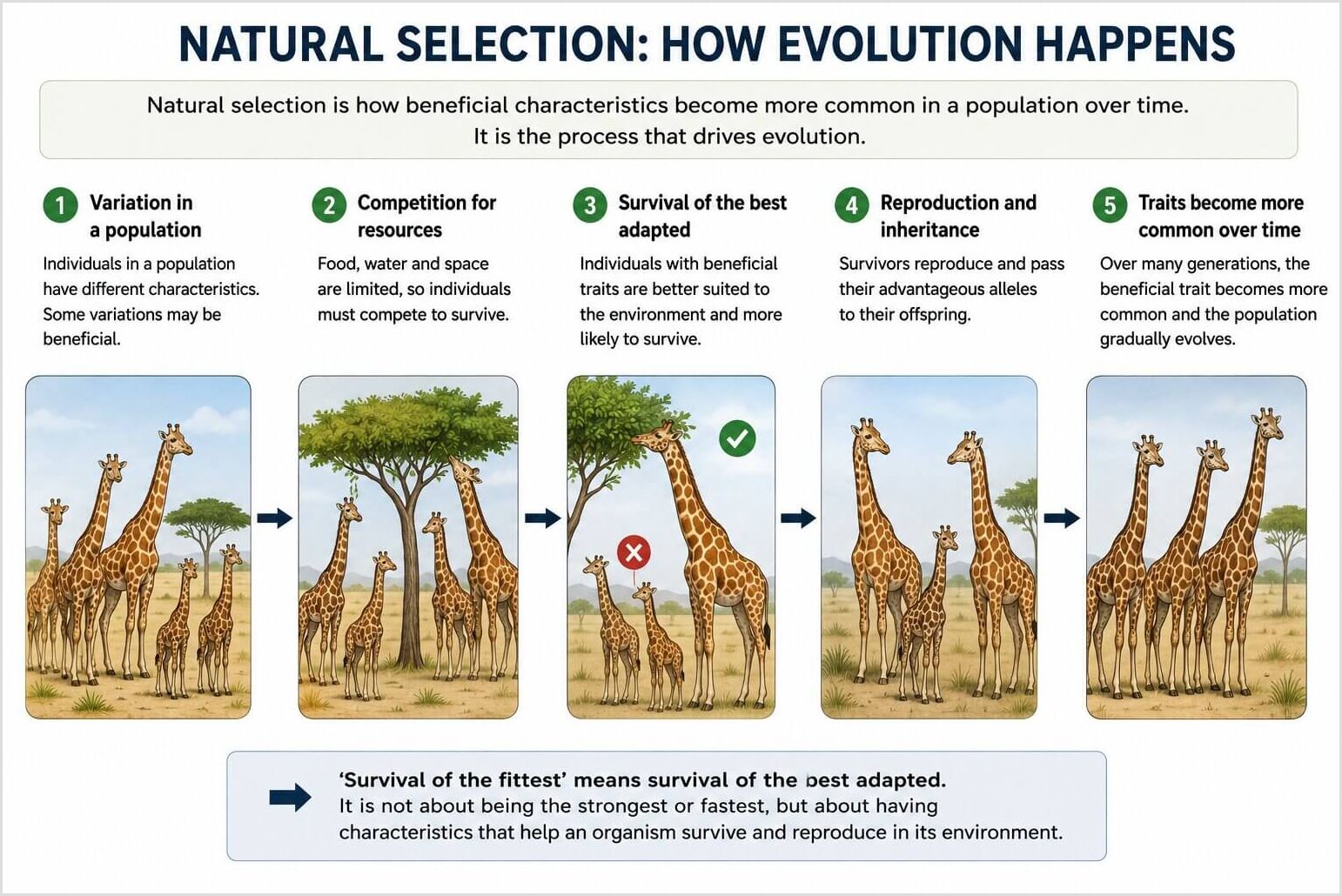
Natural selection is how beneficial characteristics become more common in a population over time. It is the process that drives evolution.
The phrase ‘survival of the fittest’ is a useful summary of natural selection. However, the word fittest refers to the organisms that are best adapted to their environment, not the strongest or fastest. This happens in a species because individuals are not identical. There is natural variation between organisms, and some variations give an advantage in a particular environment.
This is the process of natural selection:
- There is variation in a population
- Organisms compete for resources in their environment, e.g. food, water, and shelter
- Some individuals with beneficial traits are better suited to their environment. This means they are more likely to survive
- These individuals reproduce and pass their advantageous alleles to their children
- These traits become more common over many generations, and the populations gradually evolve
Darwin - The theory of evolution by natural selection
Charles Darwin developed the theory of evolution by natural selection. His thesis in 1859 shaped our understanding of how living organisms change over time and is still taught today.
HMS Beagle
Darwin joined the crew of HMS Beagle in 1831 as a companion to the captain, Robert FitzRoy. During his five-year journey, he observed plants, fossils, and animals in a variety of environments.
The Galápagos Islands were the most important location he visited. Darwin saw that closely related species had very different characteristics depending on where they lived on the island, which made him consider how organisms adapt to their surroundings over time.
Finches
Darwin studied several species of finch living on the Galápagos Islands. The birds were related, but had different beak shapes and sizes. Some had strong beaks for cracking seeds, while other birds had longer beaks to feed on insects or cactus plants. These differences allowed the birds to survive in their different locations on the islands.
Origin of Species
Darwin published his book On the Origin of Species in 1859. He argued that evolution occurs through natural selection - that organisms with beneficial traits are more likely to survive and reproduce. These characteristics become more common in the population over decades, leading to evolution.
Scientists and the public were initially sceptical of his theory. Scientists didn't understand genetics or how characteristics were inherited, while there was limited evidence compared to what is available today. There was also criticism from religious institutions, who felt Darwin's ideas conflicted with religious explanations for humanity's origins.
Darwin's theory gained support and approval as scientific knowledge improved and more evidence was discovered. This includes fossil records, genetics and modern observations of evolution. Today, evolution by natural selection is widely accepted by society.
The peppered moth
Before the Industrial Revolution, most peppered moths had light-coloured wings with dark speckles. They blended well with pale tree trunks and were less likely to be noticed by birds, their natural predators.
During the Industrial Revolution, factories released huge amounts of soot into the atmosphere. This pollution darkened many tree trunks and made the light-coloured moths easier for birds to spot. The less common dark-coloured moth now had an advantage as they were camouflaged against the soot-covered trees. They were now more likely to survive, and they passed their genes onto their offspring.
Over generations, the number of dark-coloured moths increased significantly. They are a famous example of natural selection and evolution. It shows the variation that exists within a population and that environmental changes affect what characteristics are advantageous. The peppered moths with light-coloured wings had the advantageous alleles until this was reversed during the Industrial Revolution.

Variation and evolution
Variation is the differences between individuals in a species. No two organisms are the same, and their variations allow natural selection to take place. If every organism is identical, they have the same chance of surviving and reproducing. Evolution relies on advantageous traits from some individuals for their particular environment.
There are two types of variation:
- Genetic variation - This is differences in genes inherited from parents. This can include eye colour, blood group, and natural hair colour. These inherited characteristics can be passed on to future generations.
- Environmental variation - This is caused by the area where an organism lives. For example, getting a suntan by being exposed to sunlight, muscle development through exercise, or the language spoken. These characteristics can't be passed on through reproduction.
Variations mean certain individuals are better suited to their environment. For example, if rabbits live in a snowy environment, they are more likely to survive when they have lighter fur, which is less visible to predators. When these rabbits reproduce, the genes for lighter fur will become more common in future generations.
Genetic variation can happen in several ways. The obvious way is through sexual reproduction, which mixes genetic information from two parents. There can also be mutations, which are random changes in DNA.
Ultimately, variation provides the raw material needed for natural selection. When there is greater variation in a population, there is a greater likelihood that some individuals will have characteristics suited to their environment that allow them to survive and reproduce.
Evidence for evolution
There is significant evidence that supports the theory of evolution. This evidence comes in various forms, including fossils, genetics, and observations of living organisms. This evidence has developed and cemented our understanding of evolution, making evolution through natural selection widely accepted.
Fossils
Fossils are the remains of organisms that lived in the past. They are preserved and provide a record of life on Earth from millions of years ago, showing how a species has changed.
Scientists study fossils to find similarities and differences between extinct organisms and those living today. Fossils suggest that many modern species evolved from earlier ancestors.
Many organisms decay before fossilisation can occur, which means fossil records are limited.
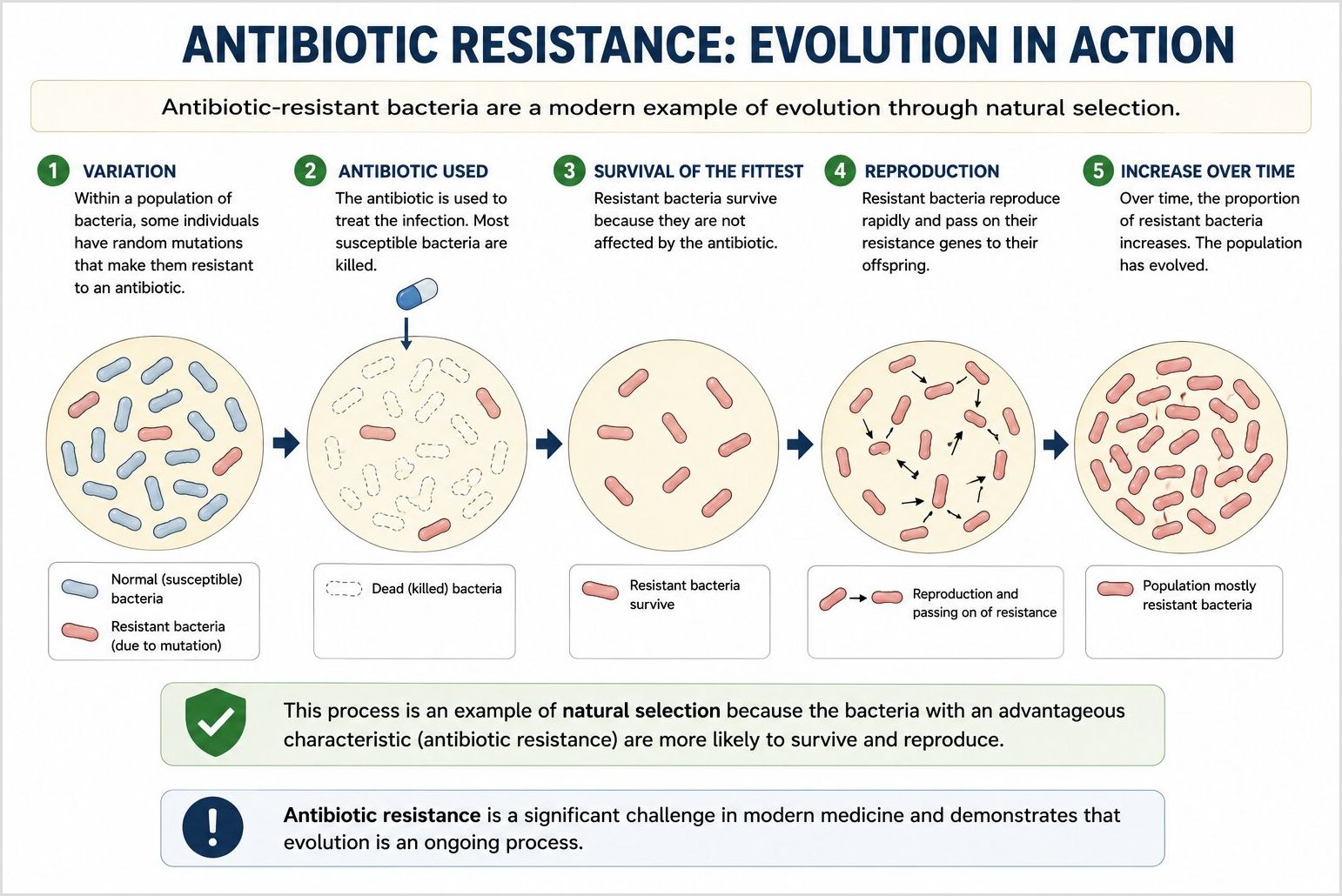
Antibiotic-resistant bacteria
Some individuals in a population of bacteria have mutations that make them resistant to certain antibiotics. When this medicine is used, the resistant bacteria survive while the other bacteria are killed. This bacterium reproduces rapidly, passing its resistance genes to offspring. Over time, the amount of resistant bacteria increases.
It's a clear example of natural selection and provides a serious challenge to modern medicine, showing that evolution is an ongoing process to ensure survival.
Extinction
A species goes extinct when there are no living members to reproduce. Environmental changes are commonly known as a form of extinction due to human activity. Other reasons include new diseases, competition from other species, and natural disasters. A species needs to adapt quickly to changing conditions to ensure its survival.
There are many examples of extinct organisms in the fossil record, which reinforces how much life on Earth has changed through its history. Fossils also show how much organisms have changed, such as antibiotic-resistant bacteria.
Lamarck
Jean-Baptiste Lamarck was a French naturalist who lived in the 18th century. He proposed a different explanation for how organisms change over time. His ideas are incorrect, but they encouraged scientific discussion about evolution and were an important foreshadowing of Darwin's theory.
Lamarck believed organisms could develop characteristics during their own lifetime. These would be passed to their children. As an example, he argued that giraffes originally had short necks and stretched them to reach leaves in trees. He believed that the longer necks developed during the giraffes' lifetime and would be inherited by their children. This is known as the inheritance of acquired characteristics.
We have learned through modern genetics that characteristics acquired by an individual organism are normally not passed on through reproduction. For example, if a person develops strong muscles through exercise, this muscular definition won't be passed to their children. Similarly, a giraffe stretching its neck to reach the leaves on a tree won't change the genes it passes on to its offspring.
Darwin's theory
In his theory, Darwin argues that variation already exists in a population. Certain individuals are born with characteristics that increase their chances of survival in their environment. These individuals are more likely to survive and reproduce, passing on their advantageous alleles. These characteristics become a common trait of the population over many generations.
If we apply Darwin's theory to giraffes, he would argue that some giraffes naturally had slightly longer necks due to genetic variation. They could reach more food, making them more likely to survive. Their offspring would inherit the gene for longer necks.
Darwin's theory is supported by scientific evidence. This includes fossils, genetic studies, observations of natural selection, and modern examples, e.g. antibiotic-resistant bacteria. Darwin's theory remains one of the most important ideas in Biology. Lamarck's theory has been disproven, but it encouraged scientific exploration into how species change over time.
Speciation
Sometimes, a section of a species can evolve so much that it can't breed successfully with other populations in its species. This process is called speciation.
A species is classified as a group of organisms that can reproduce together to produce offspring. The examples are endless: humans, monkeys, whales, dolphins, gorillas, and so on. When two groups can't reproduce together, they are considered separate species.
Separation normally takes thousands or millions of years as a population gradually evolves. A common reason for speciation is when groups within a species are separated geographically. This could be due to mountain ranges, rivers, oceans, changes in climate, or migration. When populations are in different locations, they will experience different environmental conditions and adapt over generations.
The Process of Speciation
A new species is created in the following steps:
- A population is split into two groups
- Each group experiences significantly different environmental conditions. For example, a desert and a marshland
- Variations are favoured through natural selection as each group adapts to their environment
- Genetic differences develop over many generations, and the groups become increasingly different
- When the groups meet, they are no longer able to interbreed successfully. This means a new species has formed

For example, imagine a population of birds living on a mainland. A small group is separated and colonises a nearby island. The island has different food sources, predators, and environmental factors. Over generations of birds, natural selection has led the birds living on the island to be born with different characteristics. The populations become less similar and can no longer reproduce with each other.
This explains why life on Earth is so diverse. Many living organisms share common ancestors, and millions of years of evolution and speciation have created the variety of species we see in the world around us.
Worked exam questions
We have given some example questions you may come across in an AQA GCSE Biology paper or another exam board. To understand what examiners are looking for, we have provided a model answer.
Question: Explain how natural selection leads to evolution
Answer: Every population has variation, where some individuals have unique characteristics that help them adapt to their environment. These individuals are more likely to survive and reproduce, passing on their advantageous alleles. These alleles will become more common in the population over a long period of time, which is evolution.
Question: Explain how natural selection leads to evolution
Answer: There was limited evidence available when Darwin presented his theory. Scientists had a much more limited understanding of genetics and how characteristics were inherited. It was also controversial in society as people believed it challenged religious beliefs.
Question: How do antibiotic-resistant bacteria evolve?
Answer: Bacteria with mutations can resist antibiotics. The non-resistant bacteria are killed when antibiotics are used. Meanwhile, the resistant bacteria survive and reproduce, passing their resistance on. This means the amount of resistant bacteria in the population increases over time.
GCSE Biology quiz questions
1
What is evolution?
2
What is natural selection?
3
Why do advantageous alleles become more common?
4
Who developed the theory of evolution by natural selection?
5
What provides evidence for evolution?
6
What is speciation?
Evolution - GCSE Biology revision notes
Evolution is how a population's inherited characteristics gradually change over a long period of time. Natural selection means that the individuals with advantageous traits are more likely to survive and reproduce, passing along their characteristics.
Key points:
- Evolution happens over many generations and explains the diversity of life on Earth
- The process is driven by natural selection
- Variation in individuals is important for natural selection to take place
- The theory of evolution by natural selection was discovered by Charles Darwin in 1838. He proposed his ideas in On the Origin of Species in 1859. His ideas were supported by his study of finches, which are a type of bird
- Fossils prove that species have changed over time, while antibiotic-resistant bacteria are a modern example of evolution
- Naturalist Jean-Baptiste Lamarck proposed a theory of acquired characteristics. His ideas are incorrect because acquired traits are not inherited
- Speciation is when a population has evolved so much that it can't reproduce successfully with its original form
Conclusion
Evolution explains the changes in a species over many years. It also reveals the diversity of life on our planet. To prepare for this topic, you need to understand natural selection, variation, Darwin's theory, speciation, and the evidence for evolution, including fossils and antibiotic bacteria.
The process of evolution takes a long time. Think of the duration in the lifespan of the orgasm rather than a set number of years. For example, the process of evolution in a bird is much faster than in a human because birds have a shorter lifespan and faster generation times. The advantageous characteristics become more common through natural selection. Common examples to give in your examinations include the peppered moth and antibiotic-resistant bacteria, which show evolution in the past and the present day.
For further reading, read a biography of Charles Darwin by Britannica. You can also test your understanding with past paper questions on evolution, such as how species of living things have evolved from simple life forms.
If you need help learning about evolution, TeachTutti has experienced Biology GCSE tutors who can teach you in person or virtually using the TeachTutti learning platform. Every tutor has an enhanced DBS check and will tailor lessons to your specific needs.