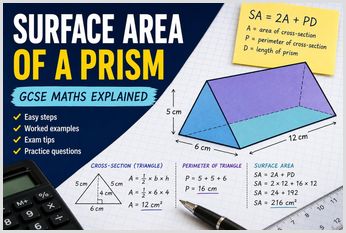
A prism is a 3D shape. There are many different types: triangular prisms, rectangular prisms, trapezoidal prisms, pentagonal prisms, and hexagonal prisms. To find the surface area of a prism, you need to know how to find the area of 2D shapes, calculate perimeters, and use formulas. Questions on this topic feature on Foundation and Higher papers.
There is a simple method to find the surface area of a prism. This can be applied to any type of prism, whether it's a triangular prism, rectangular prism, or trapezoidal prism.
This guide will explain what the surface area of a prism is and how to find it using a formula. Worked examples are provided, and you can test yourself against practice questions. FAQs are listed at the end for common questions. It is suitable for GCSE Maths students and covers all major exam boards, including AQA and Edexcel.
If you need help with your revision, TeachTutti has experienced GCSE Maths tutors. They can help you to find the surface area of the prism through bespoke tuition tailored to your needs. Lessons can be online or in-person.
What is a prism?
A prism is a three-dimensional shape. It has a cross-section that remains the same throughout the shape. Either end of the prism is identical and parallel. The sides connecting the two ends are rectangles or parallelograms.
The name of a is the shape of its cross-section. If a prism has a triangular cross-section, it's a triangular prism. A rectangular prism has a rectangular cross-section, and so on.
Common prisms include triangular prisms, rectangular prisms, trapezium prisms, pentagonal prisms, and hexagonal prisms.
The cross-section is used to find the surface area of a prism. When we have found the cross-section, calculating the total surface area is much easier. The surface area formula can be applied to any type of prism. Before applying the formula, you need to find the cross-section, then calculate the area and perimeter.

What is surface area?
The surface area is the total area of the faces on the outside of a 3D shape. Another way to think of it is the amount of material needed to completely cover the outside of an object, such as wrapping a present.
The surface area represents an area, and is measured in square units. Your answer could be written in square centimetres (cm²), square metres (m²), or square millimetres (mm²).
To find the surface area, you need to return the area of every face and add them together. Make sure you don't confuse surface area with volume. They both involve 3D objects, but measure different things:
| Surface area | Volume |
| Measures the area outside of a shape | Measures the space inside a shape |
| Written in square units (cm², m²) | Written in cubic units (cm³, m³) |
| It can be applied to painting a surface, wrapping paper, and coverings | It is useful for capacity, storage, and filling containers |
For example, let's say we have a fish tank. The surface area tells us how big the tank is, while the volume tells us how much water it can hold.
Calculate the surface area of a prism - Formula
The formula to calculate the surface area is SA = 2A+PD.
In this formula, SA is the surface area, A is the area of the cross-section, P is the perimeter of the cross-section, and D is the length of the shape.
You can apply this to any type of prism because they all have two identical ends, which together have an area of 2A. They also share a set of rectangular side faces, and the combined area is P × D.
If you add these parts together, you find the total surface area.
Example 1
We have a triangular prism. The ends are identical, so the combined area is 2 times the area of the triangle. The side faces are right angles, and the widths of them add up to the perimeter of the triangle.
If we multiply the perimeter by the length, we find the total area of all the faces. Finally, adding the perimeter and length gives us the surface area of the shape.
Example 2
A prism has a cross-sectional area of 12 cm². The perimeter is 16 cm, and the length is 12 cm.
If we substitute these values into the formula, we get SA = (2 × 12) + (16 × 12), which can be simplified to SA = 24 + 192. This means the surface area is 216 cm².
Finding the surface area of prisms
Follow the method below for all prism shapes. If you practice this with a variety of GCSE problems using different prism shapes, you will always return the correct answer.
- Find the area of the cross-section - This is the shape at either end of the prism. Use the correct formula to find the area. For a rectangle, the formula is area = length × width. For a triangle, the formula is area = 1/2 × base × height. For a trapezium, the formula is area = 1/2 × (a + b) × h
- Find the perimeter of the cross-section - This is the total distance around the outside of the shape. We need to add all the side lengths together. For example, the permieter if 16 cm if a triangular cross-section measuring 5 cm, 5cm and 6 cm (5 + 5 + 6)
- Multiply the perimeter by the length - The length is also known as the depth of the prism. Multiply the perimeter by this length. For example, 16 x 12 = 192 cm². This is the total area of the rectangular side faces
- Use the formula - Put the values into the surface area formula. The formula is SA = 2A + PD. Using our example, the formula becomes SA = (2 × 12) + (16 × 12), which can be simplified to SA = 24 + 192. This means the surface area is 216 cm²
Example 1 - Surface area of a rectangular prism
A rectangular prism is one of the easiest prisms because its faces are all rectangles. It's also known as a cuboid.
Let's say the prism has a length of 10 cm, a width of 4 cm, and its height is 3 cm. You can find the surface area through either of the methods below.
Option 1 - Add the area for each face
There are six faces on a rectangular prism. For this example:
- Top and bottom - 10 × 4 = 40 cm² each
- Front and back - 10 × 3 = 30 cm² each
- Left and right sides - 4 × 3 = 12 cm² each
If we add them together the surface area is 164 cm² (40 + 40 + 30 + 30 + 12 + 12)
Option 2 - Use the formula
The cross-section of the rectangle is 4 cm by 3 cm:
- Get the area of the cross-section - 4 × 3 = 12 cm² (A)
- Get the perimeter of the cross-section - 4 + 3 + 4 + 3 = 14 cm (P)
- The length of the prism is 10 cm (D)
- Substitute these values into the formula: the formula is SA = 2A + PD. This becomes SA = (2 × 12) + (14 × 10). It can be simplified to SA = 24 + 140. This means the surface area is 164 cm²

The method using the faces of the prism calculates every rectangle separately. The prism formula finds the surface area of a rectangle by combining the side faces in one calculation using the cross-section perimeter.
Both options can be used. However, the formula is the better option if the shape is more complicated, such as involving triangular or trapezoidal prisms.
Example 2 - Surface area of a triangular prism
A triangular prism is a common shape to come across in GCSE questions. You can apply the same formula, and you will need to multiply the area by the perimeter of the cross-section.
Let's say a triangular prism shape has a base of 6 cm and a height of 4 cm. The length of the prism is 12 cm, and the other sides of the triangle are 5 cm and 5 cm.
These are the steps to find the surface area:
- Find the area of the cross-section - Substitute the values into the triangle area formula. The cross-section is 12 cm² (1/2 × 6 × 4)
- Find the perimeter of the cross-section - Add the lengths of the three sides to get 16 cm (5 + 5 + 6)
- Multiply the perimeter by the length - The prism is 12 cm long, so the calculation is 16 x 12. This means the total area of the rectangular side faces is 192 cm²
- Use the surface area formula - The formula is SA = 2A + PD. This becomes SA = (2 × 12) + (16 × 12), which can be simplified to SA = 24 + 192. The surface area is 216 cm²

A side length is missing
The triangle may not have a value for each side length in GCSE questions. You need to use the Pythagoras theorem to find the missing side.
For example, the missing side will be 5 cm if a right-angled triangle has sides of 3 cm and 4 cm (3² + 4² = 5²). When you know the side lengths, you can find the perimeter and continue the surface area calculation.
Example 3 - Surface area of a trapezium prism
A trapezium prism is a more complex shape. However, the same method can be applied effectively.
Let's say the trapezium has parallel sides of 8 cm and 4 cm. The height of the shape is 5 cm, the length of the prism is 10 cm, and the other sides are 5 cm and 5 cm:
- Find the area - The area of a trapezium is A = 1/2(a + b)h. If we substitute in the values, this becomes 1/2 x (8 + 4) x 5, which can be simplified to 1/2 x 12 x 5. This means the area of the cross-section is 30 cm²
- Find the perimeter - Add the four sides together to get a perimeter of 22 cm (8 + 4 + 5 + 5)
- Multiply the perimeter by the length - The prism is 10 cm long, which means the total area is 220 cm² (22 × 10)
- Use the formula: the surface area formula is SA = 2A + PD. If we substitute the values into the formula, this becomes SA = (2 × 30) + (22 × 10), which can be simplified to SA = 60 + 220. This means the surface area is 280 cm²
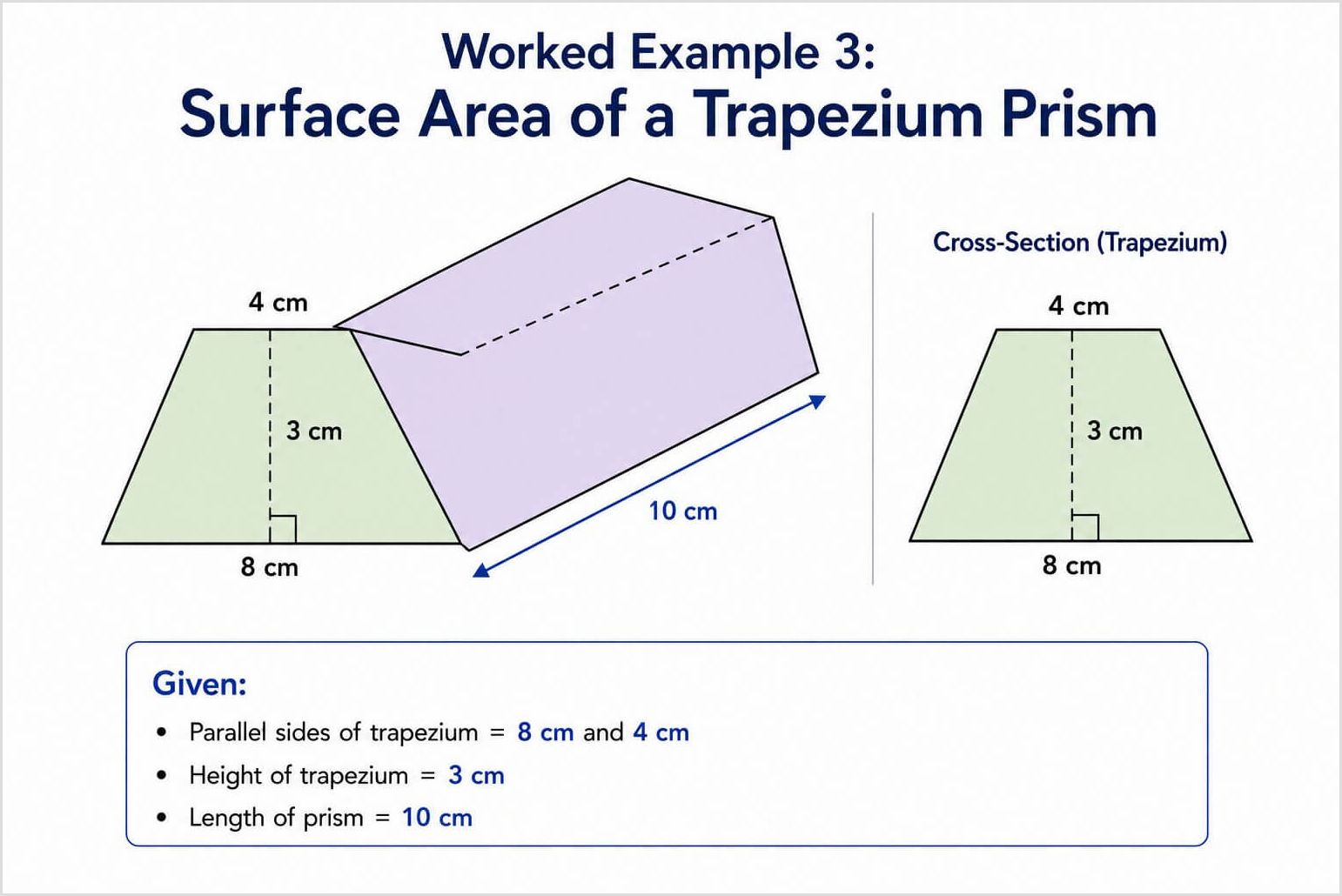
We can see that the process is the same for a rectangular and triangular prism: find the area and perimeter, multiply the perimeter by the prism length, and apply the formula. This makes the prism surface very useful: the shape of the cross-section can change, but the method is the same. Many GCSE questions use unusual cross-sections to test if students understand the method.
Using nets
Imagine folding out a box flat to show all its sides. This is a net. It's a 2D shape that is folded to turn it into a three dimensions shape. It's useful because it shows you every face of a prism at once, so you can see where the formula comes from.
For example, let's say the net of a triangular prism has two identical triangular ends, and three rectangular side faces:
- The triangle area is 12 cm², and the two triangular ends are 24 cm²
- The three rectangular faces have the dimensions: 5 cm × 12 cm, 5 cm × 12 cm, and 6 cm × 12 cm
- The total area is 192 cm² (60 + 60 + 72)
- Add everything together to get the surface area: 24 + 192 = 216 cm²

The formula for the surface area is SA = 2A + PD. This comes from the net: 2A is the two identical ends of the prism, and PD is the rectangular side faces combined.
The widths of the rectangles add up to the perimeter of the cross-section. The common length is the length of the prism. We multiply the length and perimeter to give the total area of the side faces.
Nets are useful when you're new to studying surface area and need to visualise a 3D shape. It's also good to use if the GCSE question asks you to find missing dimensions.
When you're more confident, you should rely on the prism formula to find the surface area. However, understanding nets is a useful backup and shows why the formula works.
Quiz questions
1
A rectangular prism is 8cm in length, 3cm in width, and 2cm in height. What is the surface area?
2
A triangular prism has a 10 cm base, a height of 6 cm, and the other sides are 8 cm and 8 cm. The length of the prism is 15 cm. What is the surface area
3
A trapezium prism has parallel sides of 12 cm and 6 cm. Its height is 4 cm, the length is 8 cm, and the other sides are 5 cm and 5 cm. What is the surface area?
4
A prism has a triangular cross-section. The base is 12 cm, the height is 8 cm, the length is 20 cm, and the other sides are 10 cm and 10 cm. What is the surface area?
Exam advice
You'll notice patterns when you tackle practice prism quests in GCSE Maths. We have given a few suggestions to follow that can help avoid costly mistakes.
- Find the cross-section - Start by looking for the cross-section of the prism. This shape stays the same through the prism. We can use this to calculate the area and perimeter of the prism, which are needed for the formula
- Write the formula - To make things easier and avoid mistakes, write down the formula so you can refer to it: SA = 2A + PD
- Show your workings - You get marks for correct methods, not just the right answer. Write out each stage clearly: get the area and perimeter of the cross-section, then substitute into the formula to return the answer
- Check your units - You measure surface area in square units. These are the common units: cm², m², mm². If there are mixed units, convert them into the same form before your calculations
- Double-check - Make a quick estimate to avoid mistakes. For example, if a prism is 10 cm long, with a perimeter of 20 cm for the cross-section, the area will be at least 200 cm². If your answer is 20 cm², you know you're in the wrong ballpark
- Remember the method - Repeat this mantra; find the area and perimeter of the cross-section, multiply the perimeter by the prism length, and then use the formula to calculate the answer. This works for rectangular, triangular and trapezoidal prisms
Conclusion - Surface area of a prism
The surface aea if the total area of all the faces on the outside of a prism. To find the surface area of a prism, you need to: find the area and perimeter of the cross-section, multiply the perimeter by the length, and apply the formula (SA = 2A + PD). This solution works for any prism, including a rectangular prism, a triangular prism, and a trapezoidal prism.
For further background reading, you can learn about prisms with this guide from Third Space Learning. Test your understanding with past paper questions on prisms by Corbett Maths.
If you need support revising this topic, TeachTutti has quality Maths GCSE tutors. Every tutor has an enhanced DBS check and verified qualifications. They will help you work out the area of the cross-section so you can find the surface area.