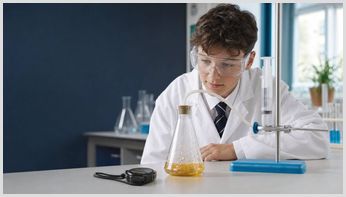
The rate of a reaction is how quickly a reactant is used up or a product is created. Some reactions happen at once, such as an explosion. Others take years, such as rust forming on the underside of a car. There are several ways of seeing how quickly a reaction takes place. This includes temperature, concentration, pressure, surface area, and catalysts.
This guide explores collision theory, rate calculations, graphs, and the required practical for GCSE Chemistry. Quiz questions and revision tips are included to improve your understanding. This GCSE Chemistry article is suitable for all major exam boards, including AQA and Edexcel.
If you need help revising this topic, TeachTutti has experienced GCSE Chemistry tutors who can support your revision. Tutors provide bespoke lessons tailored to your needs, such as preparing revision cards or understanding the various factors that affect the reaction rate.
Rate of reaction
The rate of a reaction is how long the chemical reaction takes. You can measure this by tracking how quickly a reactant is used up or how fast a product is created.
The rate of a chemical reaction varies. For example, rust takes place slowly, while fireworks are immediate. The calculation below can be applied to all types of chemical reactions:
Mean rate of reaction = quantity of reactant used (or quantity of product created) / time taken
The unit depends on the measurement. We use grams per second (g/s) for a change in mass, while cubic centimetres per second (cm³/s) is used for the volume of gas.
Let's say a reaction created 60 cm³ of gas in 30 seconds. If we use the equation above, the mean rate of gas consumption across the reaction is 2 cubic centimetres per second (60/30). The actual rate changes over time. Reactions are fast at the beginning because more particles are available. The reaction slows as the reactants are used up.
Collision theory
The collision theory explains why chemical reactions happen and the speed at which they take place. Put simply, the particles in reactants need to collide with each other for a reaction to take place.
A collision is only successful when they collide at the right orientation. They also need to have enough energy. There is a minimum amount of energy needed for a reaction. This is called the activation energy. Any less than this amount and the particles will simply move apart.
A faster reaction has more successful collisions per second. For example, if we increase the temperature, there is more kinetic energy for the particles. They move faster and collide more frequently with the required activation energy. This increases the rate of reaction.
Factors in the rate of reaction
Four main factors change how often reactant particles successfully collide with each other. These are temperature, concentration or pressure, surface area, and using a catalyst.
Temperature
When the temperature is increased, the particles in a substance gain kinetic energy. This means they move faster with more energy, leading them to strike each other more often. Because their energy exceeds the activation energy, there are more successful collisions per second.
When we lower the temperature, the particles move slowly and have less energy. This reduces the reaction rate.
It's important to control temperature in investigations. For example, if you are testing concentration, the temperature change needs to be stable. Otherwise, it will affect the results.
Concentration
The concentration of a solution is the number of dissolved particles present. A concentrated solution has more particles than a dilute solution with the same volume. When the concentration increases, the particles are packed in together, which increases the likelihood of successful collisions.
The unit for concentration is moles per cubic decimetre, or mo1/dm3.
If you add water to a solution, it lowers the concentration by spreading the particles across a larger volume. This slows the reaction as the collisions are less frequent.
Gas pressure
Pressure in a reaction relates to gases. When the pressure is increased, the gas particles are pushed together, which increases the reaction rate as they collide more frequently. By reducing the pressure, the particles spread out, and the frequency of collisions decreases.
We can see similarities between pressure and concentration. In both situations, increasing the number of particles without changing the volume leads to more successful collisions.
Surface area
This affects reactions that use a solid reactant, rather than a gas or a liquid. Only the particles at the exposed surface of a solid will be able to collide with particles from another reactant.
If we break a solid into smaller pieces, the surface area increases without changing the total mass. The greater exposure of particles leads to more successful collisions and a faster reaction. For example, a reaction between powdered calcium carbonate and hydrochloric acid is very fast because the powder has a large surface area. Using calcium carbonate chips would yield a much slower reaction.
Catalysts
A catalyst increases the rate of a reaction. This alternative reaction requires less activation energy, meaning that more particle collisions have the energy to be successful. Even better, the substance itself isn't used up.
A catalyst's sole purpose is to speed up the reaction. They don't add energy to particles, and they won't increase the total mass of product created. Different catalysts are needed depending on the reaction. For example, manganese dioxide can be used to break down hydrogen peroxide, while enzymes are used as biological catalysts to control the reactions in living organisms.
Measure the rate of a reaction
We can measure the speed of a reaction by how much reactant or product changes over time. These tests should take place at regular intervals to have an accurate rate and plot a graph.
Volume of gas
Use a gas syringe when the reaction creates gas. It needs to be in a sealed conical flask connected to the syringe by a delivery tube.
The newly formed gas will move through the tube and push the syringe plunger outwards. The volume is recorded in cubic centimetres at fixed time intervals, and these results are used to find the rate in cm3/s.
You can take several readings this way over the experiment, which is enough to plot a graph. Make sure the apparatus is airtight and fit the bung as soon as the reactants are mixed. Any delay will let gas escape, which will affect the readings.
Change in mass
You can detect a loss in mass when a gaseous product leaves an open container. The reaction vessel is put on a balance, and the mass is regularly checked. When the gas escapes, the mass falls. This change gives the mean rate in g/s.
Put a cotton-wool plug over the neck of the flask. This lets gas escape, but avoids liquid droplets leaving the container. Don't seal the flask, as the pressure could build. It's a good method if there's enough mass in the gas to create a clear change on the balance. It works with carbon dioxide, but hydrogen may be too light.
Precipitate
Sometimes, a reaction will create an insoluble solid. This is called a precipitate. When it forms, the mixture becomes cloudy. For example, this is seen in a reaction between sodium thiosulfate and hydrochloric acid. A black cross is put under the flask, and the time it takes for this cross to disappear is measured.
A shorter time means a faster reaction, and vice versa. The relative rate is calculated using the equation below. The unit used is s-1:
Relative rate = 1 / time
Colour change
A visible colour change is another way to spot a reaction rate. You can test how long it takes for a set colour to appear or disappear.
Try to use a colourimeter for more accurate readings. This can track how much light passes through the solution. Use regular readings and stick to the same settings and containers. Avoid any fingerprints, scratches, or different liquid volumes.
Calculate the rate of reaction
The mean rate of reaction is found by dividing the quantity change by the time the reaction takes:
Mean rate of reaction = change in quantity/time taken
The quantity could be the mass of a reactant, the product that has been created, the volume of gas produced, or the concentration of a reactant or product. The units for the rate depend on what is being measured. Common units for GCSE Chemistry include g/s, cm3/s, and mo1/dm3/s.
For example, let's say we need to find the mean for a reaction creating 84 cm³ of gas in 40 seconds:
- Find the change in quantity - 84 cm³
- Identify the time - 40s
- Substitute the values into the equation - The mean rate is 2.1 cm³/s (84/40). The unit is cm³/s because gas volume is measured in cubic centimetres.
Another example is a reaction mixture that changes from a mass of 125.6g to a mass of 121.1g. We need to find the mean rate of mass loss:
- The change in mass is 4.5g (125.6 - 121.1)
- The mean rate is 0.09 g/s (4.5 / 50)
- Convert minutes to seconds
The units need to match before calculating the rate using the given values. Typically, the answer will be required in units per second. This means any time given in minutes has to be multiplied by 60.
For example, a reaction creates 15 g of product in four minutes:
- The time is 240s after multiplying the minutes by 60 (4 x 60)
- The mean rate is 0.0625 g/s (15 / 240)
- Rearrange the rate equation
If you need to find the quantity changed or the time taken, you can rearrange the equation:
- Change in quantity = rate × time
- Time taken = change in quantity / rate
For example, a reaction produces gas at a mean rate of 1.5 cm³/s for 20 seconds. Rather than dividing, we multiply the rate by the quantity to find the volume of gas (1.5 × 20 = 30 cm³)
Rates of reaction - Graphs
We can use graphs to see how the quantity of a reactant or product changes over time. We can: compare the speed of different reactions, find the amount of the product created, work out the mean rate, and calculate the rate at a certain point during the reaction.
The time is shown on the horizontal axis (x). The vertical axis (y) can show a variety of measurements, including gas volume, mass, and concentration:
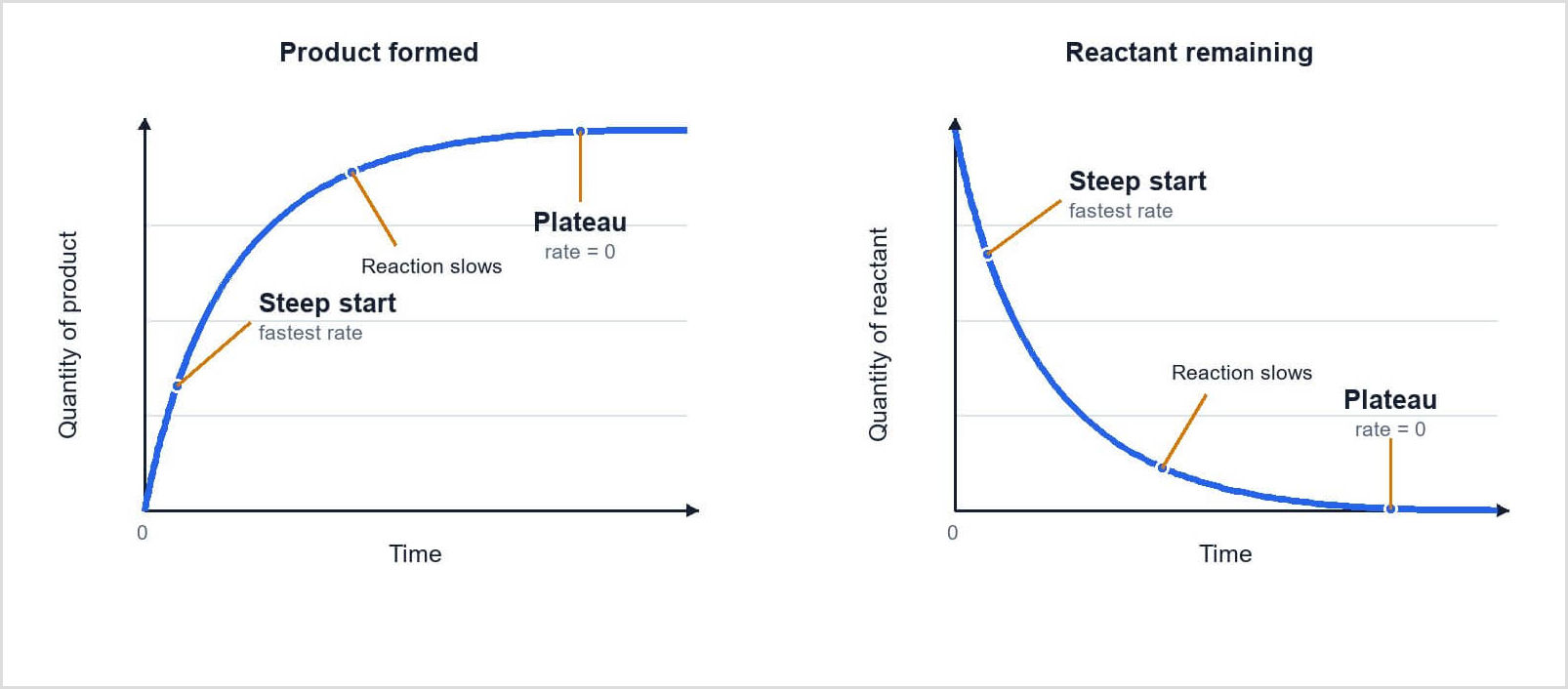
- Quantity of a product - There is a curve in the graph when we plot the quantity of a product against time. It's normally steepest at the start when the concentration of reactants is at its highest. This is when most successful collisions will take place. This will taper off as the reactants are used up, eventually becoming horizontal. This means no more product is being produced, and the rate is zero. The final height shows how much product has been created.
- Quantity of a reactant - The curve slopes downwards when we plot the quantity of a reactant against time. This downward trajectory is because the reactant is being used. It will also become horizontal when the quantity stops changing. This downward slope just shows that the measured quantity is decreasing. It doesn't mean the reaction has a negative speed.
Reaction rates
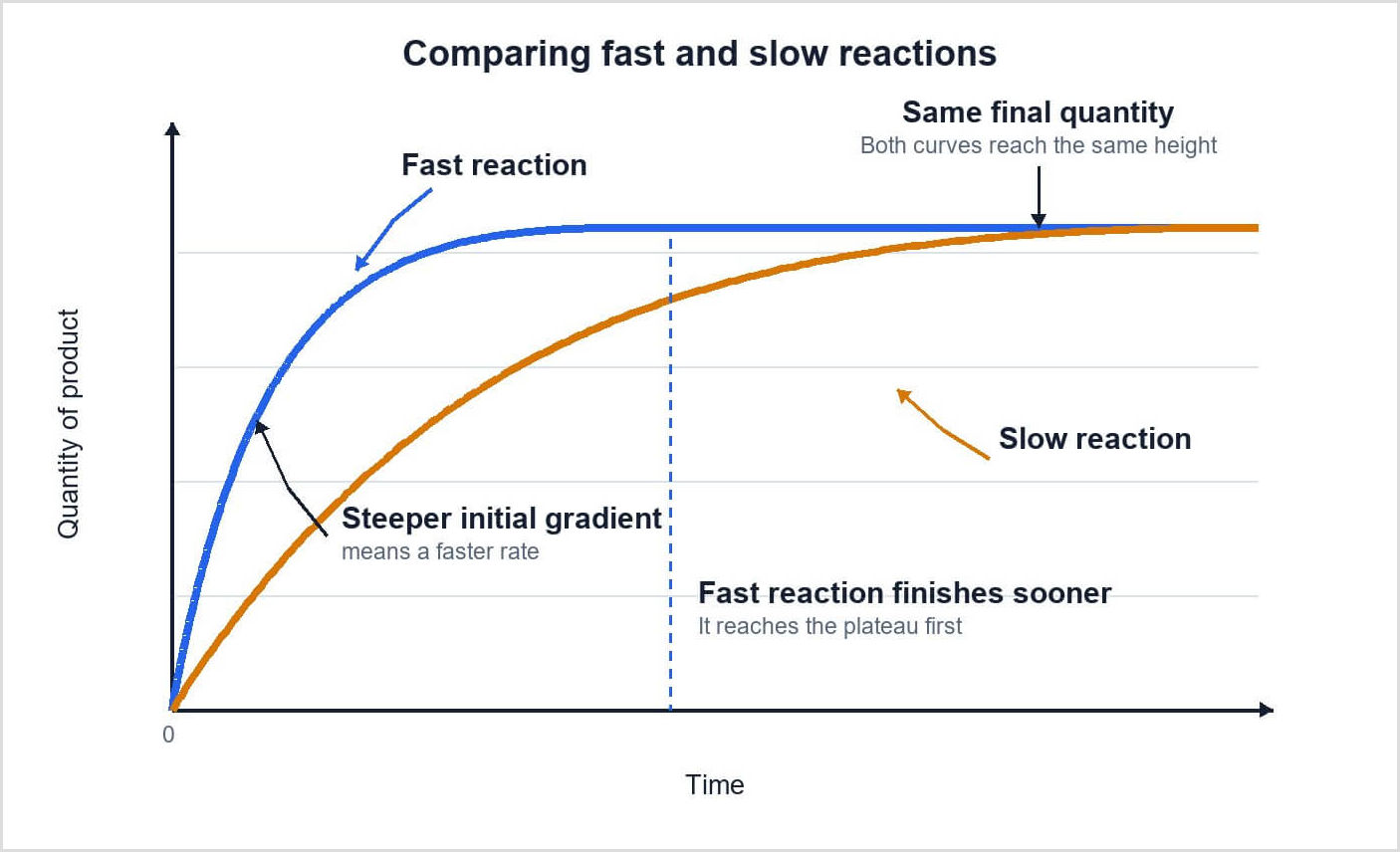
The gradient of a graph shows the reaction rate. If the gradient is steep, this means a faster reaction. A shallow gradient that doesn't peak as high points to a slower reaction. When the line becomes horizontal, the reaction rate has slowed to zero.
Two reactions can produce the same amount of product, but at different speeds. For example, one may have a steeper initial gradient, and the other may have a gradual rise. However, both will reach the same plateau, just at different times.
When you're comparing rate of reaction graphs, always look at both their gradients and their final heights. The gradient indicates the reaction rate, while the plateau indicates the total quantity produced.
Find the mean rate
You can find the mean rate between any two points on a graph using the following calculation:
Mean rate = change in quantity / change in time
For example, let's say the volume of gas is 20 cm³ at 10 seconds. After 30 seconds, it has risen from this level to 68 cm³.
- Find the change in volume - The answer is 48 cm³ (68 - 20)
- Find the change in time - The change is 20s (30 - 10)
- Find the mean rate - The mean is 2.4 cm³/s (48 / 20)
Find the rate
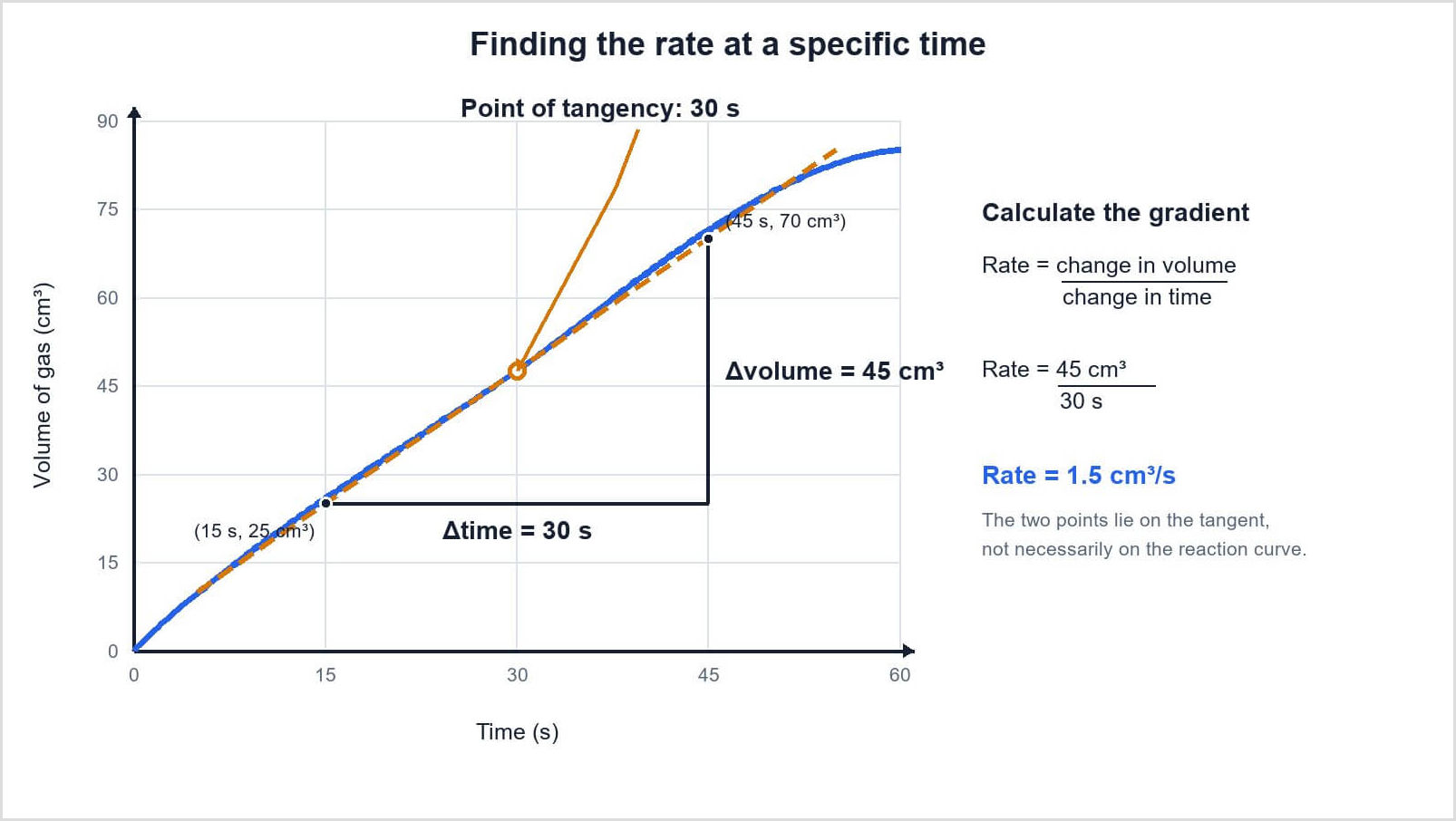
The gradient of a curved graph is always changing until it plateaus. To find a rate at a certain point, we need a tangent. This is a straight line that touches the curve and follows its direction.
Follow the steps below to find the rate:
- Find the required time on the x-axis and draw a tangent where this time meets the curve.
- Mark two points on the tangent that are widely separated. Note the coordinates of both points.
- Calculate the change in the y-values and the x-values.
- Divide the change in y by the change in x.
The equation is: Gradient = change in y / change in x
For example, let's say there are two points on a tangent. These are (15s, 25cm3) and (45s, 70cm3). The volume change is 45 cm³ (70 - 25), while the change in time is 30s (45 - 15). This means the rate is 1.5 cm³/s (45 / 30).
When drawing a tangent, aim for a large gradient triangle. This will produce a more reliable answer. If you select points that are too close together, it can lead to reading errors. The tangent should touch the curve and follow its direction beyond the required point. Use this separation between the two points to create a large gradient triangle and write down the coordinates. Remember to always answer with the correct units.
Tangents are normally drawn by hand, which means answers can vary slightly. Marks are awarded when the tangent is reasonable and the gradient has been calculated correctly.
Practical - Effect of concentration
A common practical in GCSE Chemistry is investigating how concentration affects the reaction between sodium thiosulfate and dilute hydrochloric acid. This reaction creates solid sulfur, which forms a cloudy precipitate. The reaction produces solid sulfur. This sulfur forms a cloud that gradually hides a black cross put underneath the reaction flask.
The equation for this experiment is below:
Sodium thiosulfate & hydrochloric acid -> sodium chloride & sulfur dioxide & sulfur & water
To do this experiment, you need: sodium thiosulfate, dilute hydrochloric acid, water, a conical flask, measuring cylinders or pipettes, a stopwatch, paper marked with a black cross, and goggles to protect your eyes.
The process for the experiment is below. Make sure to keep the sodium thiosulfate and water at the same volume:
- Put the cross under the conical flask and measure a set volume of sodium thiosulfate solution into the flask.
- Add a measured volume of water to create the required concentration.
- Measure a fixed volume of dilute hydrochloric acid and add it to the flask, starting your stopwatch immediately.
- Stop the timer when the cross is no longer visible through the mixture and record the time in seconds.
- Repeat the method with different concentrations of sodium thiosulfate. Try each concentration twice and calculate a mean time.
Variables
The concentration of sodium thiosulfate is the "independent variable" that is deliberately changed. The "dependent variable" is the time it takes for the cross to disappear.
Try to keep track of the following variables, ensuring they remain the same:
- Volume and concentration of hydrochloric acid
- Total volume of the reaction mixture
- Temperature of the solutions
- Size and colour of the cross
- Position of the observer and the viewing position
- Lighting conditions
- Relative rate
This investigation measures how long it takes to reach a fixed level of cloudiness. We can calculate it using the following:
Relative rate = 1 / time
If the cross disappears after 20 seconds, then the relative rate is 0.05 s-¹ (1 / 20). If this were shown as a graph, the rate would increase as the concentration increases.
Accuracy and reliability
The main weakness in this method is the cross. It's hard to tell when the cross has fully disappeared, and different people may record different times. It's also easy to start the stopwatch at the wrong moment: it needs to begin immediately as the acid is added. Temperature can also be an issue, and needs to be maintained between trials.
To improve the accuracy of the experiment, always use the same observer for each trial and stand in the same position when trying to see the cross, with the same lighting. The solutions should be kept in a water bath, and a pipette is preferable for precise volumes. Repeat each concentrate at least once, and use a light sensor or colourimeter to detect cloudiness.
Safety
Make sure you wear eye protection throughout the experiment. Hydrochloric acid can damage your eyes, and both the solution and acid should only be used at the concentrations given by the teacher.
The reaction creates sulfur dioxide. This irritates the respiratory system, so only use small quantities and keep the room well ventilated. Don't lean over the flask, and keep enough distance from your face. Any spills should be reported immediately.
Rate of reaction example questions
1
What does the rate of a reaction measure?
2
Why does the reaction speed increase with a temperature rise?
3
How does a catalyst increase the rate of reaction?
4
What is the mean rate of a reaction that creates 75 cm³ of gas in 25 seconds?
5
What is the horizontal line on a product-against-time graph?
6
Why does powdered calcium carbonate react faster than chips of the same size?
7
How can you improve an investigation about reaction speed?
8
Why do we use 1 / time in the disappearing-cross experiment?
Conclusion - Calculating rates of reaction
Every change that happens during a reaction can be linked back to particle collisions. A reaction only happens when particles collide with enough energy to overcome the activation energy:
- When we increase temperature, the reaction rate increases as particles are given more kinetic energy
- The reaction increases when the concentration or gas pressure increases, which places more particles in the same volume
- More solid particles are exposed with a greater surface area, boosting the reaction rate
- A catalyst allows the reaction rate to increase because the activation energy is lower
We measure reaction rates through gas volume, mass loss, or a visible change. We can find the mean rate by dividing the quantity change by the time the reaction has taken. A steeper gradient on a graph means a faster reaction, while a horizontal line effectively means the reaction has stopped changing.
For further reading, you can read the AQA article on the rate and extent of chemical change. There are also practical resources showing how concentration is investigated by the Royal Society of Chemistry.
If you need help, TeachTutti has qualified Chemistry GCSE tutors. Lessons can be in-person or online. Every tutor has an enhanced DBS check and approved testimonials.