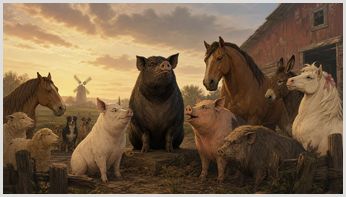
George Orwell wrote Animal Farm in 1945. The famous novella focuses on the lives of animals who rebel against the farmer at Manor Farm, hoping to create a society where every animal can live equally away from humanity. Below the surface, this is a satirical narrative on the Russian Revolution and the rise of Stalin. Ultimately, the farm ends up in a state nearly identical to what it was before, when the humans were in charge.
Every character in Animal Farm represents a historical figure, social group, or political idea. This means character analysis is crucial to understanding the themes in the novella. For example, Napoleon shows the corrupting influence of power, while Boxer reflects the loyalty and suffering of the masses.
This article explores the key and supporting characters in detail. Quotes and plot examples are provided for each character. It is suitable for GCSE English Literature revision across all major exam boards, including AQA and Edexcel.
If you need support revising this novel, TeachTutti has experienced English Literature GCSE tutors. Every tutor is testimonial-approved and can teach online or in person, depending on the student's preferences.
Napoleon
Napoleon is the main antagonist of Animal Farm. He is a Berkshire boar who rises to dictator after the rebellion against Farmer Jones. He represents Joseph Stalin, a revolutionary who became the leader of the Soviet Union.
After Old Major calls for the humans to be overthrown, Snowball and Napoleon assume command of the rebellion. Unlike Snowball, Napoleon doesn't try to win popular support and explain his actions. Instead, he prefers to be secretive and remove anyone who challenges his authority.
The cows are promised that their milk will not be stolen after the rebellion. However, the pigs learn how to milk the cows, and it's stirred into their daily food:
"Never mind the milk, comrades!"
He uses the term "comrades" to create a false sense of equality, which has strong parallels with the Soviet Union. He takes the puppies away from female dogs Jessie and Bluebell, raising them as attack dogs who will be loyal and support his regime. For example, the dogs exile Snowball and silence the other animals.
When Napoleon announces that the farm will trade with humans, he makes a declaration that sounds loyal to the rebellion. However, this patriotic language directly contradicts the original principles of the revolution:
"Long live Animal Farm!"
After taking credit for the creation of a windmill to ease the burden of the other animals, an idea introduced by Snowball, Napoleon attempts to pass responsibility to Snowball when it collapses due to a weak wall. The use of his capitalised name makes the accusation dramatic and emotive. He is attempting to direct the anger away from his own failures, turning Snowball into a scapegoat. This allows Napoleon to impose more restrictions and violence:
"Do you know the enemy who has come in the night and overthrown our windmill? SNOWBALL!"
At the end of the novella, Napoleon is aping his human predecessor at every turn. He wears human clothes, carries a whip, and walks on two legs. The name Manor Farm has been restored, and the pigs are indistinguishable from humans. Orwell uses this character to show how a revolutionary leader can become as corrupt and oppressive as the regime he overthrew.
Snowball
After the boar Old Major calls for the humans to be overthrown, Snowball and Napoleon take command and lead the rebellion. He is an intelligent, energetic pig who represents Leon Trotsky, a Russian revolutionary who lost his struggle for power against Joseph Stalin and was exiled and ultimately assassinated.
He believes in education, arranging reading and writing classes. Snowball also creates animal committees and develops the principles of Animalism, the Seven Commandments, titled by the slogan:
"Four legs good, two legs bad."
It's a simple rhyme designed to be understood by the other animals who have limited reading skills. However, it oversimplifies a complex political system, and the sheep use the slogan to interrupt debates. This slogan, therefore, is a useful way for leaders to discourage independent thought.
During the Battle of the Cowshed, Snowball displays bravery and ingenuity. He studies the campaigns of Julius Caesar and prepares a successful defence when Mr Jones tries to retake control of the farm. By comparison, Napoleon has a much smaller role in the fighting.
Boxer strikes a boy during the battle and wrongly believes he has killed him. He expresses deep remorse, and Snowball is blunt in his view that all humans are enemies. It shows that his revolutionary mindset has accepted the need for violence:
"War is war. The only good human being is a dead one."
He advocates building a windmill to produce electricity and reduce the workload of animals on the farm. Napoleon is dismissive and urinates on the detailed plans. He sets his dogs on Snowball, forcing him to flee, and then claims the windmill idea as his own and begins construction. When the windmill collapses due to weak walls, Napoleon blames Snowball. He repeats this scapegoating with the damaged crops, and Squealer rewrites the battle to present Snowball as a traitor.
Snowball was not a perfect leader, but he valued education and debate. When he was exiled, Napoleon rapidly transformed into a dictator due to a lack of opposition.
Boxer
Boxer is a cart horse, and his strength is vital to the farm after the rebellion. He is well-natured, loyal and determined. However, he doesn't think critically about the pigs' actions, with his exploitation reflecting the working class in society: their labour keeps society running while those in power exploit them.
Whenever there is a problem at the farm, Boxer works harder. He gets up early and takes on the most difficult jobs. His personal motto shows determination but also weakness. He believes all difficulties can be solved through physical effort. It directly benefits Napoleon, as Boxer never asks if the work is fair or challenges why conditions are deteriorating:
"I will work harder!"
Boxer shows deep remorse when he believes he has killed a stable boy during the Battle of the Cowshed. He shows a strong sense of morality, and he doesn't enjoy violence or see it as a means to an end. His compassion towards the boy makes his own fate more painful, as the pigs show complete disregard for his slaughter:
"I have no wish to take life, not even human life."
After Napoleon takes over Animal Farm, Boxer adopts the motto below. Despite having the strength to resist the pigs, his complete obedience is a warning from Orwell that loyalty should always be supported by independent thought:
"Napoleon is always right."
Boxer helps to build the windmill, and again after it is destroyed. His health begins to suffer after all his labour, and he collapses while pulling stones. Despite promising to send him to a veterinary surgeon, Napoleon sells him to a horse slaughterer. Benjamin is aware of the danger and warns the others, but Boxer is too weak to escape. The pigs lie about his fate and use the money to buy whisky.
Squealer
A smaller pig, Squealer, acts as Napoleon's spokesperson. He is skilled at presenting complex ideas in a convincing way and manipulating the truth. He represents propaganda and the people who manipulate information to benefit a regime.
When the pigs take milk and apples, Squealer argues that the pigs need the nutrition for the mentally draining work they need to complete. He then warns of the return of the human farmer, replacing reason with fear. In doing so, he implies that questioning the pigs will make the return of Mr Jones more likely. This leads the animals to accept unfair treatment:
"Surely, comrades, you do not want Jones back?"
When Snowball is exiled, Squealer announces that debates are banned. He calls it an act of sacrifice and uses repetition in his language to make an empty statement more convincing. Squealer relies on the lack of education among the animals and their fear of the humans and the original regime:
"Tactics, comrades, tactics!"
After Napoleon sours on Snowball, Squealer rewrites his role in the Battle of the Cowshed to claim he was a traitor who worked for Mr Jones. The animals doubt this, as they witnessed his bravery, to which Squealer argues that Napoleon is the greatest defender of the animals at the farm:
"No one believes more firmly than Comrade Napoleon that all animals are equal."
When the pigs begin to break the principles that Snowball established in the Seven Commandments, Squealer modifies them. He says killings are banned when they are done "without cause", which is notable as the amendment is after Napoleon's dogs carry out executions. Another rule is changed to allow the pigs to drink alcohol.
Squealer lies when he claims Boxer died peacefully in the hospital. This protects Napoleon from betrayal and turns Boxer's death into an act of kindness.
Old Major
Old Major is an old, prize-winning boar who is respected by the other animals. He inspires the rebellion when he gives a speech. He argues that the humans should be overthrown because the animals have hard lives and receive little benefit for their produce and hard work. Old Major says that people control all the resources of the farm, despite not producing milk, pulling ploughs, or laying eggs. He sees the animals as an exploited class with a clear enemy:
"Man is the only creature that consumes without producing."
His message is simplified down to the statement below. In using the word "comrades", he sees all the animals as equals. It's the foundation of Animalism and is part of their seven commandments. This initial vision is in direct contrast to the regime of Napoleon, where the pigs wear clothes, trade with humans, and mistreat the other animals, considering some animals "more equal" than others:
"All men are enemies. All animals are comrades."
During his speech, Old Major introduces a song called "Beasts of England", which unites the animals in the hope of a better future. It is frequently sung after the rebellion. However, Napoleon bans the anthem, fearful that its revolutionary message could threaten his position.
Old Major dies shortly afterwards, before the Rebellion takes place. The pigs turn his ideas into Animalism, which Napoleon gradually adapts to suit his position and privilege. His skull is exhumed and placed on display, becoming a political image.
While Old Major inspires a revolution with hope, his dream lacks a practical plan to protect the aims of the rebellion, making it easy to be altered when the original leader has gone.
Clover
Clover is a gentle cart horse in Animal Farm by George Orwell. She works with Boxer and supports the rebellion. Despite her strength, she is poorly educated and not assertive enough to use her strength in challenging the pigs. She represents the working class who struggle to oppose the oppression they see in society.
She challenges the white horse Mollie, whom she sees with a human near the edge of the farm. When she searches Mollie's stall, she finds sugar and ribbons. This shows her willingness to challenge behaviour that threatens the farm, remaining committed to the farm despite the harshness of life:
"What are those hairs on your coat?"
Clover is observant and can see the regression of the rebellion when Napoleon seizes power. Animals promised never to kill each other and live like humans. Despite knowing all the letters in the alphabet, she can't form words. This means Clover has to ask Muriel to read the Seven Commandments, which have since been altered to support the pigs. She assumes her memory is at fault, which shows the dangers of poor education, as the animals are unable to prove their leaders' hypocrisy.
As Boxer continues to push himself to support the farm, despite his age and injuries, Clover worries for him. She can't read the wording on the van that arrives, and believes Napoleon's lie that he will be taken for medical treatment. It's only when Benjamin reads the sign that the animals realise he is being taken to slaughter. Clover's repeated commands show her panic and desperation, powerless to save her friend:
"Boxer! Get out! Get out quickly! They are taking you to your death!"
When the novel ends, the pigs have been transformed into the very people they overthrew, walking on two legs, sleeping in beds, carrying whips, and subjugating the other animals for their own means. Clover remembers Old Major's original ideals and understands that Animal Farm has become the opposite. However, she is unable to express these thoughts coherently, showing kindness and awareness don't always lead to resistance due to poor education, fear and self-doubt.
Benjamin
Benjamin is an intelligent, cynical donkey. The oldest animal on the farm, he can read as well as the pigs, but rarely gets involved in politics. He represents people who recognise oppression but don't act.
When the rebellion takes place, Benjamin believes their difficult lives won't change. His mysterious statement reflects his pessimism and may explain why he is reluctant to speak out, aiming to outlive each regime by avoiding supporting any of them:
"Donkeys live a long time. None of you has ever seen a dead donkey."
He doesn't celebrate the victories or sing along to "Beasts of England", not giving a clear answer when asked if life has improved with Napoleon in charge. Despite his refusal to take sides, Benjamin knows the pigs are corrupt and understands that Squealer has adapted the Seven Commandments. However, his cynicism prevents him from acting against this injustice and warning the other animals.
Benjamin does act when he realises Boxer is being taken to a horse slaughterer after reading the writing on the van. His repeated insult reflects panic and anger, abandoning his reserved nature to make the animals act. However, this statement is too late, and Boxer is too tired to escape. It's a harrowing scene that underscores the importance of acting on knowledge before the danger is unavoidable:
"Fools! Fools! Do you not see what is written?"
When Boxer is taken away, Benjamin becomes more withdrawn. Orwell doesn't state why, and the reader is left to interpret this as grief or guilt. He stays on the farm as the pigs transform into human-like oppressive rulers. Orwell uses the donkey to crique pass intelligence, arguing that having an education and independent thoughts means you are required to engage in politics to better shape the world around you.
Mollie
Mollie is a young white mare. She used to pull Mr Jones's carriage and is attached to privilege, focused on herself and her own comfort over political freedom. She represents privileged Russians who opposed the Revolution or left the country after it took place.
After the rebellion, she shows her concern for the luxuries in her life rather than equality. Sugar represents a treat from humans, and she is focused on her personal pleasures:
"Will there still be sugar after the Rebellion?"
We see this again when she wants to continue wearing ribbons in her hair, which is more pointed as it's a sign of ownership. Snowball calls them a badge of slavery, but Mollie identifies them as beauty and elevated standing in society. It underscores her focus on appearance and attention from others:
"And shall I still be allowed to wear ribbons in my mane?"
When the new regime is in place, Mollie struggles to adapt. She wakes up late and shirks work by claiming she's in pain. She is taught to read, but spends most of this time learning how to spell her own name, which she decorates with flowers. Mollie contrasts sharply with the hard-working Boxer, who takes on an increased workload selflessly without complaint.
A man from a neighbouring farm is spotted stroking Mollie's nose. Mollie denies this happened, but Clover finds sugar and ribbons in her hair, which shows she is still seeking the comforts associated with humans. She disappears to join another farm, where she is seen pulling a carriage.
Mollie represents privileged people who reject political change. She doesn't try to harm or control the other animals, yet doesn't stand in the way of oppression and is entirely unwilling to make any sacrifices for greater equality. She favours comfort from an unequal system over the hardship in pursuing a fairer society.
Mr Jones
As the original owner of Manor Farm, Mr Jones is introduced as the enemy of all the animals at the farm. He's irresponsible and often drunk. He represents Tsar Nicholas II, the last emperor of Russia, whose weak leadership and involvement in World War I led to the Russian Revolution of 1917.
Mr Jones doesn't have any dialogue, which creates distance from the reader. We are more focused on his behaviour and actions. He is introduced as a drunk who is unfit to farm and neglects the animals under his control:
"too drunk to remember to shut the popholes"
When Jones loses money in a lawsuit, he turns increasingly to alcohol, while his workers become increasingly lazy. One evening, the animals aren't fed, and they break into the store shed for food. The humans respond with whips and the animals fight back. The use of violent verbs shows the balance of power shift to the animals as Jones is overthrown through his own neglect, rather than a carefully prepared plan:
"Jones and his men suddenly found themselves being butted and kicked"
Now displaced from the farm, Jones returns with armed men. This triggers the Battle of the Cowshed. Snowball prepares the defence and is wounded when Jones fires his gun, killing a sheep in the process. Despite this, the humans are defeated and forced to retreat.
Mr Jones spends much of his time drinking and complaining at the village pub, the Red Lion. He doesn't muster any support and has to leave, dying in a home for alcoholics. Napoleon eventually copies the behaviour of his predecessor by moving into Jones's farmhouse, drinking alcohol, carrying a whip, and trading with human farmers.
Orwell uses Mr Jones to depict a weak system rife with injustice. This validates the need for a rebellion, although Napoleon's transformation shows that a poor replacement will not always remove the oppression that was rebelled against in the first place.
Supporting characters
Moses
Moses is Mr Jones, the farmer. He avoids work, and he talks about Sugarcandy Mountain, a supposed paradise the animals will reach after death. He represents organised religion, in particular the Russian Orthodox Church:
"Sunday seven days a week"
The idyllic Sugarcandy Mountain is a place of permanent rest, which comforts the tired animals. This indirectly encourages them to accept their suffering rather than challenge it.
He reappears years after the Rebellion when the animals are again suffering, now under Napoleon's rule. The pigs give him food and "an allowance of a gill of beer daily", despite denouncing his stories as lies. This is because the preaching of Moses keeps the animals hopeful and the pigs in power.
Muriel
Muriel is an old and wise white goat. She can read and has many friends among the animals.
The horse Clover asks her if the pigs have broken any rules by checking the Seven Commandments whenever the pigs appear to break a rule. Muriel's response seems to permit their behaviour, though they seem to have been altered from the original rule. This altered commandment shows that the pigs have changed society's rule to protect themselves:
"No animal shall sleep in a bed with sheets."
She is unable to prove that anything has changed in this altered text. Orwell implies that literacy is only useful if the records are trusted and people are willing to act.
Mr Frederick
Mr Frederick owns the neighbouring farm, Pinchfield. It is small and well-maintained. Frederick is tough, aggressive and dishonest. He represents Adolf Hitler and Nazi Germany.
Frederick tricks Napoleon by buying timber from the farm with forged bank notes. Napoleon is humiliated by the exchange, which reflects the failure of the Nazi-Soviet pact, when Hitler invaded the Soviet Union and came within 20 miles of Moscow:
"Frederick had got the timber for nothing!"
After this trickery, Frederick uses blasting powder to blow up the windmill, attacking the farm with his men and wounding Boxer. The animals force him to retreat, but at great cost, reflecting the victory against Nazi Germany.
Mr Pilkington
Mr Pilkington is a wealthy owner of a large, neighbouring farm. He represents Britain and the United States. Napoleon plays Pilkington and Frederick against each other while deciding who to sell the timber to. When Frederick attacks the farm, Pilkington doesn't offer any real assistance, which reflects the distrust between the Soviet Union and the West.
Pilkington praises Napoleon's methods. Both the pigs and the farmers are now willing to exploit workers and are afraid of resistance challenging their authority. His words confirm that Animal Farm no longer threatens human society:
"If you have your lower animals to contend with, we have our lower classes!"
Mr Whymper
Mr Whymper is employed by Napoleon to act as a go-between for the animals at Animal Farm and human society. He is a solicitor and the first person allowed to visit after the farm was established.
In the description below, Whymper is implied to pursue personal gain over principle. He knows working with the farm will benefit him financially, so he ignores Napoleon's dictatorial regime:
"a sly-looking little man"
He provides the pigs with supplies and a means to sell their produce. Napoleon can also hide his own shortages from the outside world with Whymper. He represents those who are willing to work with oppressive regimes for personal gain.
The dogs
After the rebellion, the two female dogs give birth to nine puppies. Napoleon raises them away from their mothers, which marks the end of open debate. The dogs are loyal to Napoleon, chasing Snowball away and surrounding him when he addresses the farm. They wear collars, implying servitude to a master rather than the farm:
"nine enormous dogs wearing brass-studded collars"
The acts of the dogs escalate when they kill animals who supported Snowball. They represent Stalin's secret police and the use of state violence to crush opposition. They never speak, appearing only as instruments of their master, rather than individuals with free thought.
The sheep
The sheep are simple and loyal to power. They repeat slogans that they don't fully understand due to their poor education. This makes them easy to control. Napoleon uses the slogan below by Snowball whenever he wants to stop a debate, getting the sheep to drown out open debate with blind agreement:
"Four legs good, two legs bad!"
When the pigs begin to walk upright, the sheep reveal an altered version. They highlight that repetition can make even obvious falsehoods acceptable over time:
"Four legs good, two legs better!"
The hens
The hens raise a rebellion against Napoleon when he takes over the farm. They are promised that they will be able to keep their eggs after the rebellion. However, they are taken from the hens to buy goods for the farm. They see this as an attack on their bodies and freedom, dropping their eggs from the rafters rather than giving them freely. It is a desperate form of resistance:
"their eggs were smashed to pieces"
Napoleon takes away their food and threatens death to anyone who helps them. Nine hens die before the rebellion is crushed. This resistance reflects Stalin's forced collectivisation and the treatment of those who refused state demands.
Jessie and Bluebell
Jessie and Bluebell are female dogs. They give birth to a litter of puppies after the rebellion. Napoleon takes over their upbringing, which is a key step towards dictatorship. He deprives them of their parental upbringing, controlling what they learn and ensuring they will be faithful:
"Napoleon took them away from their mothers"
The mothers can't prevent their children from joining Napoleon's private army, which leads them to commit horrible acts, including exiling Snowball and executing those who supported him. Their lives show how authoritarian leaders look to influence the young through isolation and controlled education.
Minimus
Minimus is a pig who can write poetry. He composes the second national anthem of the farm after "Beasts of England" is banned because it calls for freedom, unity, and resistance. His creativity is used to praise Napoleon in exaggerated terms and support his rule, calling him a kind protector. The disparity between the poem and reality is extremely ironic:
"Friend of the fatherless! Fountain of happiness!"
Orwell uses Minimus to argue that even art can become propaganda if the artist serves those in power.
Conclusion - Character list in Animal Farm
George Orwell's novella is brilliant because it turns a complex political history into a simple, engaging story. This is done through iconic, memorable characters. As his name suggests, Napoleon's rise shows the corrupting effect of power, while Boxer's selfless acceptance reflects the cost paid by the loyal workers. Characters like Snowball and Squealer highlight the themes of propaganda, fear, inequality, and political control.
When revising these characters, consider their personality and motives when considering their actions. Try to remember key plot examples and at least one quote for each character, reflecting these traits. For further reading, you can learn more about George Orwell’s life and work with this article by The Orwell Foundation. You can also study the Russian Revolution of 1917 for historical context in this article by the Holocaust Encyclopedia.
If you need help with memorising quotes or essay technique, TeachTutti has verified English Literature GCSE tutors. Our tutors will provide bespoke tuition to suit your needs. Every tutor has an enhanced DBS check.