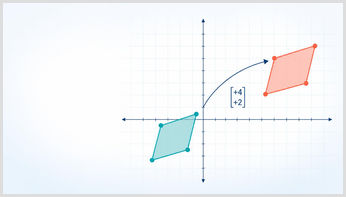
Translation is a common topic in transformation questions. It is a geometric transformation that moves a shape a specific distance to a new position. The new shape doesn't rotate, flip, or change its size. It looks simple, but interpreting the vector incorrectly or making a mistake when calculating the size of the gap to the new position can affect your marks.
This GCSE Maths revision guide will explain what a translation is, how to read and use column vectors, and how to slide a shape on a coordinate grid. Images are included to help you revise this topic, and we also include quiz questions to test your understanding. The article is suitable for all major exam boards, including AQA and Edexcel.
If you need help revising this topic, TeachTutti has qualified GCSE Maths tutors. Lessons can be at home, online, or a combination of the two. Our tutors will tailor lessons to your specific needs, such as helping you to translate one vertex at a time and where to start to avoid overlap.
Understanding Translation - Key points
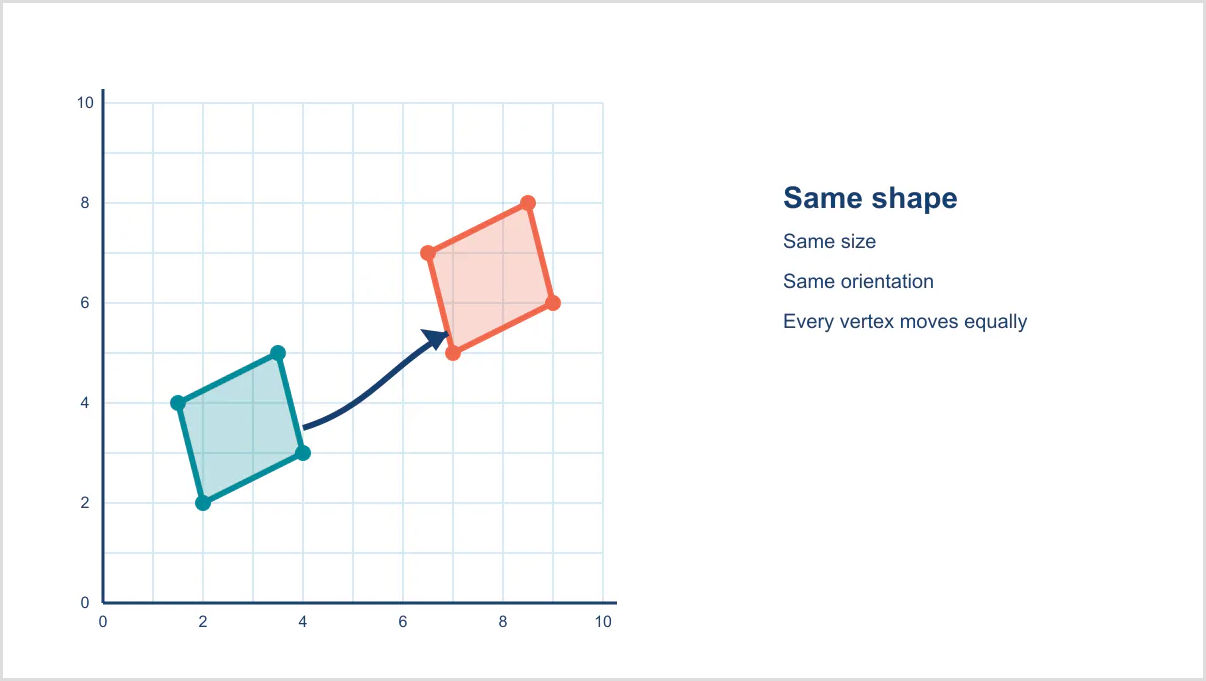
A translation is a transformation. The shape is moved to a new position. To ensure the shape doesn't change size or turn around, every point of the shape is moved by the same amount, in the same direction.
Its shape also won't flip during this transformation. Essentially, the original and translated images are congruent: they have the same angles, lengths, and orientation.
When you are tackling translation questions in GCSE Maths examinations, the original shape is referred to as the object. The shape after it has moved is known as the image.
Reading a Translation vector
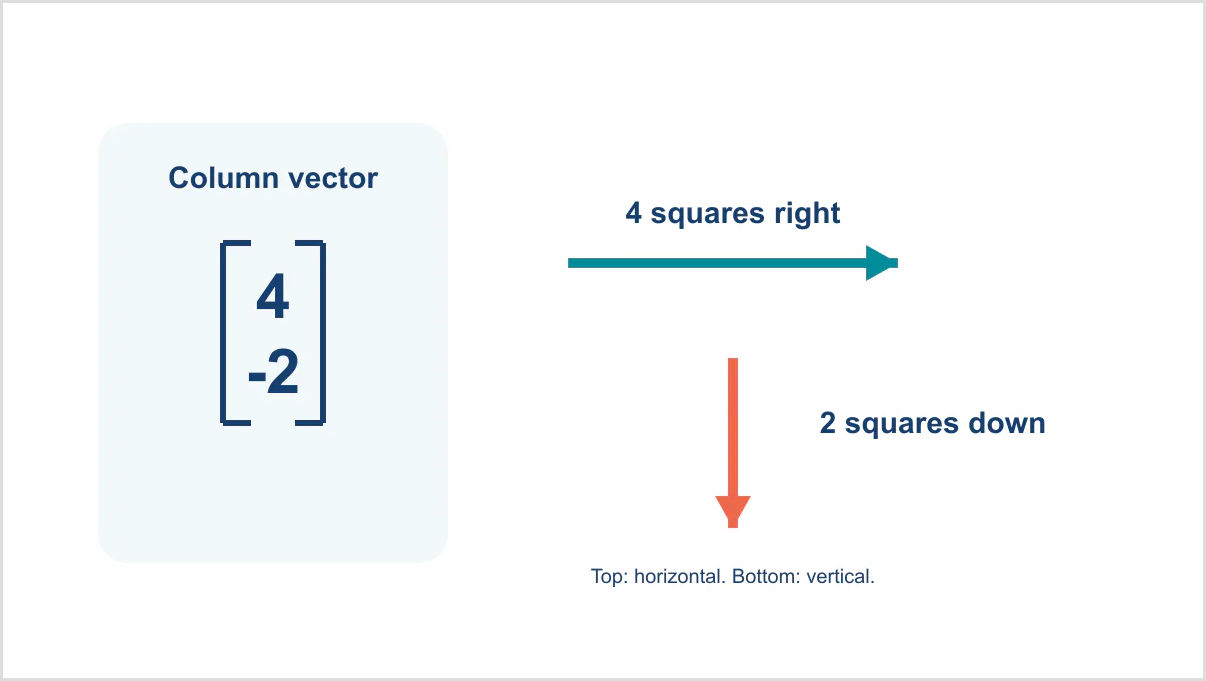
A column vector is how the shape moves. It's normally written as numbers in brackets. This tells you how far a shape has moved by comparing points on the original shape with their corresponding vertices in the new position.
In the example below, the vector means to move 4 squares to the right and 2 squares up:
- The top number is the horizontal movement. A positive number means move right, and a negative number means move left.
- The bottom number is the vertical movement. A positive number means move up, and a negative number means move down.
If the number is zero, this means there is no movement in that direction. For example, if the vector is [0 5], this means there is no movement left or right, while the shape moves 5 squares up vertically.
Translating a shape
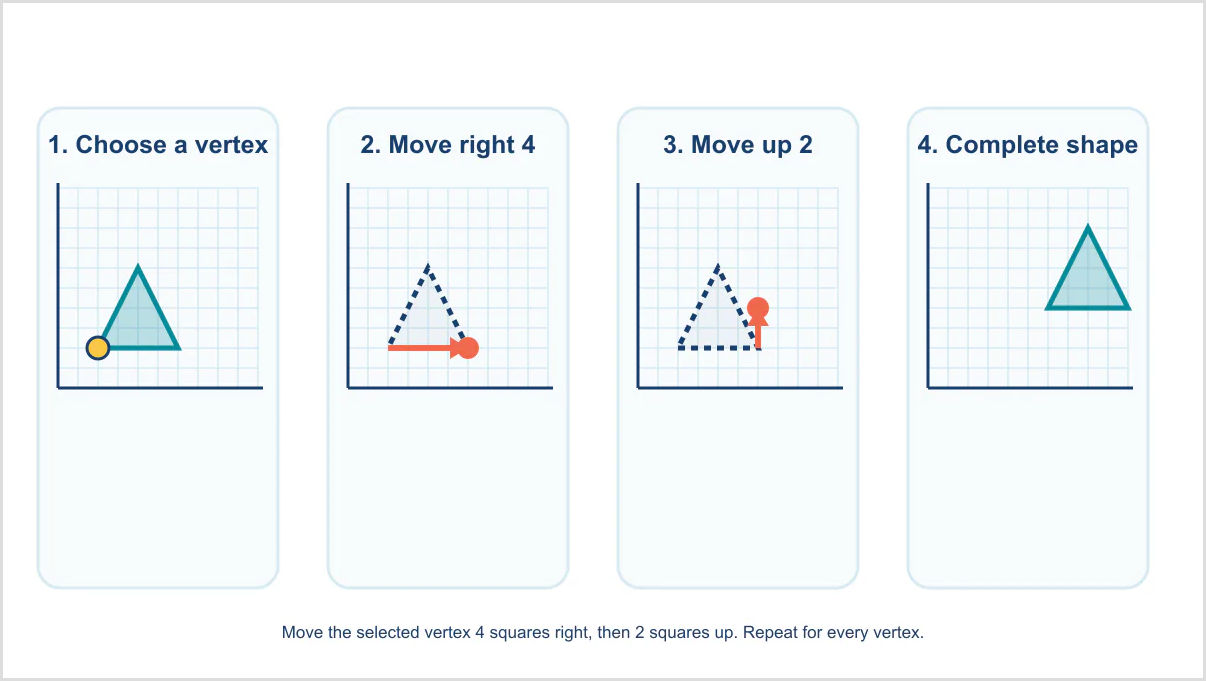
When you translate a shape, every vertex needs to be moved by the same amount. Work carefully using the column vector to avoid missing a point:
- Start with your first corner of the original shape.
- Move this point left or right using the top number in the vector.
- Use the bottom number to count the number of positions you need to move up or down. Mark the new position.
- Repeat this process for each vertex. Finally, join the new points together to complete the image.
For example, the vector [4 2] means moving every vertex 4 squares right and 2 squares up. Always check your answer at the end to ensure the gap between the object and the translated image is correct and the shape looks the same.
Describing a Translation - GCSE Maths
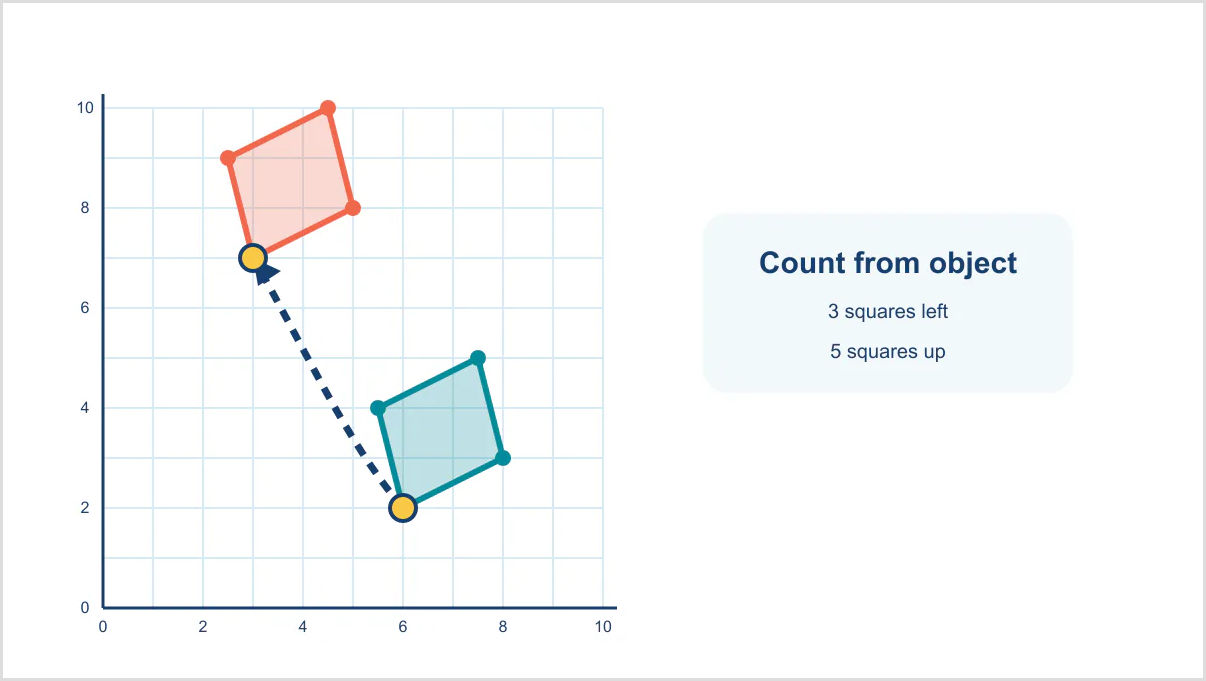
You may get exam questions that show you the object and image, then ask you to describe the translation.
Pick your vertex on the original shape and find the matching vertex in the image. Count how far it has moved horizontally and vertically, writing the values down in this order.
For example, let's say a point has moved 3 squares left and 5 squares up. The translation would be 3 left and 5 up.
You should check a pair of matching vertices to confirm the movement is correct. To be safe, try checking a second pair to avoid a counting error.
Translation rules
There are rules to follow when answering GCSE Maths questions about the object and the image:
- Every vertex moves in the same direction and by the same distance
- The shape doesn't change size, and it keeps the same orientation. It should never flip.
- Write the horizontal movement followed by the vertical movement.
- A positive number means right or up.
- A negative number means left or down.
- If the number is zero, this means there is no movement in that direction.
- Only the position of the shape changes. It isn't a translation if the size, angle or direction are altered.
Learning Translation - Common mistakes
There are common errors to watch out for when tackling translation questions:
- Vector order - Make sure you read the horizontal movement first, then the vertical movement. You should always move left or right, followed by moving up or down.
- Negative numbers - Be careful not to miss negative numbers. A negative number means move left, and a negative vertical number means move down.
- Moving only one vertex - Each vertex has to move by the same amount. The image will change size or shape if any point has been moved to the wrong position.
- Shape change - The shape should never change shape, such as by rotation, flipping it, or enlarging it. Instead, the transformation slides the shape to a new place.
- Counting incorrectly - Always count from the object to the image when you have to describe a translation. If you count in the opposite direction, the translation will not be correct.
Worked example
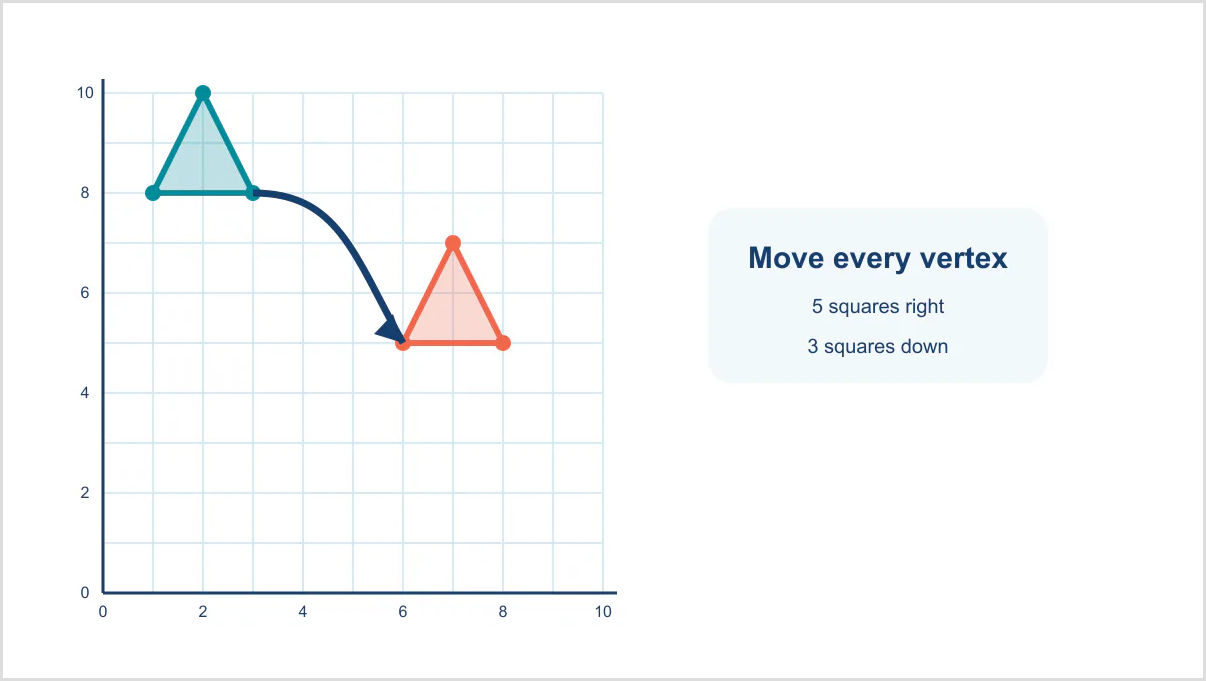
A triangle is translated 5 squares right and 3 squares down. Describe the translation.
The triangle has moved 5 places to the right and 3 down. If we draw this image, each vertex needs to be moved by this amount. When you have marked the new vertices, join them together in the same order to recreate the triangle in its new position.
It's a good idea to start with a vector from the original object that's well away from any overlap area to avoid confusion and count the number of positions you need to move to reach the correct place. This gives you a quick check and reference before you translate the rest of the shape.
Quiz questions
1
A shape is translated 4 squares right and 2 squares up. Which movement is correct?
2
A shape moves 3 squares left and 5 squares down. What statement is true?
3
4
A shape is translated 0 squares right or left and 6 squares down. What happens?
5
Which statement about a translation is false?
6
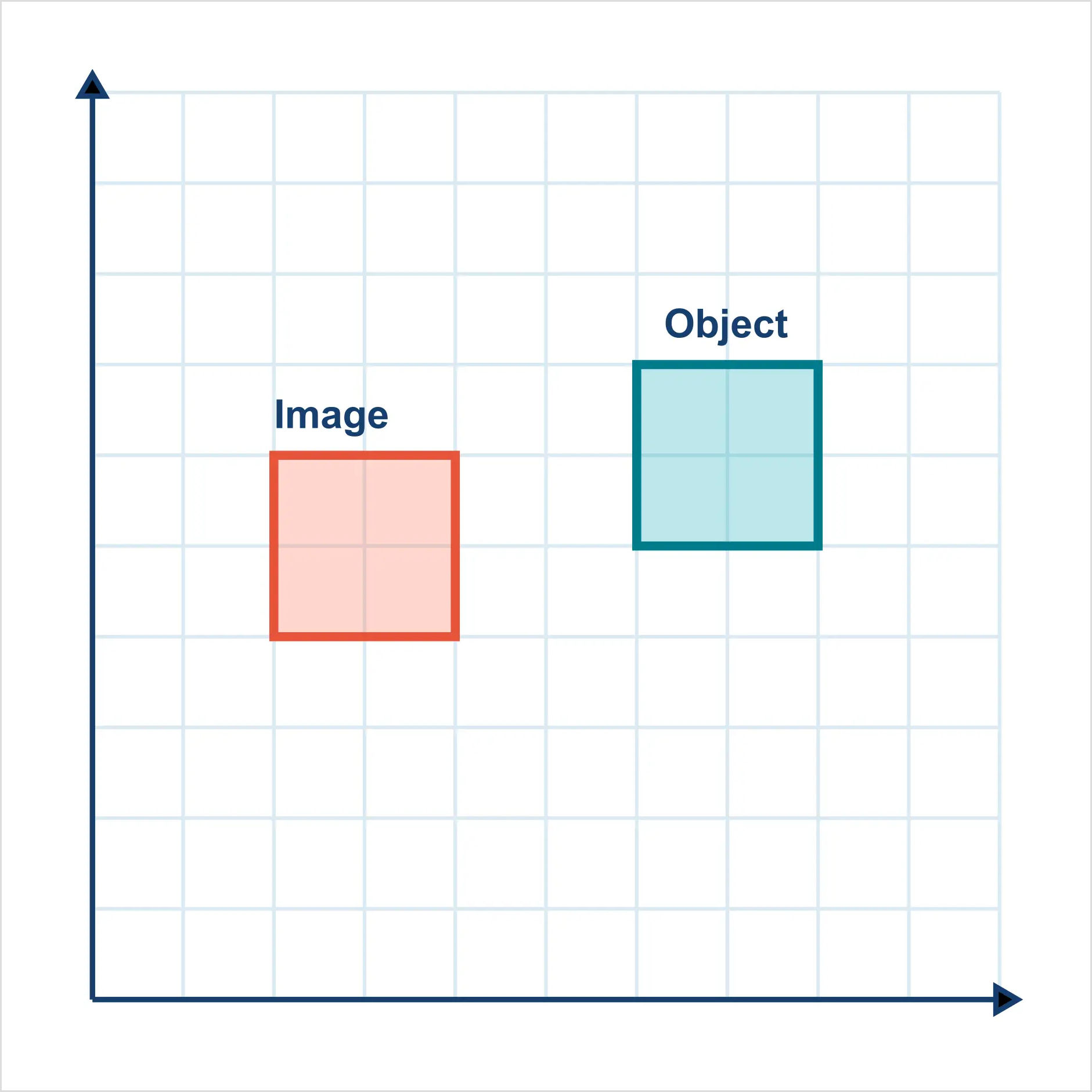
Look at the object and image on the grid. How has the shape moved?
7
The image is 1 square right and 4 squares down from the object. Which translation describes this?
Final thoughts on Translation - Exam Revision
Translation means sliding a shape from one position to another. You start with the horizontal movement, followed by the vertical. Ensure that each vertex moves by the same amount, and check that the image is the same size and orientation as the object. It's a good idea to count the movement with a matching pair of vertices so you can spot a mistake or accidentally reversed sign.
For further reading, you can use the Desmos graphing calculator to practice with a coordinate grid, drawing your own shapes and translating them. You can also test your understanding with past paper translation questions by TES.
If you would like further help with translations, top GCSE Maths tutors can support your revision. Every tutor has an enhanced DBS check and will identify your strengths and weaknesses in the build-up to GCSE Maths, such as working on exam technique.