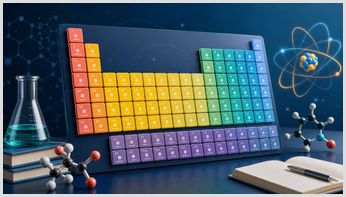
Mendeleev's periodic table is a staple of chemistry. The layout of the table shows patterns in atomic structure, bonding, reactivity, and physical properties.
This article will explore the periodic table groups, periods, and electron blocks in the periodic table. It covers atomic radius, ionisation energy, and electronegativity. We will also describe how an element's position can reveal its properties. It is suitable for GCSE and A-Level Chemistry revision across all the major exam boards, including AQA and Edexcel. Quiz questions are included to test your understanding.
If you need help, TeachTutti has qualified A-Level Chemistry tutors who can provide bespoke tuition, such as explaining the characteristics of elements in the table, including their chemical and physical properties. You can also follow the link to learn how tutoring works with TeachTutti.
Periodic table explained
The periodic table is an organised chart of all the known chemical elements. They are arranged in order of their atomic number, which tells how many protons are in the atom's nucleus. The table is called "periodic" because elements are positioned in groups with similar properties occurring at regular intervals. For example, reactivity and atomic size are common attributes at regular steps.
The table is divided into rows and columns:
- The columns are called groups. Elements in the same group have similar properties and share outer-electron configurations. This makes them act in similar ways. For example, the elements in group 1 are alkali metals, such as lithium and hydrogen. They are all shiny and reactive, with low densities and low melting points.
- The rows in the table are called periods. Moving across a period shows patterns in atomic radius, ionisation energy, and electronegativity. These patterns are called periodicity, which lets scientists predict how an element may bond, react, or form ions.
The periodic table was published by Dmitri Mendeleev in 1869. He ordered the known elements based on their properties, mainly by atomic mass and their chemical makeup. He used patterns to predict the properties of missing elements, which he left as gaps in the table. The modern periodic table is based on this premise. Rather than using atomic mass, it starts on the left and arranges elements to the right in order of increasing atomic number.
Reading the periodic table - A Level Chemistry
Every box in the periodic table is a chemical element. Boxes show the element symbols, atomic numbers, and relative atomic mass. Their position on the table also gives information about their electronic configuration and chemical behaviour.
Every element has a unique symbol, which contains one or two letters. The first letter is a capital letter. If there is a second letter, it's usually for differentiation and will always be lowercase. For example, Carbon is shown as C, Chlorine is Cl, and Calcium is Ca.
Some symbols have older or Latin names. Sodium has the symbol Na, which comes from the Latin "natrium".
The atomic number in the box is how many protons are in an atom's nucleus. There's a different atomic number for each element.
An atom is neutral when there are the same number of electrons and protons. For example, a neutral sodium atom has 11 protons and 11 electrons, which matches its atomic number.
When an atom becomes an ion when it gains or loses electrons. The protons don't change when this happens.
Relative atomic mass
The relative atomic mass is the weighted mean mass of an element's atoms compared to 1/12 of a carbon-12 atom's mass. It takes into account the mass of all the naturally occurring isotopes.
This explains why the atomic mass is normally not a whole number. For example, the atomic mass of chlorine is 35.5 because natural chlorine contains various isotopes, including chlorine-35 and chlorine-37.
Position in the table
We can learn about an element just by its position in the periodic table:
- The group it belongs to tells us its outer-electron configuration and chemical properties.
- Its period describes the highest occupied main electron shell.
- The block it is in shows the type of subshell that takes the final electron.
- You can predict if it's a metal, non-metal or metalloid from its position.
Example - Sodium
Sodium is in group 1 and period 3. The atomic number is 11. This means a neutral sodium atom has 11 protons and 11 electrons.
The electron configuration for Sodium is 1s² 2s² 2p6 3s¹. The last electron is in a 3s subshell, which means sodium belongs to the s-block. Sodium often loses the final electron, which is the only electron in its outer shell. Because it loses an electron, this means it creates a Na+ ion.
Groups and periods in the periodic table
The columns in the periodic table are groups, and the rows are periods. The group and period that an element belongs to give more information about its electron configuration.
Groups
The modern periodic table has 18 groups. Elements belonging to the same group have similar chemical properties and outer-electron configurations.
You can calculate the number of outer electrons if the element belongs to a main group. For example, group 1 elements have one outer electron, while group 17 elements have seven electrons. The elements in group 18 have full outer shells, except for helium.
The outer electrons an element has affect how it reacts and the ions it creates:
- Group 1 - The metals in this group lose an electron and create 1+ ions.
- Group 2 - The metals in this group lose 2 electrons and create at least 2 ions.
- Group 17 - The non-metals gain an electron and create 1- ions.
- Group 18 - These elements are unreactive because their outer shells are complete.
Properties change as you move down a group. The metals in group 1 become increasingly reactive, while group 17 elements become less reactive. This is caused by various factors, including atomic radius and electron shielding.
Periods
The rows in the table are periods. There are seven periods in the modern periodic table. The period number shows the highest occupied main electron shell. For instance, Sodium belongs in period 3 because its highest-energy electron is in the third shell.
The atomic number increases by one every time you move across a period from left to right. A proton and an electron are added. The new electron is usually in the same main shell. This means the growing nuclear charge has a stronger effect as you move across the row.
There are general trends as you move across a period:
- Atomic radius decreases.
- First ionisation energy increases.
- Electronegativity increases.
- Metallic character decreases.
There are also metals on the left of the table and non-metals on the right. The structure and types of bonding also change.
S, p, d and f blocks
There are four blocks in the periodic table: the s-block, p-block, d-block, and f-block. The block for an element shows which atomic subshell receives its highest-energy electron. The blocks connect the layout of the periodic table with elements that have similar outer electron configurations.
If we understand an element's block, we can predict the end of its electron configuration, connect its position with the outer electrons, and spot patterns in bonding and reactivity.
s block
This block includes hydrogen, helium, and the elements from groups 1 and 2. An s subshell can hold 2 electrons. For example, Sodium (group 1) is 1s² 2s² 2p6 3s¹ - the final electron enters the 3s subshell. Magnesium (group 2) is 1s² 2s² 2p6 3s² - there are two electrons in the same subshell.
Helium is in group 18 because it behaves like a noble gas and has a complete outer shell. Despite this, its belong to the s-block because its electron configuration is 1s².
p block
Except for Helium, the p-block covers all groups from 13 to 18. There are three orbitals in a p subshell, and it can hold six electrons. The block contains metals, metalloids and non-metals. It includes halogens and noble gases.
For example, this is the electron configuration for Chlorine: 1s² 2s² 2p6 3s² 3p5. It belongs to this block because its highest-energy electron is in a p subshell. There are seven outer electrons, which explains why it gains an electron to form a Cl- ion.
d block
This is the central block of the periodic table. These elements have a differentiating electron that enters a d subshell. There are five orbitals in a d subshell, which can hold up to 10 electrons. This means the block is 10 columns wide.
The majority of these elements are transition metals. Their properties include variable oxidation states, coloured ions and compounds, catalytic activity, and complex-ion formation.
A transition is an element that creates at least one stable ion with a partially filled d subshell. Zinc doesn't fit the criteria - despite being in the d-block - because Zn²+ has a full 3d¹0 subshell.
f block
The f-block is the two separate rows below the table. These elements belong to periods 6 and 7. An f subshell has seven orbitals and can hold 14 electrons. This is why both rows have 14 positions.
The upper row is the lanthanides, and the lower row is the actinides. There's usually less focus on the f-block for A Level Chemistry, but it's worthwhile having a general understanding of its electron configuration properties.
Periodic trends
When there is a pattern in the properties of elements across a period or group, we call this a periodic trend. The patterns come from changes in:
- Atomic radius - The distance between the nucleus and the outer electrons. For example, a change could be the electrons moving closer to the nucleus.
- Nuclear charge - This increases when the nucleus contains more protons
- Electron shielding - The inner electrons reduce the attraction between the nucleus and outer electrons.
Atomic radius
The atomic radius is the size of an atom of that element being discussed. There isn't a fixed outer boundary to an atom, so it depends on how the radius is measured.
As we move across a period, there are more protons in the nucleus, but the shielding stays the same as new electrons enter the main shell. This means the radius generally decreases across a period, with the atom shrinking as a strong nuclear charge pushes the electrons closer together.
Conversely, the atomic radius increases down a group. An occupied electron shell is added each time we move down the group. These electrons are further away from the nucleus and have more shielding, which outweighs the increased nuclear charge. For example, Potassium has a larger atomic radius than Sodium due to having an extra occupied shell.
First ionisation energy
This is how much energy is required to remove an electron from each atom in a mole of gaseous atoms:
X(g) -> X+(g) + e-
The energy required to remove an electron normally increases across a period. The nuclear charge rises while the shielding remains the same. This means more energy is needed to remove an electron, as the radius has shrunk and the outer electrons have a stronger attraction to the nucleus.
First ionisation energy drops as we move down a group. The outer electron is more shielded due to its greater distance from the nucleus. This means less energy is needed as there's less attraction to the nucleus.
These trends aren't always smooth. For example, there are two drops in period 3, rather than the expected increase in energy:
- Aluminium - This has less first ionisation energy than magnesium, which has an outer electron in the 3d subshell. Meanwhile, Aluminium's electron is removed from the higher-energy 3p subshell, which is easier to remove.
- Sulfur - Less energy is required than Phosphorus, which has one electron in each of its three 3p orbitals. Meanwhile, Sulfur has one orbital with a pair of electrons. Repulsion between these paired electrons makes it easier to remove one.
Electronegativity
Electronegativity is how an atom attracts the bonding pair of electrons in a covalent bond.
It normally increases across a period. This is because the nuclear charge increases and the atomic radius decreases, causing the nucleus to more strongly attract shared electrons. However, it decreases down a group, as the greater distance and shielding weaken the attraction.
Fluorine is the most electronegative element, while Noble gases are normally excluded because they don't form bonds.
Electronegativity variations can be used to predict bond polarity. For example, if a bonded atom is more electronegative, it will strongly attract the shared electrons, gaining a partial negative charge.
Melting and boiling points
The trends for melting and boiling points are complex. It depends on the structure and the strength of the forces/bonds that have to be overcome. There's no set direction for every period.
For example, let's look at period 3:
- Sodium, Magnesium, and Aluminium - They have giant metallic structures. Their melting points rise as the metallic bonding strengthens.
- Silicon - It has a giant covalent structure. Silicon has a very high melting point because many covalent bonds need to be broken.
- Phosphorus, Sulfur, and Chlorine - They create simple molecules, and the London dispersion forces decide their melting and boiling points.
- Argon - They are individual atoms. It has a low melting point because there's a weak London force between the molecules.
The molecule size is important. Sulfur has S8 molecules, which have more electrons and stronger London forces than P4 and Cl2 molecules. This means Sulfur has a higher melting point than expected from its position in the period.
Summary
| Property | Across a period | Down a group | Explanation |
| Atomic radius | Decreases | Increases | Nuclear attraction, distance, and shielding change |
| First ionisation energy | Increases | Decreases | Attraction between the nucleus and the electron that is removed |
| Electronegativity | Increases | Decreases | Attraction between the nucleus and bonding electrons |
| Melting and boiling points | No trend | Depends on the group | Structure, bonding, and intermolecular forces |
Groups and elements for A-Level Chemistry students
Several areas of the periodic table are focused on in A Level Chemistry. You'll need to understand the common properties of elements in the same period and group, as well as their reactions and trends. You're expected to explain these patterns using atomic structure and bonding.
Group 2 - Alkaline earth metals
Alkaline earth metals are the focus of group 2. This includes Beryllium, Magnesium, Calcium, Strontium, Barium, and Radium. The elements are arranged with 2 electrons in their outer s subshell. These metals normally lose both outer electrons and create 2 or more ions:
M -> M²+ + 2e-
The reactivity increases as you move down the group. The outer electrons move further away from the nucleus with greater shielding. This weakens the attraction to the outer electrons, even though the nuclear charge increases. This means the first and second ionisation energies decrease.
Calcium, Strontium, and Barium are elements with similar properties. They create a metal Hydroxide and Hydrogen when they react with cold water. The reaction increases as you move down the group. Magnesium reacts slowly with cold water, but more quickly with steam, creating Magnesium oxide and Hydrogen:
M(s) + 2H2O(l) -> M(OH)2(aq) + H2(g)
The solubility of the hydroxides increases down the group. For example, Magnesium hydroxide is much less soluble than Barium hydroxide, which are at either end of the group. Solutions become more alkaline as more hydroxide ions are introduced.
Sulfates in this group are the opposite. Their solubility decreases down the group. For example, Barium sulfate is highly insoluble, creating a white precipitate. This is used to test for sulfate ions.
Group 17 - Halogens
Group 17 is the halogens. These elements are Fluorine, Chlorine, Bromine, Iodine, and Astatine. The atoms have seven electrons in their outermost shell. They typically gain an electron and create 1- halide ions.
The halogens of group 17 are diatomic molecules, with two atoms. For example, Cl2, Br2 and I2. At room temperature, Chlorine is a pale green gas, Bromine is a red-brown liquid, and Iodine is a grey-black solid that forms purple vapour if it's heated.
The melting point and boiling point increase down the group. Larger molecules have more electrons and are more likely to polarise, allowing stronger London dispersion forces between the molecules. Conversely, reactivity decreases. A halogen reacts by gaining an electron. Further down the group, the nucleus is less attracted to an electron because of greater atomic radius and shielding.
If the halogen is more reactive, it can displace a less reactive halogen from its halide ions solution. For example, Chlorine oxidises bromide ions to bromine. Chlorine is reduced because it gains electrons, while Bromide ions are oxidised as they lose electrons:
Cl2(aq) + 2Br-(aq) -> 2Cl-(aq) + Br2(aq)
You can spot halide ions using acidified silver nitrate solution. This is acidified with dilute nitric acid before the silver nitrate is added. When applied, Chloride ions create a white precipitate of silver chloride, Bromide ions create a cream precipitate of silver bromide, and Iodide ions create a yellow precipitate of silver iodide. Use ammonia solution to confirm the result. For example, silver chloride dissolves in dilute ammonia, silver bromide requires concentrated ammonia, and silver iodide doesn't dissolve.
Group 18 - Noble gases
The elements in the same column of group 18 are all noble gases. These are Helium, Neon, Argon, Krypton, Xenon, and Radon. The electrons in their outer shell are complete, making them stable and largely unreactive.
These gases are normally single atoms rather than molecules. They have low melting points and boiling points. This is because weak London dispersion forces act between their atoms.
Each time we move down the group to the next element, the boiling point increases. The elements are arranged in order of their atomic number. As larger atoms have more electrons, this distorts electron clouds, creating stronger temporary dipoles and London forces.
Heavier members of this group are able to create compounds. For example, Xenon can create compounds with highly electronegative elements, including Fluorine.
Period 3 elements
Elements in period 3 include Sodium, Magnesium and Aluminium, which are metals with giant metallic lattices. Silicon has a giant covalent structure, while Phosphorus, Sulfur and Chlorine create simple molecules. Finally, Argon is monatomic with a single atom.
The melting points rise across the metals at the start of this period, before falling away as the structure changes to simple molecular elements.
The acid-base behaviour of the oxides also changes. Sodium oxide and Magnesium oxide are basic, which changes to amphoteric for Aluminium oxides (reacting with acids and bases). This changes with silicon dioxide, which is weakly acidic and reacts with strong bases. Finally, Phosophorus, Sulfur, and Chlorine create acidic oxides.
Both of these changes reflect the change from metallic to non-metallic across the period. The oxide bonding also changes from ionic to covalent as the elements in group 3 move from left to right. The non-metal oxides on the right of the group create acidic solutions when they react with water. For example, Sulfur dioxide dissolves in water to form Sulfurous acid.
Transition metals
A transition metal is an element that creates at least one stable ion with a partially filled d subshell. They are found in the d-block and are useful in industry, biological systems and analytical chemistry. They have similar properties:
- They can form ions with different oxidation states. This is due to the 3d and 4s electrons having similar energies.
- Iron creates Fe²+ and Fe³+ ions. Vanadium can create ions in several oxidation states, including +2, +3, +4 and +5. Changes in oxidation states are important in redox reactions.
- Most ions are coloured. The surrounding ligands in complex ions cause the d orbitals to split into different energy levels. Electrons in an atom can absorb visible light and transition between these levels. The colour is related to the wavelengths of light that aren't absorbed. For example, ions with full or empty d subshells have no colour because they can't go through the same d-electron transition.
A transition metal is an effective catalyst. They can transfer electrons from one atom to another during a reaction due to their ability to change oxidation state. They can also provide an alternative reaction pathway as a catalyst because their surfaces can absorb reactants. This includes Iron in the Haber process, Vanadium(V) oxide in the Contact process, and Nickel in the hydrogenation of alkenes.
These ions can create coordinate bonds with molecules or ions called ligands, which give a pair of electrons to the central metal ion. For example, the copper (II) ion in water creates the complex ion [Cu(H2O)6]²+.
Mastering the periodic table - Exam questions
The periodic table effectively shows you an element's electron configuration, likely ion charge, bonding and chemical behaviour. In exams, you're expected to explain why a pattern occurs by referring to nuclear charge, shielding, atomic radius, and electron configuration.
Writing an electron configuration
When writing the electron configuration, remember that the atomic number is the number of electrons in a neutral atom. These electrons can be placed in subshells in order of increasing energy.
For example, Calcium has an atomic number of 20. Its electron configuration is: 1s² 2s² 2p6 3s² 3p6 4s². The element is in period 4, as the fourth shell is the highest occupied main shell. It belongs to group 2 and the s-block because its configuration ends with 4s².
Remember that the 4s subshell fills before 3d for d-block elements. If positive ions form, the 4s electrons are the first to be removed. For example, the Iron configuration is Fe: [Ar] 3d6 4s². Its common ions are configured as Fe²+: [Ar] 3d6 or Fe³+: [Ar] 3d5.
Ion charge
To reach a stable outer-electron configuration, elements will gain or lose electrons. For example, Magnesium (group 2) has 2 outer electrons. It normally loses both to form Mg²+: Mg -> Mg²+ + 2e_. Meanwhile, Oxygen (group 16) has six outer electrons. It gains two electrons to create O²-: O + 2e- -> O²-.
Understanding ion charge explains the formula of magnesium oxide: a Mg²+ ion balances one O²- ion, giving MgO.
This approach works for main-group elements, but it's less reliable for transition metals due to their variable oxidation states.
Comparing atomic radii
You may be asked to compare the size of two atoms or ions.
For instance, magnesium has a smaller atomic radius than sodium. Both belong to period 3, with their outer electrons occupying the same main shell. However, Magnesium pulls the electrons together because it has one more proton with the same shielding, creating a stronger nuclear charge.
A positive ion is normally smaller than the atom you're comparing it with. For example, a Magnesium atom loses its two outer 3s electrons to create Mg²+, removing the third occupied shell. The electrons that are left have a greater attraction to the nucleus.
A negative ion is larger than its neutral atom. Adding electrons increases repulsion in the electron cloud, without the proton amount being altered.
First ionisation energy
You may be expected to explain first ionisation energy.
A strong answer needs to consider nuclear charge, distance from the nucleus, electron shielding, and the subshell or orbital that contains the electron.
For example, sodium has a lower required energy than Magnesium. This is because Magnesium has a greater nuclear charge, while the electron removed from both atoms is in the third shell. There is a strong attraction for the outer electron because the shielding remains similar.
You could be asked to explain an exception. For instance, Aluminium loses an electron from a higher-energy 3p subshell, which explains why it has a lower first ionisation energy than Magnesium.
Bonding and structure
You can predict the bonding of elements from their position on the periodic table.
A metal from the left and a non-metal from the right will create an ionic compound because the metal loses electrons, while the non-metal gains them. This means Sodium and chlorine create Na+ and Cl- ions, which is Sodium chloride.
Two non-metals create covalent bonds by sharing electron pairs. For instance, Chlorine atoms create Cl2 molecules, while carbon and oxygen create CO2.
Metals create giant metallic structures. A positive metal ion attracts delocalised electrons, explaining electrical conductivity and malleability.
Reactivity
We can also predict reactivity by comparing elements in the same group.
Metals in group 2 react further down the group as their outer electrons are further from the nucleus and more shielded. This means they are easier to remove.
The elements in group 17 become less reactive as you move down group 17. The attraction for the gained electron in these elements is lessened due to increased distance and shielding.
Successive ionisation energies
We can measure the energy needed to remove an individual electron from a gaseous ion using successive ionisation energies. Each value is more than the previous because an electron has been removed from an increasingly positive ion. If there's a big jump, this means the next electron is removed from an inner shell, revealing the number of outer electrons and the element's grouping.
For example, let's say the first two ionisation energies rise, but there's a big jump between the second and third values. There are two outer electrons in the atom. When both are removed, the third electron has to come from an inner shell. This means the element is from group 2.
Preparing your explanation
If you're faced with a comparison question, use logical reasoning. Start with the trend or comparison. You should then compare nuclear charge, followed by shielding and distance. Explain the effect this has on attraction and link this to the property that's being measured.
A-Level periodic table - Quiz questions
1
What is the element's atomic number?
2
Why does atomic radius decrease across period 3?
3
What electron configuration is for a period 3, group 2 element?
4
Why does aluminium have a lower ionisation energy than Magnesium?
5
What statement is correct about reactivity down group 17?
6
What happens when chlorine water is added to Potassium bromide solution?
7
Why does Silicon have a high melting point?
8
Why does a large jump in energy happen between an element’s second and third ionisation?
9
What is a feature of transition metals?
10
What period 3 oxide is amphoteric?
Conclusion - Understanding the periodic table
The periodic table is essential for spotting patterns and analysing elements and their compounds. The periodic table is divided into rows and columns, known as periods and groups respectively. Each element in a group shares the same outer-electron configuration, while periods show how increases in nuclear charge cause properties to change. These patterns show trends in atomic radius, ionisation energy, electronegativity, and reactivity. They let us predict ion charges, bonding, and the behaviour of unfamiliar elements.
For further reading, you can explore element data and visual trends with the interactive periodic table by the Royal Society of Chemistry. The table of elements by IUPAC is useful as a reference when tackling practice questions.
For support, explore TeachTutti's verified A-Level Chemistry tutors for bespoke tutoring, such as explaining an element's position in the periodic table and the properties of the elements within a group or period. You can also follow the link to learn more about how lessons work with TeachTutti. Feel free to read our answers to frequently asked questions about tutoring.