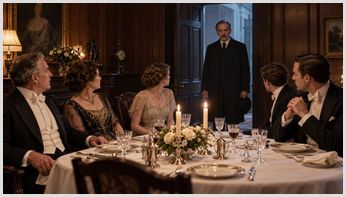
An Inspector Calls is a morality and drawing-room play written by J.B. Priestley in 1945. It is set in 1912 and follows the prosperous Birling family in the fictional town of Brumley. They are visited by Inspector Goole, who is investigating the death of a working-class woman, Eva Smith. As the inspector questions them about the suicide of Eva Smith, secrets are revealed that conflict with their outwardly respectable lives.
The characters in this play show contrasting attitudes to class, power, and responsibility. For example, Mr and Mrs Birling defend their actions, while their children accept the harm they have caused. Priestley uses their differing reactions to argue that our choices affect other people, even indirectly.
This article explores the key and supporting characters in An Inspector Calls. Each character is analysed, including their personality and motivations. Key quotes and plot examples are provided. It is suitable for GCSE English Literature revision across all major exam boards, including AQA, OCR, and Edexcel.
If you need further support, TeachTutti has qualified English Literature GCSE tutors who provide bespoke tuition. Lessons can be in-person or online using the TeachTutti learning platform.
Characters at a glance
Despite being the focus of the plot, Eva Smith never appears on stage. The key characters are the Birling family, Gerald Croft, and Inspector Goole. The family maid, Edna, has a small role.
| Character | Role | Key quote |
| Arthur Birling | A wealthy factory owner. He prioritises profit and his reputation. | "a man has to mind his own business and look after himself and his own" |
| Sybil Birling | The wife of Arthur. Her character judgment is affected by strong class prejudices. | "I accept no blame for it at all." |
| Sheila Birling | The daughter who questions her family's values and accepts her own fault in Eva's death. | "But these girls aren’t cheap labour - they’re people." |
| Eric Birling | The son who is revealed to have raped Eva Smith, leaving her pregnant. He accepts responsibility for his actions. | "the fact remains that I did what I did." |
| Gerald Croft | Sheila’s fiancé. He began a relationship with Daisy Renton, who is revealed to have been Eva Smith. | "I didn’t feel about her as she felt about me." |
| Inspector Goole | A mysterious visitor. He challenges each character about the consequences of their actions. | "We are members of one body. We are responsible for each other." |
| Eva Smith / Daisy Renton | The working-class woman at the centre of the investigation. She had to resort to prostitution to sustain herself, and later changed her name to Daisy Renton. | "She’d had a lot to say – far too much – so she had to go." - Arthur Birling on Eva |
| Edna | The Birlings’ maid. She represents the servant's position in the wealthy household. | "Please, sir, an inspector’s called." |
Arthur Birling
Arthur Birling is a wealthy factory owner. He prizes his family's social standing and reputation. During dinner, he dominates the conversation and expects his views to carry weight. In the description below, the word "portentous" implies he takes himself too seriously. He tries to impress Gerald Croft, a friendly competitor and his daughter's fiancé, showing that he recognises the higher social standing of the Croft family. His daughter's engagement to Gerald is a chance to strengthen his business connections and standing:
"a heavy-looking, rather portentous man"
He dismisses Eva Smith when she leads a strike for higher wages. He considers this a business decision, but it also reflects his dislike for anyone who challenges his authority, seeing Eva's willingness to speak up as a fault. It reflects how little control working-class people had over their livelihoods:
"She’d had a lot to say – far too much – so she had to go."
His comments about the Titanic, whose fateful voyage had not yet come to pass in 1912, are dramatic irony. The audience knows the ship sank, and his certainty, with his use of the word "unlikable", implies foolishness and leads the audience to question his wider views. Arthur never accepts blame and is more concerned with public scandal:
"unsinkable, absolutely unsinkable"
Sybil Birling
Sybil Birling is Arthur’s wife. Like her husband, she values social ranking and is introduced as a woman lacking in sympathy. She doesn't question her actions and believes good manners reflect good morals:
"a rather cold woman and her husband’s social superior"
She is supposed to help people in need as a member of a women's charity. However, she turns the pregnant Eva Smith away, offended when she is addressed as "Mrs Birling". She criticises Eva's account of her dire situation and alludes to her working-class background, believing that a poor woman will always steal money if the opportunity arises. Sybil shows significant hypocrisy in her claims to moral authority, while refusing to recognise goodness in anyone of lower social standing than herself:
"As if a girl of that sort would ever refuse money!"
Ironically, she believes the father of Eva's child should be responsible, when this condemns her own son, Eric, who raped Eva. Mrs Birling refuses to see this truth and refuses to accept any responsibility. She clings to the belief that she has done her duty:
"I accept no blame for it at all."
Sheila Birling
Sheila is introduced as Gerald Croft's excited fiancée. She enjoys the creature comforts of her family's wealth and is delighted by her engagement ring. Despite the preoccupation with materialism, she challenges her father's comments on cheap labour, drawing attention to the lives behind her father's business expenses. She recognises the workers as people with feelings and needs. This foreshadows her growing sympathy towards Eva:
"But these girls aren’t cheap labour - they’re people."
Sheila abuses her social position. She is jealous of Eva when shopping at Milwards. She uses her influence as a wealthy customer to have Eva Smith dismissed when she believes Eva was laughing at her. Sheila admits her fault, and the word "desperately" shows the strength of her regret. She understands her cruelty, and she doesn't try to excuse her selfish behaviour:
"I know I’m to blame – and I’m desperately sorry."
Her independence increases under questioning from Inspector Goole. She challenges her parents and rejects Gerald when he admits his affair with Eva. She recognises that her misgivings about the inspector don't excuse her family's behaviour, showing her character arc since she was introduced cheerfully at the opening dinner. She reflects Priestley's hope that people can learn from their mistakes:
"You’re pretending everything’s just as it was before."
Eric Birling
Eric is a troubled man who struggles to speak with his family and has a drinking problem. He lacks confidence but still challenges his father at the dinner table, pointing to family tensions:
"not quite at ease, half shy, half assertive"
He met Eva after drinking and forced her to allow him into her lodgings. His use of the word "nasty" is vague, softening the threat behind his behaviour. He uses money and social standing to exploit a woman, which can't be dismissed as drunkenness:
"I was in that state when a chap easily turns nasty."
When Eva is revealed to be pregnant with his child, Eric steals money from his father to support her. Eva refuses the stolen money. This shows that despite the Birlings' wealth and status, Eva is morally superior by standing by her principles despite her hardship.
When Eric confesses his actions to his father, his response shows that authority has taken the place of trust. It doesn't excuse Eric's actions, but help explain his secrecy in stealing the money:
"You’re not the kind of father a chap could go to when he’s in trouble."
Eric accepts that his actions were wrong, contrasting with his opening, evasive account. He starts to confront his role in Eva's death rather than protect his family:
"the fact remains that I did what I did."
Gerald Croft
Gerald Croft is engaged to Sheila and the son of Sir George and Lady Croft of Crofts Limited. He's an ideal match for the Birlings with his superior social standing.
He's introduced as a charming confidence man who knows how to behave in the play's social setting. Despite his respectable image, Gerald knew Eva as Daisy Renton, intervening at the Palace bar when she is harassed by Alderman Meggarty. He puts her in a room that belongs to a friend, which is intended as protection but puts her in a position of dependency when they begin an affair:
"the easy well-bred young man-about-town"
Gerald acknowledges that he didn't share her affections. Unlike Eva, he had the freedom to end their relationship and return to his usual life. Priestley shows how an apparent kindness can also lead to an unequal balance of power:
"I didn’t feel about her as she felt about me."
He is upset by the news of her death, but his attention gradually shifts towards proving Goole isn't a real police inspector. After the threat of a scandal has passed, he offers Sheila her engagement ring, which becomes an attempt to restore the comfort of the opening scene before the inspector's introduction, attempting to gloss over the recent events:
"Everything’s all right now, Sheila. What about this ring?"
His response to the interrogation suggests his regret hasn't led to lasting change. Priestley uses his character to encourage the audience to look beyond charm and good manners when judging a person's character.
Inspector Goole
Inspector Goole is a mysterious figure with a clear aim: to force the dinner guests to acknowledge their role in Eva Smith's suffering.
He doesn't care about their wealth or social standing, and his surname sounds like "ghoul", hinting that he's a supernatural entity that knows exactly what each character has done. The telephone call at the end of the play compounds this uncertainty, as a real police officer calls to report that Eva Smith has just died by suicide.
Goole commands the room without relying on physicality: the lighting seems to become brighter and harder when he arrives, reflecting the uncomfortable scrutiny he brings:
"an impression of massiveness, solidity and purposefulness"
Goole reveals information gradually, showing a photograph of Eva Smith to one character at a time. This creates suspensions and stops the Birling family from preparing a shared defence. His direct questions slowly disprove their attempts to distance themselves from Smith.
In the quote below, "one body" refers to society as a connected whole: when a part of it suffers, the others can't deny any involvement. The repeated "we" invites the audience to consider their own responsibility to others:
"We are members of one body. We are responsible for each other."
When he leaves, he graphically warns of the consequences if they ignore this message, which the characters in 1912 may not fully grasp, taking place before the fallout from two world wars. Priestley compares the family's actions to the wider damage caused by a society that doesn't care for its citizens:
"they will be taught it in fire and blood and anguish."
Eva Smith / Daisy Renton
Eva Smith is ever-present in the play, despite never appearing on stage. She isn't able to explain her choices to the audience, and we learn about her through the inspector's account and those he questions. This means that people with great social power control how her story is told.
She is described as beautiful and capable. The description below shows her vulnerability as a working-class woman, where her security depends on the decisions of wealthy employers and customers. She demands better wages from her employer and is principled, refusing to accept stolen money. This challenges the assumption that poor people are not moral, even though the money would improve her desperate situation:
"very pretty and looked as if she could take care of herself"
She tries to make a fresh start when she loses her job, changing her name to Daisy Renton. Despite this, she can't escape her financial situation, showing the limits of individual perseverance when opportunities are unequal.
The Inspector relates her story to "millions" who endure the same sufferings that those at the dinner table choose to ignore. The common surname "Smith" further underscores the relevance of Eva's situation to those who similarly receive little attention. She is both an individual and a symbol of wider injustice:
"millions and millions and millions of Eva Smiths and John Smiths still left with us"
Supporting characters in An Inspector Calls
Edna
She is the Birlings' maid and serves the family. Edna politely announces the inspector's arrival, showing the formal divide between servants and employers:
"Please, sir, an inspector’s called."
Edna works quietly while the family discuss business and marriage. Her lack of lines in the play reflects her position as a working-class woman who is constantly present, yet disregarded by those of higher social standing.
Alderman Meggarty
Gerald intervenes when Alderman is making unwanted advances towards Daisy at the Palacy bar. His description removes the dignity from his public title as a person who works in local government:
"half-drunk and goggle-eyed"
Mrs Birling is shocked by his behaviour, as she expects someone of his standing to be respectable.
Sir George Croft
This is Gerald's father. He represents the established business world that Arthur wants to join. Arthur hopes the union of their children will bring the firms closer together, allowing them to consider their march up the social ladder. The absence of Sir George underscores his wealth and title, as Arthur views the family celebration as a business opportunity:
"lower costs and higher prices"
Lady Croft
Gerald's mother believes that Gerald could have done "better for yourself socially" than Sheila Birling as his fiancée. This suggests that money alone won't ensure the Crofts' approval. Arthur is anxious about Lady Croft, showing insecurity that lies beneath his confident speeches at dinner.
Colonel Roberts
He is the chief constable and a contact of Arthur Birling. The name-drop doesn't distract the inspector from his questioning, showing that Arthur's personal connections won't secure favourable treatment:
"I don’t see much of him."
Conclusion
The characters in An Inspector Calls react differently when their comfortable lives when they are forced to address their involvement in the tragic fate of Eva Smith. The children, Sheila and Eric, accept their blame to differing extents, while their parents and Gerald are focused on a return to normalcy.
The differences in the characters' attitudes and their social situation are underscored by the setting in 1912, before World War One brought major changes to British society. Read the National Archives' account of women and the First World War to understand how women's lives and work changed during this period in history. You can also read the biography of J.B. Priestley by the J.B. Priestley Society to understand how his works were influenced by his time volunteering in WW1.
If you need support, TeachTutti has top GCSE English Literature tutors. Every tutor has an enhanced DBS check and will tailor lessons to your needs, such as preparing revision notes and identifying key quotes to memorise for each character.