A polynomial is an expression of indeterminates and coefficients that only uses specific operations and has a finite number of terms. They are a common feature in maths, including factorising cubic expressions, sketching curves, and solving equations. The factor theorem and remainder theorem are used in polynomial division; despite appearances, they are closely connected.
This article explains polynomials for A Level Maths. We provide worked examples that are solved step-by-step, involving division, remainders, factors, and roots. You'll also see common mistakes to avoid and quiz questions to test your understanding.
If you need help revising this topic or a particular theorem, TeachTutti has verified A Level Mathematics tutors who can teach you online or in person. Follow the link to learn how tuition works with TeachTutti.
What is a polynomial?
A polynomial is an algebraic expression where the variable only has non-negative whole-number powers. This means x can be raised to powers like 1 or 2, but not to negative or fractional powers.
For example, 3x³ + 2x² - 5x + 7 is a polynomial. It has four terms: 3x³, 2x², -5x, and 7. The numbers multiplying the powers of x are coefficients. In this example, the coefficient of x³ is 3, x² is 2, and x is -5, respectively. The 7 is a constant term because it doesn't depend on x.
The degree is the highest power of the variable with a non-zero coefficient. For example, the degree in the above example is 3 because the highest power is x³.
Below are common degrees in A Level Maths:
| Degree | Name | Example |
| 1 | Linear | 2x + 3 |
| 2 | Quadratic | x² - 4x + 1 |
| 3 | Cubic | x³ + 2x - 5 |
| 4 | Quartic | x4 - 3x² + 2 |
There doesn't need to be every power below the degree in a polynomial. For example, x4 + 3x + 2 is a quartic, despite not having an x³ or x² term.
If the expression has negative or fractional powers of x, it isn't a polynomial. For example:1/x + 2 (x raised to the power -1); the square root of x (x raised to the power 1/2); 2 raised to the power x (the variable is in the exponent). Fractional coefficients are allowed, such as 0.5x² + 3x - 1. This is a polynomial because its powers of x are non-negative whole numbers.
Working with polynomials
To divide and factorise polynomials, you need to know your way around simplifying expressions and expanding brackets. This is necessary to keep each step organised and avoid errors:
- Collect like terms - Like terms have the same variable that's raised to the same power. 3x² and 5x² are examples, as opposed to 3x² and 5x. Add/subtract the coefficients of like terms to simplify a polynomial: 3x² + 4x - x² + 2x - 7 = 2x² + 6x - 7. In this example, 3x² - x² becomes 2x², while 4x + 2x becomes 6x. The constant term remains -7.
- Expand brackets - To expand brackets, multiply each term in a bracket by every term in the other bracket. Take the following expression: (x + 2)(x² - 3x + 4). Multiply each term in the second bracket by x (x³ - 3x² + 4x) and then multiply each term by 2 (2x² - 6x + 8). Add the results and collect like terms: x³ - 3x² + 4x + 2x² - 6x + 8 = x³ - x² - 2x + 8.
- Remove a common factor - Checking for a common factor makes factorisation much easier. First, check if each term shares a number/power of x/both. In the following example, both terms contain 3x², which can be placed outside the bracket: 6x³ - 9x² = 3x²(2x - 3). Expand to check your results (3x² x 2x = 6x³, and 3x² x -3 = -9x²).
- Write polynomials in descending powers - Arrange a polynomial from the highest power of x to the lowest. For example: 4 - 2x + x³ = x³ - 2x + 4. You should include missing powers with a coefficient of zero to keep the powers lined up, making it easier to place and subtract terms: x³ - 2x + 4 = x³ + 0x² - 2x + 4. The expression doesn't change.
How to divide polynomials
Polynomial division means dividing one polynomial by another. It's helpful if you know one factor of a cubic and need to find the remaining factors.
These are the terms associated with polynomial division:
- Dividend - This is the polynomial you're dividing.
- Divisor - The expression you're dividing by.
- Quotient - The answer to the division. Any remainder is excluded.
The relationship between these terms is: Dividend = divisor multiplied by quotient + remainder.
The process is: divide the leading terms, multiply, subtract and bring down the next term.
Let's try to divide x³ - 2x² - 5x + 6 by x - 1:
- Find the first term of the quotient - Divide x³ by x to get x². Multiply by x²: x²(x - 1) = x³ - x². Subtract from the first two terms of the dividend: (x³ - 2x²) - (x³ - x²) = -x². Bring down -5x to give: -x² - 5x.
- Find the next term - Divide -x² by x to get -x. Multiply the divisor by -x: -x(x - 1) = -x² + x. Subtract to get -6x ((-x² - 5x) - (-x² + x)). Bring down +6 to get: -6x + 6.
- Complete the division - Divide -6x by x to get -6. Multiply the divisor by -6: -6(x - 1) = -6x + 6. Subtracting leaves zero with no remainder. The quotient is x² - x - 6, which means the answer is: x³ - 2x² - 5x + 6 = (x - 1)(x² - x - 6). x - 1 is a factor of the original polynomial because the remainder is zero.
Not every polynomial division will leave zero. Let's try to divide x³ - 2x² - 5x + 8 by x - 1:
- The constant term is 8. Everything else is the same as the previous example, but the final subtraction is now: (-6x + 8) - (-6x + 6) = 2.
- The quotient is x² - x - 6, but the remainder is now 2: x³ - 2x² - 5x + 8 = (x - 1)(x² - x - 6) + 2.
- Write it this way as an algebraic fraction. It's form is valid when x doesn't equal 1: (x³ - 2x² - 5x + 8)/(x - 1) = x² - x - 6 + 2/(x - 1).
Don't divide if the remainder has a lower degree than the divisor. If you divide by a linear expression, the remainder will be a constant or zero, such as x - 1.
Multiply the divisor by the quotient, then add the remainder. Always recover the original dividend. For example, this has a remainder: (x - 1)(x² - x - 6) + 2. If we expand and simplify it, this confirms the division is correct: x³ - 2x² - 5x + 6 + 2 = x³ - 2x² - 5x + 8.
Remainder theorem
The remainder theorem shows how to find a remainder without using polynomial division. If f(x) is divided by x - a, the remainder is f(a); f(a) is the value of the polynomial when x = a. Put another way, substitute a into the polynomial.
Let's use the following polynomial: f(x) = x³ - 2x² - 5x + 8:
- Substitute x = 1 when dividing by x - 1: f(1) = 1³ - 2(1)² - 5(1) + 8 becomes f(1) = 1 - 2 - 5 + 8 = 2.
- The remainder is 2.
It's a useful method when you only need to find the remainder. Polynomial division is still needed if the question also requires the quotient.
Be careful with the sign in the divisor. To find the substitution value, set the divisor equal to zero. For x + 2, this would be x + 2 = 0, which means x = -2.
Let's use the same polynomial: f(x) = x³ - 2x² - 5x + 8:
- f(-2) = (-2)³ - 2(-2)² - 5(-2) + 8 becomes f(-2) = -8 - 8 + 10 + 8 = 2.
- The remainder when dividing by x + 2 is 2.
- If you need to substitute negative numbers, use brackets. In this example, (-2)² = 4, so the term -2(-2)² equals -8.
Find an unknown coefficient
If there's a remainder, we can use this theorem to find a missing coefficient.
For example, f(x) = x³ + kx + 4 leaves a remainder of 10 when divided by x - 2. Take the following steps to find k:
- The divisor is x - 2. The remainder theorem tells us that f(2) = 10 and to substitute x = 2: 8 + 2k + 4 = 10.
- We can then simplify: 2k + 12 = 10 becomes 2k = -2
- This means k = -1.
- We can check by substituting k = -1 into the polynomial and evaluating it at x = 2: 8 - 2 + 4 = 10.
Using the factor theorem
The factor theorem is a shortcut for determining whether a linear expression is a factor of a polynomial. If f(a) = 0, this means x - a is a factor of f(x). The opposite is true: if x - a is a factor, then f(a) = 0.
Let's use the polynomial f(x) = x³ - 2x² - 5x + 6:
- Substitute x = 1 to check if x - 1 is a factor: f(1) = 1 - 2 - 5 + 6 = 0. This returns zero, which confirms x - 1 is a factor.
- We can test x + 1 by substituting x = -1: f(-1) = -1 - 2 + 5 + 6 = 8. This shows that x + 1 isn't a factor. Dividing by x + 1 will leave a remainder of 8.
- Remember to always show the substitution and the result before giving your conclusion.
Find an unknown coefficient
Let's say x + 2 is a factor of f(x) = x³ + kx² - 4x - 12:
- As x + 2 is a factor, f(-2) has to equal zero: (-2)³ + k(-2)² - 4(-2) - 12 = 0.
- We can then simplify: -8 + 4k + 8 - 12 = 0 becomes 4k - 12 = 0.
- This means k = 3.
- Unlike the remainder theorem, a known factor means the remainder must be zero.
The factor theorem works when the coefficient of x is not 1. Set the expression equal to zero to find the value you need to substitute.
For example, let's use 2x - 1:
- This becomes 2x - 1 = 0, which means x = 1/2.
- For g(x) = 2x³ + x² - 5x + 2, we need to substitute x = 1/2: g(1/2) = 1/4 + 1/4 - 5/2 + 2 = 0.
- This means 2x - 1 is a factor of g(x).
Factorising polynomials and solving equations
Used together, the factor theorem and polynomial division can help you factorise cubic polynomials and solve equations. A good approach is to find a linear factor, divide by that factor, then factorise the resulting quadratic:
- Factorise a cubic polynomial - Look at this polynomial: f(x) = x³ - 2x² - 5x + 6. The expression x - 1 is a factor (f(1) = 0) and dividing by x - 1 gives: x³ - 2x² - 5x + 6 = (x - 1)(x² - x - 6). We need two numbers that multiply to -6 and add to -1 to factorise this quadratic. These numbers are -3 and 2 (x² - x - 6 = (x - 3)(x + 2)). The factorised expression is: f(x) = (x - 1)(x - 3)(x + 2).
- Solve a polynomial equation - Let's try to solve: x³ - 2x² - 5x + 6 = 0. First, use the factorised form: (x - 1)(x - 3)(x + 2) = 0. A product is zero when at least one of its factors is zero. We need to set each factor equal to zero (x - 1 = 0 -> x = 1, x - 3 = 0 -> x = 3, x + 2 = 0 -> x = -2). The solutions are x = -2, x = 1 and x = 3. Remember that factorising gives a product of expressions, while solving gives you the value of x to satisfy an equation.
- Find a first factor when none is given - Look for a common factor. Otherwise, use the factor theorem to find possible roots. If it's a polynomial with integer coefficients and a leading coefficient of 1, the integer root has to be a factor of the constant term. In the previous example (x³ - 2x² - 5x + 6 = 0), the constant term is 6. This means possible integer roots are: 1, -1, 2, -2, 3, -3, 6 and -6. The factor x - 1 is returned when you test x = 1, which returns zero. You can now divide and keep factorising. Bear in mind that these possible integer roots are not guaranteed solutions.
- Solve when a factor contains 2x - The previous bullet point showed that 2x - 1 is a factor of: g(x) = 2x³ + x² - 5x + 2. Dividing by 2x - 1 gives x² + x - 2. This means g(x) = (2x - 1)(x² + x - 2). When we factorise, this returns: g(x) = (2x - 1)(x + 2)(x - 1). That means the solutions to g(x) = 0 are: x = 1/2, x = -2 and x = 1. The factor 2x - 1 gives the root x = 1/2.
If the quadratic doesn't factorise easily, you can use the quadratic formula. If the discriminant is positive, it has two distinct real roots. If it's zero, there's a repeated real root. If it's negative, it has no real roots. This means a cubic doesn't need to have three distinct real roots.
Sketching polynomial graphs
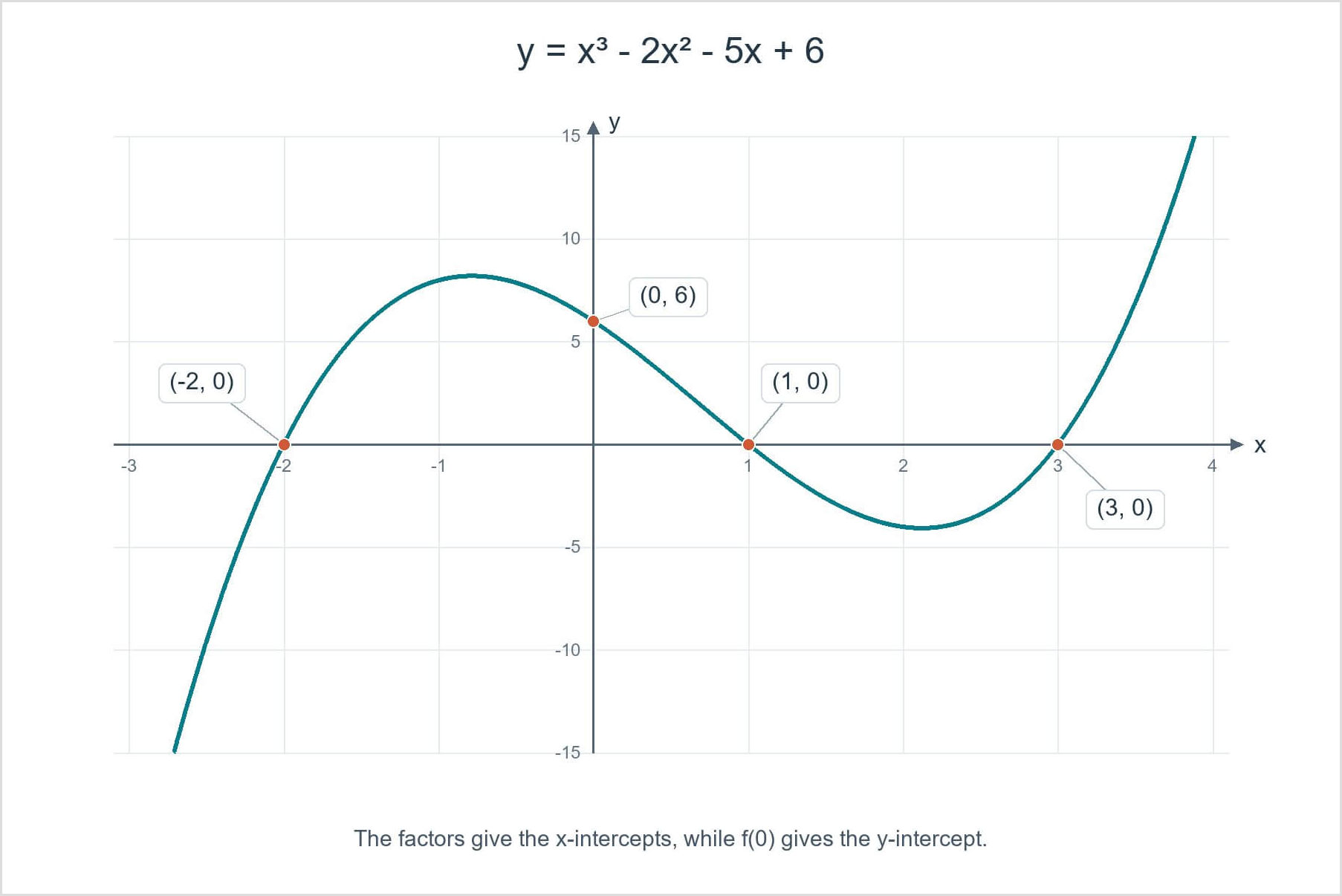
When factorising a polynomial, the roots show where the graph meets the x-axis, and the constant term shows the y-intercept. The term with the highest power tells us how the graph behaves at each end.
Let's use the following polynomial: f(x) = x³ - 2x² - 5x + 6:
- When it's factorised, it becomes f(x) = (x - 1)(x - 3)(x + 2).
- The roots are x = -2, x = 1 and x = 3. This means the graph meets the x-axis at: (-2, 0), (1, 0) and (3, 0).
- Substitute x = 0 into the original expression to find the y-intercept: f(0) = 6. This means the graph crosses the y-axis at (0, 6).
Leading term
The leading term has the highest power of x. If this variable becomes very large (positive or negative), it will affect the graph's end behaviour. In the polynomial above, the leading term is x³. The positive coefficient means the graph falls towards the left and rises towards the right.
These are the main patterns for the ends of the graph:
| Degree and leading coefficient | Left-hand end | Right-hand end |
| Odd degree, positive coefficient | Falls | Rises |
| Odd degree, negative coefficient | Rises | Falls |
| Even degree, positive coefficient | Rises | Falls |
| Even degree, negative coefficient | Falls | Rises |
Repeated roots
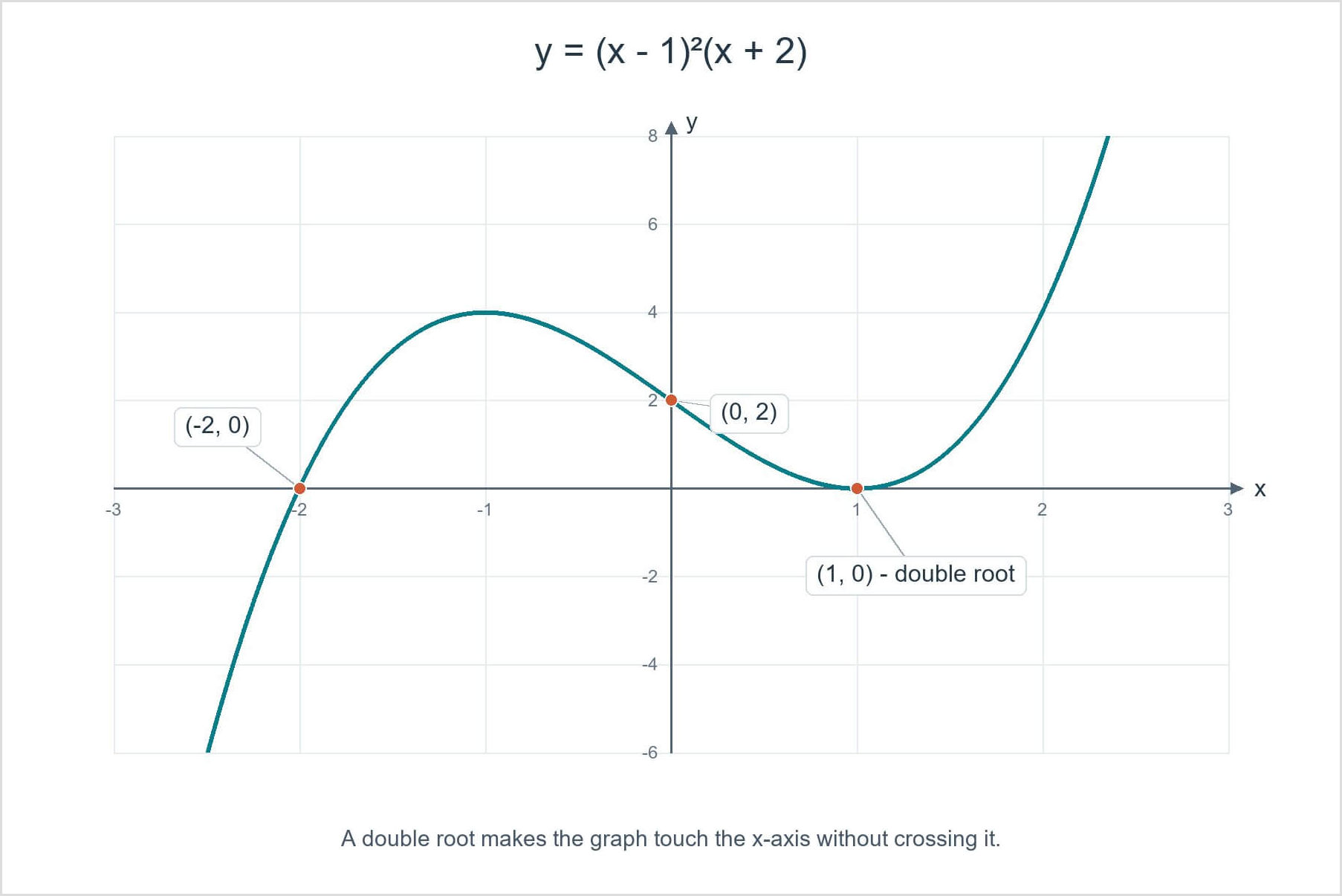
A repeated root is when a factor appears more than once. For example, (x - 1) appears twice in the following polynomial, meaning x = 1. The other root is x = -2: g(x) = (x - 1)²(x + 2).
When there's a double root, the graph touches the x-axis but turns back and doesn't cross it. A single root crosses the x-axis. In this example, the graph crosses the x-axis at (-2, 0). It then touches the x-axis and turns at (1, 0). The y-axis is crossed at (0, 2), because g(0) = 2.
Roots that have an even multiplicity make the graph touch the axis without crossing. Roots with an odd multiplicity will cross, though it may flatten as it does.
Take the following steps to sketch a polynomial graph:
- Factorise the expression and find its real roots.
- Mark the x-intercepts, and substitute x = 0 to find the y-intercept.
- Use the leading term to find out the end behaviour of the graph.
- Check for repeated roots before drawing a smooth curve.
- All three roots are single roots in the cubic f(x) = x³ - 2x² - 5x + 6: the curve crosses the x-axis at each root, passes through (0, 6), and runs from the bottom left to the top right.
Common mistakes with polynomials
Small algebra errors can affect every step of a polynomial question. These checks will help you avoid some of the most common mistakes:
- Substitute the wrong sign - Before you substitute using the factor or remainder theorem, set the divisor equal to zero. Use x = -3 for x + 3, and x = 3 for x - 3. For example, calculate f(-3) to see if x + 3 is a factor (not f(3)).
- Missing a power during division - There is no x² term in a polynomial like x³ - 5x + 6. Write it out first with the zero coefficient: x³ + 0x² - 5x + 6. This keeps your terms in the right columns.
- Subtracting part of an expression - Ensure you subtract the entire expression during polynomial division. You need to change the sign for every term inside the brackets, e.g. (-x² - 5x) - (-x² + x) becomes -x² - 5x + x² - x = -6x. The final x becomes -x as it's being subtracted.
- Confusing a factor and a root - A factor is an expression, and a root is a value of x. For example, the root is x = -2 when the factor is x + 2. Check the wording of the question: give a factorised expression for a factor and the value of x if you need to solve an equation.
- Stopping before the expression is factorised - Finding one linear factor of a cubic may be part of the full factorisation. For instance, when fully factorised, (x - 1)(x² - x - 6) becomes (x - 1)(x - 3)(x + 2) as the quadratic also factorises. Check for any remaining factors to break down before moving on.
- Assume every root is a crossing point - A graph doesn't have to cross the x-axis at every root. If it's a double root, it will touch the axis and turn back. For example, y = (x - 1)²(x + 2) touches the axis at x = 1 and then crosses it at x = -2. Look for repeated factors before you start sketching.
Practice questions - A Levels Maths
1
What is the quotient when x³ - 3x² - 4x + 12 is divided by x - 3?
2
What is the remainder when f(x) = x³ + 2x² - 3x + 5 is divided by x + 2?
3
What is k when x - 2 is a factor of f(x) = x³ + kx² - 5x + 2?
4
What are the solutions to (x + 3)(x - 2)(2x - 1) = 0?
5
What happens to the x-axis for a graph of y = (x + 1)²(x - 4)?
Final thoughts
You need to be clear about how the polynomial methods connect to understand this topic. Polynomial division finds a quotient and a remainder. The remainder theorem uses substitution as a shortcut, and the factor theorem helps us spot the factors. Used in combination, you can solve polynomial equations and analyse their graphs.
To test your understanding, try these past paper questions on polynomials from Physics and Maths Tutor. Choose the correct method or a combination when approaching each question. Check substitution signs and keep the powers aligned when you divide. Check your answers by multiplying the factors back together.
If you need help with polynomial revision, TeachTutti has experienced A Level maths tutors. Every tutor has an enhanced DBS check and can teach in person or online, depending on your preference. Follow the link to learn how lessons work with TeachTutti, including our flexible approach to tuition.
Frequently asked questions
Glossary
- Polynomial - An expression containing non-negative whole-number powers of a variable, e.g. 2x² + 3x - 1.
- Variable - A symbol that represents a numerical value, e.g. x.
- Term - Part of an expression. It's separated by addition or subtraction. For instance, the terms are 3x², -2x and 5 in 3x² - 2x + 5.
- Coefficient - The number that multiplies a variable/power, e.g. the coefficient is -4 in -4x².
- Constant term - A term that doesn't have a variable, e.g. 6 in x² + 6.
- Degree - The highest power of the variable. It has a non-zero coefficient in a simplified polynomial.
- Leading coefficient - The coefficient of the highest-power term, e.g. this is 3 in 3x³ - x + 2.
- Factor - An expression that divides a polynomial without any remainder.
- Factorisation - An expression written as a product of factors, e.g. x² - 1 = (x - 1)(x + 1).
- Root - A value of the variable that makes the polynomial zero.
- Repeated root - A root with a corresponding factor that appears multiple times. For example, x = 2 is a double root in (x - 2)², x = 2.
- Dividend - The expression that's being divided.
- Divisor - The expression you're dividing by.
- Quotient - The result of division (not including a remainder).
- Intercept - A point where a graph meets an axis.
- Discriminant - The value b² - 4ac for a quadratic ax² + bx + c. It tells us how many real roots are in the quadratic.