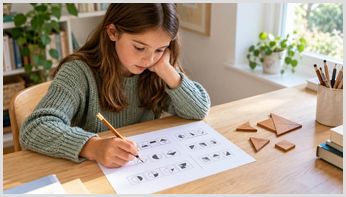
Non-verbal reasoning (NVR) is a lesser-known aspect of the 11 Plus exam. Students are required to work with shapes, patterns, and diagrams, using critical thinking and logic to solve an issue. This could be finding the next image in a sequence, spotting the odd one out, or working out how a shape changes when it's rotated.
If your child is new to this test, the questions can seem puzzling at first glance. Preparing early gives them the opportunity to tackle different question types, develop a method for spotting patterns, and refine their exam technique. Check the requirements of your target school, as this content varies by institution.
This guide explains what is required in the non-verbal reasoning test, and how to help your child to prepare effectively. If you want more support, TeachTutti has top 11 plus tutors who can travel to your home for tuition or teach virtually. Follow the link to find out how TeachTutti works.
What is non-verbal reasoning?
Non-verbal reasoning or NVR requires solving problems visually. The student is shown shapes and diagrams. They need to find relationships between them to find the answer. This means spotting rules and applying them logically. They need to do this carefully, checking that their rule explains the whole pattern.
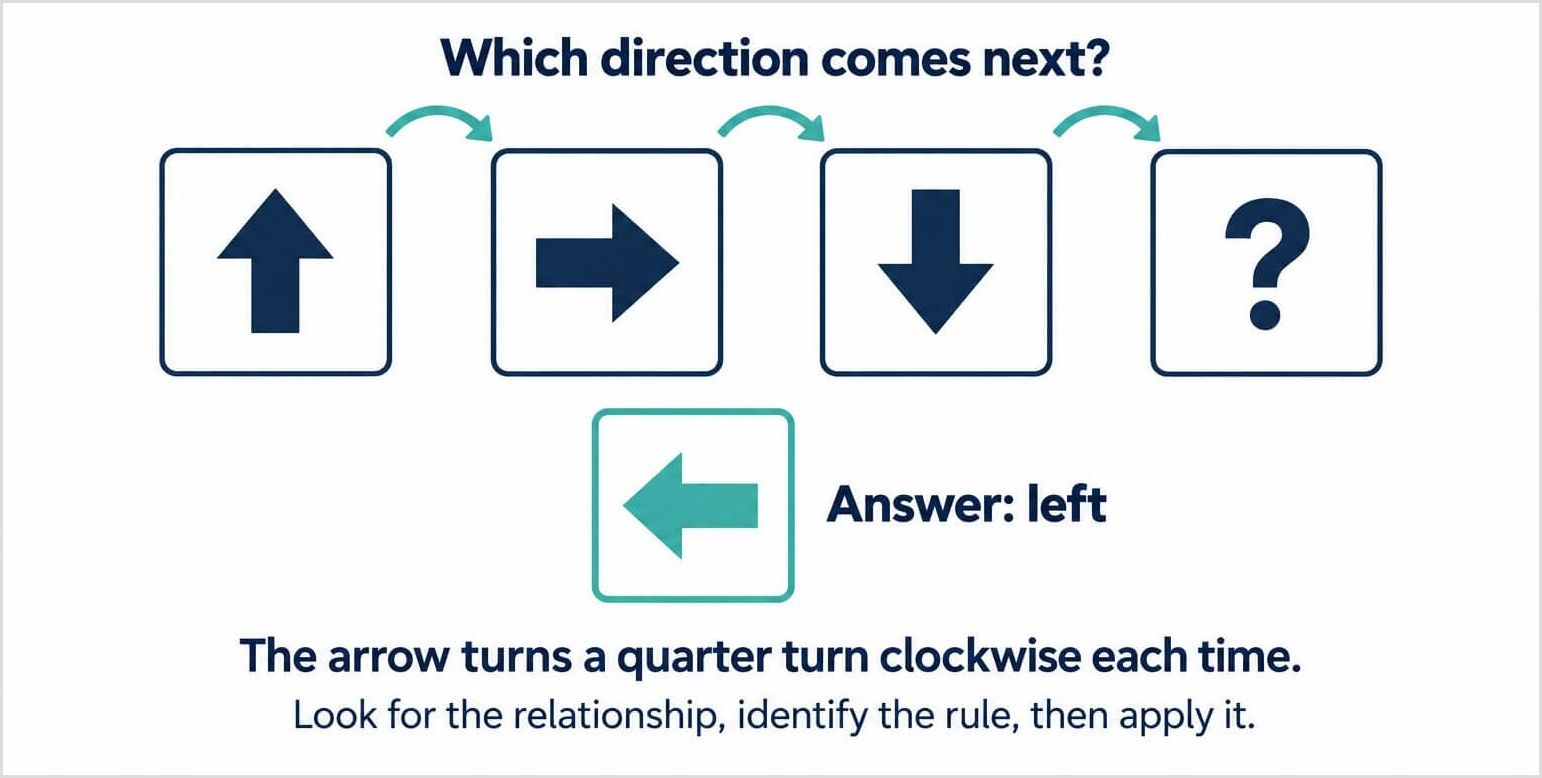
For example, a question could show an arrow pointing up, then right, then down. The child needs to find the next direction of the arrow. This requires them to recognise that the arrow turns a quarter clockwise each time.
Non verbal reasoning test - Breakdown
The student needs to answer questions about shapes and diagrams within a set time. The question usually gives a visual problem and several possible answers. The student has to find the rule and the option that fits.
The challenge could be to complete a sequence, find a missing shape in a grid, or choose an image that is different from the others. Read the instructions carefully, as clearly understanding the problem is part of the solution.
The exam format depends on the entrance test. NVR may be in a combined paper with other subjects or a separately timed section. Spatial reasoning questions can also be included, such as how shapes look when turned, folded, or viewed from a different angle.
Check the admissions information and available resources for your target school, such as non-verbal reasoning practice papers. Confirm that NVR is assessed, then look at the question types to expect and how it's organised. Focus on question familiarity first with your child, then introduce time limits and answer formats.
Common question types
NVR questions vary significantly, but they normally require you to find a rule and match it to the correct answer. The question type depends on the student's entrance test:
- Sequences and patterns - A series of images is shown with one missing. The student needs to discover the change between the images and choose the image option that completes the sequence. For example, a shape may gain one dot at each step. Complex sequences may involve two changes at once, such as a shape rotation while its shading alternates.
- Odd one out and matching groups - An odd-one-out question means finding the image that doesn't share a feature with the others, such as three shapes having two dots, and the fourth having three dots. A matching-group question asks students to choose an image belonging to a given set. The rule can involve symmetry, the number of sides, or the position of a smaller shape inside a larger one.
- Analogies - Children have to apply a change to another image. They need to show how one shape changes into another, then explain what happens if a second shape goes through the same transformation. For example, an outline triangle becomes filled in, which means an outline square would also become shaded.
- Matrices - This is a grid of images with a blank space. The student has to find the relationship across the rows and down the columns to find the missing image. A simple example is a row that contains a circle, a triangle, and a square in a different order. The child needs to find out what shape is missing from the incomplete rows and check that it also matches the column.
- Rotations and reflections - Rotation means turning a shape, while reflection questions mean flipping it to create a mirror image. Be careful to spot the difference between rotation and reflection, as the answer options may include both. Look for a distinctive feature, such as a dot in the corner, and track where this feature moves during the transformation.
- Spatial reasoning - You need to imagine how a shape looks in a different position or form. For example, the student may need to match a cube to its net, recognise a shape from another viewpoint, or predict a pattern when the shape is folded. The child needs to think about how the parts fit together. For instance, they need to consider what faces will meet when a cube net is folded.
How to answer non-verbal reasoning questions
Follow a consistent method to give your child a sense of control when tackling an unfamiliar question. We've given our step-by-step approach below. This boils down to analysing the images carefully and testing the rule before committing to an answer:
- Analyse the question - Make sure the task is clear. Does the student need to complete a sequence, find an odd one out, or apply a transformation? Avoid rushing through the essentials, which guarantees a wrong answer.
- Compare the features - Compare one feature at a time. These include: shape - are the figures the same, or do their outlines change; number - what is the total number of shapes, dots, sides, or lines; size - do elements get larger or smaller; shading - does a fill alternate or move between sections; position - does an element move inside or around another shape; direction - does a shape turn or reflect.
- Find a possible rule - Ask the student to describe the change. For example, "The arrow turns a quarter turn clockwise" is much clearer than "the arrow moves". The question may require more than one rule. For instance, if the rotation explains the direction but not the shading, the student needs to consider what is happening to the shading separately.
- Test the rule - The rule needs to explain all the images. Ask the student to check the full sequence, group or grid before settling on this rule.
- Eliminate answers - The student can rule out options that break the pattern. For example, if the answer has to contain three dots, anything with more or less than this number can be removed. The child can then check the remaining options against the complete rule. In early practice, give them plenty of time to explain their reasoning.
Preparing for non-verbal reasoning papers
For NVR exam preparation, the child needs to understand how the question works. Start with manageable tasks, then build towards mixed questions and timed practice:
- Entrance test requirements - Look at the admissions guidance for your target school. Check whether the test requires non-verbal reasoning, and look for any official familiarisation material and practice material.
- Question types - Introduce a small set of questions at a time that cover the same skill, such as reflections. Explain the task, work through an exam, then get the child to try on their own. When they understand the fundamentals, move to another question type. Return to each topic periodically to ensure they're retaining the understanding.
- Build understanding - Hold off on timed practice until the child is confident comparing details, testing rules, and checking their answers. Putting a time limit on the task can encourage rushing or guessing as they race to beat the clock. If the child gets stuck or begins to panic, guide them with questions, such as "What changes between the images?"
- Explain answers - Picking the correct answer doesn't mean the child understood the question. Ask them to describe the rule they applied to ensure their understanding. Keep it relaxed and conversational.
- Review mistakes - When the child makes a mistake, look through for the issue. For example, it could be an unfamiliar question type, or a detail they missed. Make a note of any recurring problems and revisit similar questions.
- Timed and mixed practice - When the child is comfortable with different question types, put them into short practice sets so they can see what approach to use when the task changes. Introduce time limits and check if their accuracy is affected as their pace increases: finishing quickly is only a positive if the answer is correct.
- Consistent and manageable - The routine needs to start well in advance of the assessment, so that it fits around school, other interests, and rest. The sessions should be short and focused. Having plenty of time means you can adjust the work to the child's needs, such as choosing a different topic if they get frustrated.
Guide to practising non-verbal reasoning
As well as doing exam practice with the student, you can explore shapes and patterns through everyday activities. For example:
- A jigsaw encourages children to think about how the pieces fit together.
- Construct toys give opportunities to turn shapes, compare positions, and explore how 3D structures work.
Ask the child what they notice, such as how the piece will fit or what it looks like from the other side. If you are exploring rotations and reflections, using paper shapes and a mirror can make these differences visible.
Use these activities alongside practice papers as a relaxed way to explore visual relationships. Try to ask questions that link the puzzle to an exam question, as the child may not always make the connection.
This is an example of a manageable weekly routine. Adapt the frequency and length to the child's concentration. When their confidence increases, mix the questions and add time limits:
- A session where you introduce a question type, work through an example, and try a few untimed questions.
- A session where you let your child try a similar question independently. Discuss their answer afterwards.
- A session where you return to past mistakes and ask questions from topics you've covered.
- Puzzle time, where you try a tangram, jigsaw, or construction activity. There is no score or time limit.
Common mistakes
We've explored the main mistakes to avoid when answering non-verbal reasoning questions. When revising, look for any recurring mistakes from the list below:
- Confusing rotation and reflection - A rotated shape has been turned, and a reflected shape is flipped to create a mirror image. They look similar, particularly if there are only a few details. The student needs to look for a distinctive feature, such as an off-centre dot. To see the difference, try turning a paper copy of the shape or looking at it in a mirror.
- Misreading the answer - Look for slight differences in the answer options, such as the direction of a line, the number of dots, or the shading of a section. Before choosing an answer, the student needs to compare it against each part of the rule they've chosen.
- Time management - Tackle 11 plus non-verbal reasoning papers in timed conditions. The student will learn when they have stopped making progress on a difficult question. It's better to move on and return to the question if time allows. Listen carefully to instructions - a separately timed section could bar students from returning to an earlier question.
- Rushing - While some students tend to move slowly through an exam, others rush and risk losing marks. Always double-check answers and check the wording of the question.
Final thoughts - Non-Verbal Reasoning exam revision
Non-verbal reasoning in the eleven plus entrance exam is a key assessment for independent schools in the UK. Use non-verbal reasoning practice papers and past papers to familiarise your child with different question types and improve their exam technique, including time management and spotting small details in the rules.
Learn to compare shapes and identify a rule. Start with untimed practice, using free 11 plus online resources, such as free practice papers. When your child is more confident with the format, introduce time limits with mock tests. Review their exam results to spot weaknesses, such as a particular topic or missing details due to rushing.
For further reading, follow the link for free 11 Plus practice papers in Non-Verbal Reasoning by CGP.
If you need help, TeachTutti has experienced 11 plus tutors who are used to tutoring students aged 10-11. Lessons can be online or in person and will focus on the needs of the child, such as the specific requirements of the test provider, GL Assessment. You can also find out how TeachTutti works and about our flexible approach to ongoing tuition.